
Scaling AI in enterprise CRMs is all about turning small wins into large-scale success. Here’s the key takeaway: AI-driven CRMs can boost sales by 15%, improve customer retention by 20%, and reduce costs by 25%. But to achieve this, businesses must focus on three main areas:
- Data Quality: Unified, clean data is critical. Use tools like Salesforce MuleSoft to integrate disconnected systems and automate data cleaning.
- Infrastructure: Ensure your systems can handle increased demands with proper computing power, deployment pipelines, and real-time monitoring.
- Security and Compliance: Address risks like breaches and biases while adhering to frameworks like GDPR or HIPAA. AI can help detect threats and automate compliance monitoring.
Once the foundation is solid, scale AI features like automating tasks, predictive analytics, and real-time updates. Regular monitoring and retraining keep systems accurate as data evolves. Platforms like Salesforce, HubSpot, and Zoho CRM offer AI tools to simplify scaling, or you can invest in custom solutions for more complex needs.
Bottom Line: Scaling AI in CRMs requires a strong foundation, the right tools, and continuous improvement. Businesses that get this right will see measurable gains in efficiency, customer satisfaction, and revenue.
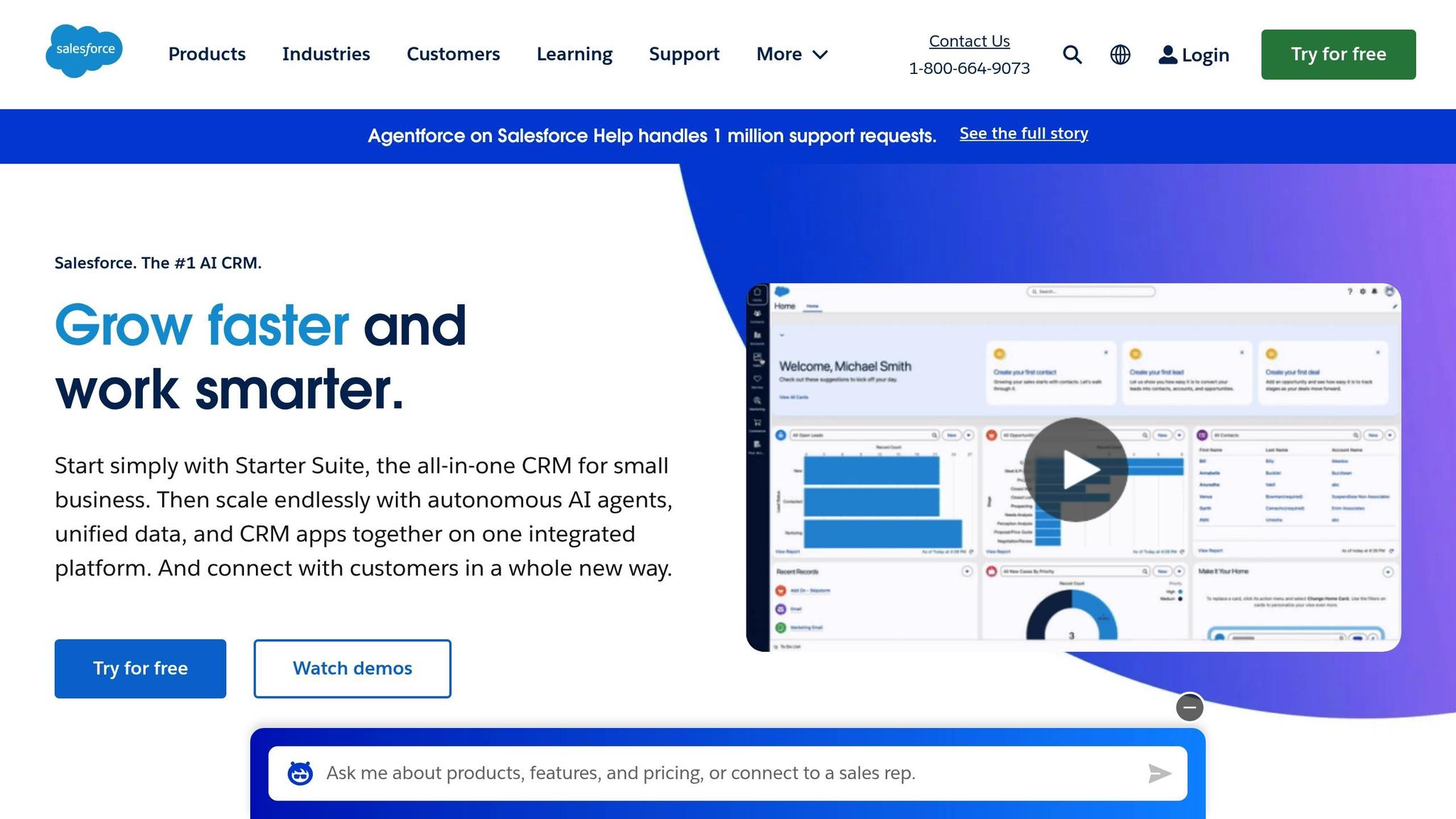
How an AI CRM Scales With You | Salesforce Explained
Requirements for Scaling AI Features
A strong, unified foundation is what separates successful enterprise AI rollouts from those that never make it past the pilot stage.
Data Quality and Integration
High-quality, unified data is the backbone of any successful AI initiative. Even the most advanced AI models are only as good as the data they’re trained on. According to McKinsey, companies that prioritize data quality can achieve up to a 30% improvement in sales forecasting accuracy [4].
But data issues like fragmentation, incomplete records, inaccuracies, biases, and outdated information can derail even the best AI strategies – especially as organizations scale [4]. Addressing these problems early is critical to avoid compounding errors.
At the enterprise level, integrating data becomes even more challenging. Customer information often comes from multiple, disconnected systems. Tools like Salesforce MuleSoft can help by linking these systems together, creating a unified view of the data [6].
Gartner research highlights that companies focusing on data quality see better AI outcomes, improving both customer satisfaction and financial performance [4]. To achieve this, organizations should invest in automated tools for data cleaning and validation, which can catch and fix inconsistencies before they impact AI performance.
Practical steps to improve data quality include:
- Establishing clear data governance policies with well-defined management standards.
- Performing regular data audits to catch issues early.
- Implementing real-time monitoring systems to flag problems as they arise.
- Encouraging a data-driven mindset across teams through focused training programs.
Once a solid data foundation is in place, the next priority is ensuring the IT infrastructure can handle scaling demands.
Infrastructure Readiness
Having great data is only half the equation – your infrastructure has to be up to the task. Many organizations succeed in building effective AI models during pilot projects but hit a wall when trying to deploy them at scale [7].
Gartner predicts that 30% of generative AI projects will fail to move past the proof-of-concept phase due to poor planning, rising costs, and unclear value [7]. This underscores how crucial it is to evaluate infrastructure readiness before committing to large-scale AI initiatives.
Critical infrastructure needs include:
- Adequate computing power to handle the increased data processing demands.
- Deployment pipelines that allow seamless updates across systems.
- Real-time monitoring tools to track model performance.
- Integration capabilities to connect AI with existing business applications [7].
Equally important is having the right talent. Data scientists, DevOps engineers, and business analysts play a key role in scaling AI operations effectively [7].
By designing infrastructure that scales efficiently, organizations can ensure that successful pilots evolve into enterprise-wide solutions, rather than remaining isolated experiments [7].
Security and Compliance
Scaling AI introduces new security challenges that traditional approaches may not fully address. With 95% of businesses identifying AI-powered CRM security as a priority area, addressing these risks early is essential [10].
Some of the primary risks include data breaches, biased decision-making, adversarial attacks, model theft, and resource exhaustion [8]. Generative AI adds another layer of complexity, enabling threats like advanced phishing schemes and automated malware creation [8].
Regulatory compliance becomes trickier as AI systems expand. Depending on the industry and location, businesses may need to meet requirements from frameworks like GDPR, CCPA, or HIPAA [10]. Alarmingly, 70% of organizations admit they’re not prepared to meet GDPR standards, and 41% have faced regulatory actions over privacy and data protection [9].
"AI is transforming CRM security by providing a new level of intelligence and automation to protect customer data." – Marc Benioff, CEO of Salesforce [10]
To mitigate risks, organizations should focus on:
- Using robust encryption, secure protocols, and strict access controls.
- Ensuring training data is diverse and representative to reduce bias.
- Incorporating adversarial training to defend against potential attacks.
- Establishing clear data curation processes [8][10].
The stakes are high – data breaches cost businesses an average of $4 million, making security investments not just advisable but essential [10]. Multi-layered security approaches, including strong authentication, regular system updates, activity monitoring, and backup procedures, can provide an additional safeguard [9].
Interestingly, AI can also enhance security efforts. Currently, 71% of businesses use AI to detect and respond to security threats. Automated compliance monitoring, advanced threat detection, and intelligent data classification are just a few ways AI can strengthen security while scaling [10]. This creates a virtuous cycle where AI both demands improved security measures and provides the tools to achieve them.
How to Scale AI-Driven CRM Features
Once you’ve built a strong foundation, the next step is scaling AI-powered features to maximize efficiency and deliver more value.
Automate Routine Processes
One of the quickest ways to see results is by automating repetitive tasks that take up time but don’t add much strategic value. AI shines in this area, taking over tasks like data entry, lead scoring, and customer follow-ups so your team can focus on more complex work.
Take data entry automation, for example. AI can pull customer details from emails, forms, and calls, then organize everything in your CRM. This not only keeps the system accurate and up to date but also reduces errors caused by manual input.
Lead scoring also gets a major upgrade with AI. Instead of using simple point-based systems, AI analyzes hundreds of factors – like website activity and email engagement – to predict which leads are most likely to convert. This helps your sales team zero in on the best opportunities.
With customer follow-ups, AI can automatically trigger sequences based on specific actions or timelines. It even tailors the timing, channel, and messaging for each interaction, ensuring no prospect slips through the cracks while keeping things personal.
The trick to effective automation? Start small. Pick one process, measure the results, and expand gradually once it’s proven to work. By doing this, you’ll also set the stage for integrating predictive analytics into your CRM.
Use Predictive Analytics
Predictive analytics transforms your CRM into a decision-making powerhouse. By analyzing past patterns and current trends, AI helps you make proactive moves instead of reacting to issues as they arise.
For example, sales forecasting becomes far more precise. AI models consider deal progress, seasonal trends, and individual performance to deliver forecasts that are much closer to reality. Businesses using AI-driven CRM tools report a 30-50% improvement in response times [13].
AI can also help with customer churn prediction. By spotting subtle shifts in engagement, support requests, or usage habits, it flags accounts that might be on the verge of leaving. This gives your team time to step in with targeted retention strategies.
Another benefit is personalized recommendations. AI can suggest products, services, or content tailored to each customer’s preferences and behavior, creating a better experience while encouraging repeat purchases.
The demand for these predictive tools is growing fast. The global CRM market is projected to grow by 13.9% annually through 2030 [5]. Companies that adopt these features early stand to gain a competitive edge in understanding and serving their customers.
"Generative AI and large language models stand to transform and improve virtually every customer experience." – Andy Jassy, Amazon CEO [13]
Monitor and Update AI Models
Scaling AI features doesn’t stop at implementation. To keep them effective, you need to monitor and update them regularly. AI models aren’t “set it and forget it” tools – they require consistent oversight to stay accurate and useful.
Start with performance monitoring. Track metrics like accuracy, precision, and recall to catch any signs of decline. Automated alerts can notify you when performance drops by even 2% to 5%, allowing you to address issues before they escalate [12].
Without regular updates, AI models can lose up to 25% of their accuracy in just six months [12]. This happens as customer behavior shifts, business conditions change, and new data patterns emerge that weren’t part of the original training.
To counter this, schedule model retraining every 3 to 6 months, depending on how quickly your data changes [12]. Retraining involves feeding the model updated information to help it adapt to new trends.
Here’s a quick look at the difference between fine-tuning and retraining:
| Aspect | Fine-Tuning | Retraining |
|---|---|---|
| Scope | Adjusts specific parameters or data. | Involves a full re-training of the model. |
| Data Usage | Uses a smaller, task-specific dataset. | Requires a larger, updated dataset. |
| Time & Resources | Faster, less computational power needed. | Time-intensive, higher computational needs. |
| Objective | Adapts model to a new task or domain. | Improves performance with updated data. |
Automated retraining can cut operational costs by up to 30% [12], ensuring your models stay relevant. This is especially important given that only about 40% of machine learning algorithms make it past the pilot phase [11].
Lastly, create feedback loops with your CRM users. Their insights can highlight where models might be falling short in real-world applications. Combining this human feedback with automated monitoring ensures your AI tools remain effective as your business grows.
sbb-itb-f02ae4e
Tools and Platforms for Scaling AI in CRMs
Selecting the right tools and platforms is a critical step in scaling AI features within your enterprise CRM. The global AI-powered CRM market is on track to hit $79.8 billion by 2025, growing at an annual rate of 33.8% [14]. Once you’ve established a scalable AI foundation, the next move is to adopt tools that enhance integration and performance.
Custom Solutions from CRM Experts Online
For enterprises with unique and complex needs, custom-built solutions can be the most effective way to scale AI features. CRM Experts Online specializes in crafting tailored CRM solutions that address specific business challenges while incorporating advanced AI functionalities.
Their process covers everything from system analysis to deployment and ongoing support. What sets them apart is their focus on fully integrated, end-to-end strategies designed to tackle the toughest challenges in scaling AI.
"CRM Experts Online, the best-in-class software company that is highly focused on developing high quality CRM solutions, can cover all of your business needs with the entire responsibility of performing the initial system study, design, development, implementation, support and training." [3]
They offer different service tiers to meet varying enterprise needs. For example:
- Comprehensive Support Plan: At $4,500/month, this includes full-scale implementation, dedicated teams, and unlimited live training.
- Managed Support Option: Priced at $1,300/month, this plan provides essential CRM development, consulting, and shared project management.
Custom solutions allow businesses to bypass the limitations of off-the-shelf products, offering flexibility and eliminating ongoing licensing fees. Additionally, many CRM platforms now come with built-in scalability features, making AI integration more straightforward.
CRM Platform Scalability Features
While custom solutions are tailored to specific needs, mainstream CRM platforms also provide robust scalability through built-in AI tools. When evaluating these platforms, integration capabilities are key. Businesses using integrated CRM platforms often see a 30% boost in sales productivity and a 25% reduction in manual tasks [14].
Here’s a look at some of the top CRM platforms for scaling AI:
- Salesforce with Einstein: Known for enterprise-level extensibility and cross-functional data access, Salesforce starts at $25/user/month [15]. Its high customizability makes it a go-to for large enterprises with complex requirements. It holds a 4.4/5 rating on both G2 and Capterra [2].
- HubSpot CRM with Breeze Copilot: Ideal for scaling B2B companies, HubSpot offers a free tier and paid plans starting at $20/user/month [15]. It’s an all-in-one solution with strong ratings of 4.4/5 on G2 and 4.5/5 on Capterra [2].
- Microsoft Dynamics 365 with Copilot: Perfect for businesses already using Microsoft’s ecosystem, this platform integrates seamlessly with its productivity tools. As Forrester notes:
"Microsoft Dynamics 365 with Copilot is a strong contender in the AI CRM market, with its robust feature set and seamless integration with Microsoft’s productivity suite" [14].
- Zoho CRM with Zia: Starting at $14/user/month [15], Zoho CRM offers powerful AI features at an affordable price. Despite its lower cost, it maintains solid ratings of 4.1/5 on G2 and 4.3/5 on Capterra [2].
| Platform | Starting Price | AI Feature | Best For | G2 Rating |
|---|---|---|---|---|
| Salesforce | $25/user/month | Einstein | Enterprise extensibility | 4.4/5 |
| HubSpot CRM | Free / $20/user/month | Breeze Copilot | All-in-one B2B scaling | 4.4/5 |
| Zoho CRM | $14/user/month | Zia | Feature-rich automation | 4.1/5 |
| Pipedrive | $19/user/month | AI Sales Assistant | Streamlined sales teams | 4.3/5 |
The right platform can make a huge difference. Companies using AI-powered CRM platforms report up to a 30% increase in sales revenue and a 25% improvement in customer satisfaction [14]. For example, businesses have seen a 25% boost in sales productivity by leveraging these tools [14].
A real-world example highlights the impact of AI integration. At Ramp, sales reps used to manually update Salesforce after calls, remember conversation details, draft follow-up emails, and notify managers of issues. With Momentum’s AI integration, these tasks are automated. After a call, the system summarizes the conversation, drafts follow-up emails, updates Salesforce fields, sends next steps to Slack, and flags risks or product mentions instantly [15].
As Forrester explains:
"Generative AI allows the front office to extract useful information from CRM records and surface relevant insights in the flow of their work, in real time, without relying on IT" [15].
The focus should always be on tools that transform how your team works, not just how the interface looks [15]. With AI CRM adoption growing by 30% in the last year and 60% of businesses planning to increase investments in AI-powered CRM solutions [14], choosing the right platform now can set your organization up for long-term success.
Support and Maintenance for AI Features
Keeping AI features running smoothly requires structured, ongoing support. Veronica Drake from Stack Moxie highlights its importance:
"Monitoring AI systems post-deployment is crucial to ensure they perform as intended, remain reliable, and adapt to changing conditions" [20].
With projections showing that over 70% of CRM platforms will integrate AI by 2025 [18], having strong support systems in place is key to long-term success. Below, we’ll explore how support frameworks, training, and feedback loops can ensure stability and continuous improvement.
Support Frameworks
An effective support framework starts with assembling cross-functional teams that combine technical know-how with business insights. These teams can quickly address issues while ensuring AI initiatives align with broader business goals [16]. For companies lacking in-house AI expertise, managed services offer a practical alternative, providing specialized support in areas like data management, AI model development, and system integration [5].
Automated alerts play a critical role in resolving issues quickly. By tracking key performance metrics – such as accuracy, precision, recall, and F1 score – real-time monitoring tools can flag deviations from expected performance. Adding anomaly detection systems, which use statistical and machine learning methods, helps identify potential problems early on. Regular checks on data quality further ensure consistent and reliable inputs for the AI models [20].
Training and Knowledge Sharing
Technical maintenance is only part of the equation; user empowerment is just as important. Live training sessions keep administrators and users informed about the latest AI capabilities. For example, companies leveraging AI-driven customer service report higher satisfaction rates – 68% versus 52% among those not using AI [18]. These results often depend on well-designed training programs that cover technical setups, performance metrics, troubleshooting, and practical applications.
A well-organized knowledge base can further support users. This resource should include troubleshooting guides, best practices, and examples of real-world applications. Regular updates ensure it remains a valuable tool for learning and problem-solving [19]. Cross-functional training also bridges gaps between departments, enabling teams like sales to use predictive analytics for lead scoring or customer service reps to handle complex queries effectively.
Feedback Loops
User feedback is essential for refining AI systems. By identifying areas of underperformance, feedback helps guide adjustments to improve accuracy and reliability [20]. AI analytics can track critical metrics like resolution rates, response times, customer satisfaction, and net promoter scores [19].
Monitoring for model drift is another crucial aspect of maintaining AI systems. Over time, models may degrade as data patterns or user behaviors shift. Research emphasizes:
"Scalable systems include model monitoring as a core function – not an afterthought" [16].
To address this, organizations can implement drift detection systems that evaluate prediction quality, data trends, and user feedback. Automated retraining can be triggered when performance thresholds are crossed [17].
Regular audits – both internal and conducted by third parties – help assess AI system performance, compliance, and ethical standards. These reviews can uncover potential issues before they disrupt operations [20]. Transparent AI practices not only enhance trust but also demonstrate a commitment to continuous improvement [19].
Conclusion
Scaling AI within enterprise CRMs calls for strong data foundations, a resilient infrastructure, and ongoing support. Success begins with unified data, scalable computing power, and automated workflows. From there, integrating predictive analytics and maintaining rigorous model monitoring are crucial steps.
The numbers highlight the urgency of this shift. While 78% of executives claim to have a strategy for embedding generative AI into customer experiences, many are still grappling with quality assurance. Alarmingly, 56% of organizations lack processes to review AI output and address errors[1]. This gap underscores the importance of building reliable systems that can adapt as operations grow.
Well-optimized, scalable systems not only reduce overhead but also improve performance as customer demand increases[21]. They provide long-term reliability and align with diverse business goals, making them indispensable for staying competitive.
CRM Experts Online offers tailored support to guide enterprises through this transformation. With over two decades of experience, CEO John Perez and his team specialize in custom enterprise CRM solutions built on the open-source SugarCRM platform. Their solutions emphasize customization and seamless integration. Their latest innovation, CRMCoPilot.AI, underscores their commitment to advanced AI by automating lead generation, outreach, and CRM integration across various systems[22].
"The real value isn’t in knowing how to use a CRM or an ERP platform – it’s in knowing how to configure AI bots to automate the work in these platforms."
- John P., Founder @ CRM Experts Online [23]
The future of AI in CRMs goes beyond automation – it’s about augmenting human roles. With 87% of executives predicting AI will enhance human capabilities, the focus must shift to empowering teams rather than just automating tasks[1]. Achieving this requires investments in flexible infrastructure, streamlined data management, and MLOps frameworks to simplify deployment and maintenance[21].
Collaboration between technical experts and business leaders is key to ensuring AI initiatives align with organizational objectives. CRM Experts Online offers support plans ranging from $250 to $4,500 per month, providing solutions for businesses of all sizes.
Organizations that scale AI effectively will shape the future. By implementing these strategies and partnering with experienced providers, your enterprise can unlock the full potential of AI-powered CRM systems.
FAQs
What challenges do businesses face when scaling AI in enterprise CRMs, and how can they address them?
Scaling AI features within enterprise CRM systems isn’t without its hurdles. Common challenges include poor data quality, integration roadblocks, steep implementation costs, security vulnerabilities, and unpredictable AI behavior in practical use cases. If left unaddressed, these issues can significantly limit the impact of AI-powered tools.
To tackle these obstacles, businesses should prioritize creating a scalable infrastructure capable of handling AI demands. Ensuring access to well-organized, high-quality data is equally critical, as is offering thorough training programs for employees who will work with AI systems. On top of that, setting up strong monitoring frameworks and emphasizing rigorous security measures can reduce risks and ensure smoother AI adoption. By addressing these key areas, companies can harness AI to elevate customer experiences and streamline operations effectively.
How can businesses maintain data quality and streamline integration when scaling AI in CRM systems?
To ensure smooth integration and top-notch data quality when scaling AI in CRM systems, businesses need to prioritize clean, accurate, and well-structured data. Eliminating errors and inconsistencies in data not only boosts AI performance but also leads to smarter decision-making.
Using AI-driven tools for automated data validation and enrichment can make this process more efficient and less time-consuming. On top of that, establishing strong data management practices – like setting clear policies and conducting regular audits – helps maintain consistent and trustworthy data throughout the organization.
Focusing on these strategies allows businesses to harness the full power of AI in their CRM systems, leading to improved customer interactions and streamlined operations.
Why are security and compliance important when scaling AI features in enterprise CRMs, and how can businesses manage potential risks?
When integrating AI features into enterprise CRMs, keeping security and compliance at the forefront is critical. These measures protect sensitive customer data, guard against breaches, and help businesses stay aligned with legal and regulatory requirements. Without proper precautions, companies could face data leaks, unauthorized access, and hefty fines – especially in industries with strict regulations.
To mitigate these risks, businesses should adopt strong security practices such as data encryption, routine system audits, and AI model testing. These steps help uncover vulnerabilities like data poisoning or unauthorized access. Staying compliant with industry-specific regulations is equally important, and AI-powered compliance tools can make this process easier by enabling real-time monitoring and automating risk management tasks.
Focusing on security and compliance allows companies to expand their AI capabilities with confidence, maintaining both operational efficiency and customer trust.
Related Blog Posts
- AI in CRM: Demand Forecasting Basics
- How AI Improves CRM Resource Utilization
- How AI Improves CRM Workflow Efficiency
- Top CRM User Adoption Challenges Solved by AI

CRM & ERP Enterprise Technology Expert and Entrepreneurial Executive with 20+ years of leading CRM, ERP, Customer Experience, and Block-chain initiatives and projects across internal and customer facing technologies. Proven success in closing large deals in Pre Sales customer facing engagements and deploying enterprise wide CRM & Customer Experience solutions internationally and domestically.