
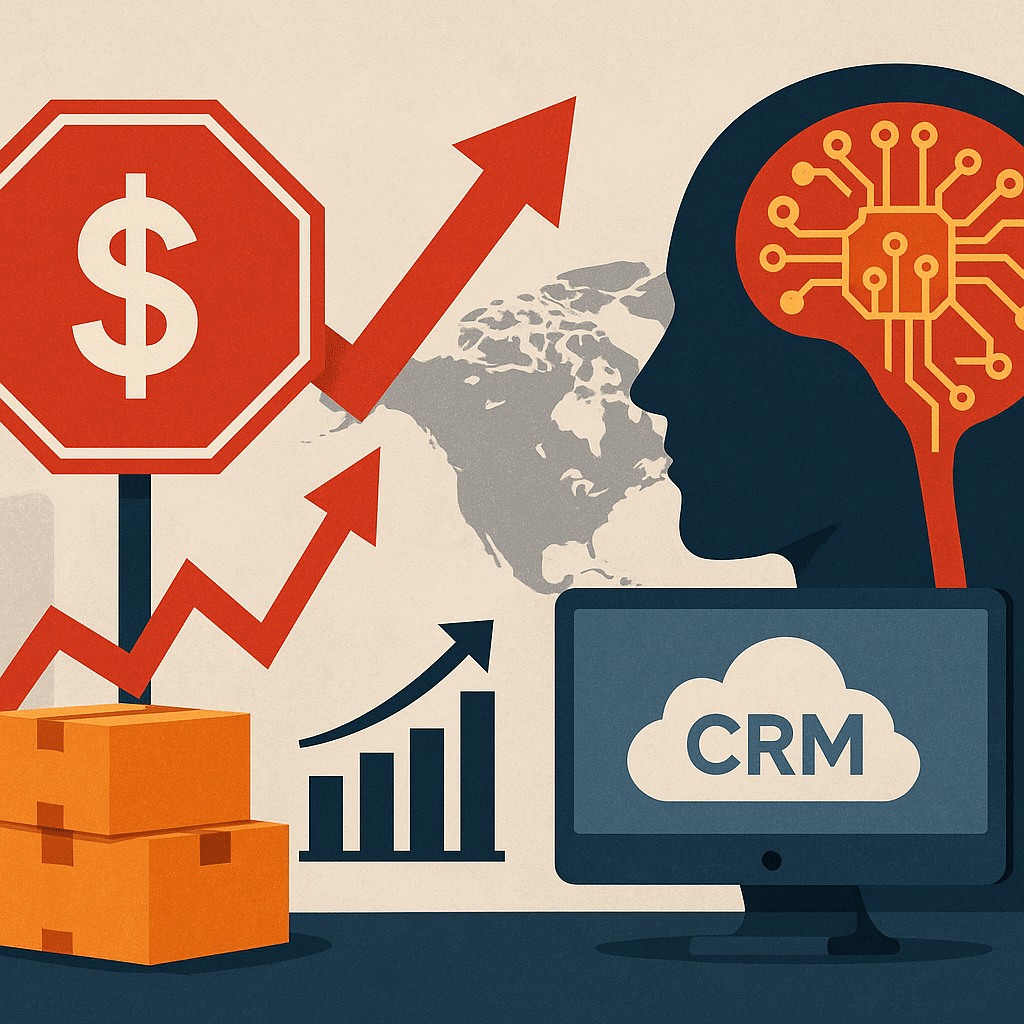
The U.S. decision to end the de minimis exemption is set to reshape global e-commerce. For years, small online orders slipped past customs without significant duties. Now, even the tiniest shipments may carry added costs — sometimes hundreds of dollars more per transaction. According to MarketWatch, the decision has already rattled e-commerce platforms, with Etsy and eBay seeing shares tumble in response.
For many businesses, this is more than an operational headache. It challenges established pricing models, strains customer loyalty, and forces companies to rethink their supply chains. The real question isn’t whether tariffs will affect your business, but how well you can adapt. That’s where CRM systems — strengthened by AI — prove invaluable.
Customer Visibility in a Shifting Market
When tariffs increase costs, customers respond in different ways. Some absorb the changes and stay loyal, while others quickly pivot to cheaper alternatives. In fact, Reuters reports that 1.36 billion packages valued at $64.6 billion entered the U.S. duty-free in 2024, most from China — a flow of imports now directly impacted by new tariffs. Without clear visibility, businesses risk losing customers without realizing it until it’s too late.This shift is especially painful for small businesses, which often operate with tighter margins and less flexibility. As Forbes recently reported , the end of the de minimis exemption will hit small businesses hardest, leaving them with higher costs and customers who may be less willing to absorb price increases.
???? Watch: How U.S. Tariff Changes Impact Small Businesses and Consumers
This clip highlights the immediate challenges small businesses face as tariffs reshape global trade. From rising costs to shrinking margins, it underscores why visibility and proactive strategy are now essential for survival.
CRM systems provide a critical advantage here. They allow companies to segment customers by price sensitivity, making it easier to personalize communications and offers. Automated outreach can re-engage accounts most at risk of churning, while real-time sales data highlights early shifts in buying behavior. With these insights, companies can adjust strategies proactively rather than reactively.
AI-Powered Forecasting and Scenario Planning
Tariffs create uncertainty; AI helps remove the guesswork. Scenario modeling allows companies to simulate how revenue might change if tariffs rise by 10% or 20%. Forecasting tools predict how customer preferences could shift, such as trading premium products for more affordable options.
These shifts aren’t limited to the U.S. — they reflect global trends. The OECD’s report on Risks and Resilience in Global Trade highlights how geopolitical shifts, transportation bottlenecks, and tariffs are among the most disruptive forces shaping international commerce today, which underscores why AI-driven forecasting has become essential.
AI also supports smarter supply chain decisions. By analyzing supplier performance, risk factors, and cost structures, AI can recommend alternative sourcing regions or vendors. This not only protects margins but also helps businesses build resilience in the face of shifting global trade policies.
To see how industry leaders are thinking about tariffs, global trade, and AI, check out this panel discussion hosted by Brent Leary, Esteban Kolsky, Nicole France, Bob Stutz, and Jon Reed. In this conversation, they explore the ripple effects of shifting trade policies and how AI may reshape enterprise strategies.
???? Watch: Will Tariffs and Trade Disrupt AI in the Enterprise?
Their insights reinforce just how much uncertainty tariffs create — and why AI-powered scenario planning is so critical for businesses navigating change.
Compliance and Automation
With new tariffs come new compliance requirements: classification codes, documentation, and evolving regulations. Handling this manually is time-consuming and error-prone, exposing companies to delays and penalties. According to U.S. Customs and Border Protection, businesses are now required to file declarations even for low-value shipments that were once exempt. Handling this manually is time-consuming and error-prone, exposing companies to delays and penalties. The U.S. International Trade Commission (USITC) is responsible for maintaining the U.S. Harmonized Tariff Schedule, including classification codes and duty guidelines. Keeping up with frequent updates and nuanced rules can easily overwhelm smaller teams.
| Manual Compliance Workflow | Automated with CRM + AI |
|---|---|
| Manually classify shipments | CRM auto-classifies shipments |
| File paperwork by hand | Dashboard auto-updates in real time |
| Cross-check tariff codes | AI pushes tariff updates instantly |
| Track costs in spreadsheets | Alerts trigger when margins drop |
CRM platforms integrated with AI streamline this process. Automated shipment classification reduces mistakes, while real-time tariff updates flow directly into dashboards where sales and finance teams can see them instantly. Alerts can be triggered when landed costs exceed margin thresholds, enabling immediate course correction. This automation keeps teams aligned, costs visible, and surprises minimized.
Building Resilience with CRM + AI Consulting
The recent tariff changes are only one example of how quickly global trade can shift. Tomorrow it could be new data privacy laws, supply chain disruptions, or economic sanctions. Businesses that treat CRM as merely a sales tracker will find themselves exposed.
With AI enhancements, CRM becomes the nerve center of organizational resilience. It allows companies to:
-
Predict disruptions with scenario modeling and forecasting
-
Protect margins with cost alerts and pricing adjustments
-
Safeguard compliance by automating classification and regulatory workflows
-
Strengthen customer trust with proactive outreach during periods of uncertainty
Real-world examples show why this matters. During COVID supply chain shocks, companies with AI forecasting inside their CRM were able to reroute suppliers in days instead of months. When GDPR rules went into effect, businesses with automated compliance workflows avoided costly penalties while competitors scrambled.
At CRM Experts Online, we help companies move beyond “CRM as a tracker” to CRM as a resilience engine. Our consulting approach blends AI, automation, and strategy to ensure your business can adapt quickly, protect profitability, and keep customer relationships strong — no matter how turbulent the market becomes.
Conclusion
Tariffs are an unavoidable reality of global commerce. Companies that fail to adapt risk eroding their margins and losing customer trust. Those that embrace CRM and AI, however, gain the tools to transform uncertainty into strategy.
At CRM Experts Online, we specialize in building CRM systems that don’t just capture data — they empower businesses to navigate disruption with confidence.
???? Want to prepare your business for tariff disruptions? Contact us here
Related posts
-
How Predictive Analytics Powers Scenario-Based Forecasting
Supports your AI forecasting talking points with deeper insights. -
Best Practices Guide: Integrating CRM and Marketing to Automate Manufacturing Operations
Relevant if your tariff-impacted clients are in manufacturing or operations-heavy verticals. -
How to Measure CRM ROI with Key KPIs
Ties into the tariff-impact formula—great for readers measuring the financial effect of changes. -
From Chaos to Control: How We Operationalized a GTM Stack
Strong internal case study demonstrating operational resilience and best practices in CRM deployment.