
AI tools are transforming lead scoring by analyzing data across multiple channels like email, social media, and web activity. These tools help businesses prioritize leads with a higher likelihood of conversion, saving time and boosting ROI. Below are the top 7 AI tools for multi-channel lead scoring and what makes them effective:
- Salesforce Einstein Lead Scoring: Uses predictive analytics to rank leads and integrates seamlessly with Salesforce tools.
- 6sense Revenue AI: Processes massive buyer data to uncover hidden intent and prioritize high-value accounts.
- MadKudu Predictive Engine: Focuses on transparency in lead scoring and identifies product-qualified leads (PQLs).
- Zapier Automated Workflows: Automates lead management by connecting over 7,000 apps for smoother workflows.
- HubSpot Predictive Lead Scoring: Combines behavioral and demographic data for accurate lead prioritization.
- Clay Data Enrichment Platform: Enriches raw data from multiple sources to identify high-potential leads.
- Infer (Aurea) Predictive Analytics: Uses advanced AI to deliver precise lead scoring and personalized outreach.
Quick Comparison Table
| Tool | Channel Coverage | AI Capabilities | Integrations | Starting Price | Ideal For |
|---|---|---|---|---|---|
| Salesforce Einstein | Email, web, social, mobile | Predictive analytics, machine learning | Salesforce ecosystem | $80/user/month | Medium to Enterprise |
| 6sense Revenue AI | Web, email, advertising, intent | Deep learning, buyer intent analysis | Major CRMs, marketing platforms | Contact for pricing | Enterprise |
| MadKudu Predictive | Email, web, product usage | Behavioral scoring, PQL focus | HubSpot, Salesforce, others | Contact for pricing | Medium to Enterprise |
| Zapier | Over 7,000 apps | Workflow automation, basic scoring | Universal app connector | $19.99/month | Small to Medium |
| HubSpot Predictive | Email, web, social, ads | Logistic regression, lead prioritization | Broad integrations, APIs | $15/user/month | Small to Enterprise |
| Clay Data Enrichment | Email, LinkedIn, databases | Custom scoring, data enrichment | APIs, Slack, major CRMs | $134/month | Medium to Large |
| Infer (Aurea) | Email, web, social, mobile | Predictive analytics, segmentation | Salesforce, Workday, ServiceNow | Contact for pricing | Medium to Enterprise |
These tools simplify lead scoring while improving accuracy and efficiency. Choose the one that aligns with your business size, budget, and integration needs.
Using AI for predictive leads scoring in Clay.com
1. Salesforce Einstein Lead Scoring
Salesforce Einstein Lead Scoring uses artificial intelligence to pinpoint and prioritize leads with the highest potential by analyzing their behavior across various channels.
Broad Channel Coverage
Einstein pulls data from a wide range of sources, including explicit, implicit, and third-party inputs [2]. It tracks everything from website activity and email engagement to social media interactions and marketing campaign responses, building a comprehensive profile for each lead. This multi-channel approach is crucial, especially as B2B companies now handle 67% more leads annually compared to five years ago [2]. By consolidating insights from multiple platforms, Einstein provides a complete picture of a lead’s potential, creating a solid foundation for its predictive analytics.
Advanced AI Modeling
The AI engine behind Einstein Lead Scoring excels at identifying leads most likely to convert [2]. It does this by automatically building scoring models that weigh key data points and behavioral trends. As new data flows in, the system uses predictive analytics to refine its models, ensuring the scoring becomes more accurate over time.
Seamless Integration
Einstein’s predictive capabilities get a boost from its ability to integrate with various business systems. For example, it connects with ERP platforms to incorporate financial, inventory, and operational data, improving scoring precision [3]. Integration with marketing tools like Pardot or Marketo enables it to analyze engagement across different marketing channels, leading to better scoring and more focused outreach [3]. When paired with Salesforce Commerce Cloud, Einstein can predict buying behavior and fine-tune cross-sell or upsell strategies. Additionally, Einstein Activity Capture syncs with email and calendar tools like Outlook or Gmail, automatically logging sales interactions for a more complete view [3].
2. 6sense Revenue AI
6sense Revenue AI impresses with its ability to process and analyze massive amounts of buyer behavior data from various touchpoints. Leveraging its Signalverse technology, the platform processes an astounding one trillion buyer signals daily, giving businesses unparalleled insights into prospect activity [4]. This capability forms the backbone of a comprehensive channel strategy.
Channel Coverage Breadth
6sense collects intent signals from both identified and anonymous sources, utilizing over 80 specialized filters [4]. This extensive data collection allows teams to manage complex, multi-step campaigns from a single platform. One standout feature is its website personalization, which adapts messages based on visitor behavior and buying stage [5]. By monitoring not only direct interactions but also anonymous browsing, the platform uncovers insights even from prospects who haven’t yet made themselves known.
AI Model Sophistication
The platform’s AI has been refined through over a decade of B2B data training [6]. Its machine learning capabilities analyze buying signals, predict which stage a prospect is in, prioritize accounts, and recommend actionable steps for sales teams [6]. By shedding light on the "dark funnel" – where prospects conduct offline research and evaluations – 6sense identifies high-value prospects and maps out their buying stages and interests [7].
The results speak volumes. For instance, Code42 saw a 30% increase in opportunity volume and a 70% jump in deal size, with 82% of accounts progressing as predicted [7]. Similarly, Automox reported an 88% rise in closed-won deals after implementing an ABM strategy powered by 6sense insights [7].
"6sense helps B2B organizations achieve predictable revenue growth by putting the power of AI, big data, and machine learning behind every member of the revenue team."
- The 6sense Team [6]
These predictive capabilities also enhance system integrations, making them even more impactful.
Integration Capabilities
6sense integrates seamlessly with leading CRMs, marketing platforms, and sales tools [9]. It connects with systems like Salesforce, Microsoft Dynamics, HubSpot, Marketo, LinkedIn, Google Ads, and Facebook [8][9]. These native integrations ensure smooth data synchronization and enable automated workflows across your tech stack. By consolidating insights from various sources, 6sense allows marketing, CRM, and sales enablement tools to work in harmony, eliminating the need for manual data handling or complex custom setups. This streamlined approach ensures that your existing technology investments are used to their fullest potential.
3. MadKudu Predictive Engine
MadKudu brings a fresh perspective to AI-powered lead scoring with its transparent "glass box" model. This approach ensures sales teams can clearly understand and trust the scores they rely on, enabling smarter decisions across various marketing channels.
Channel Coverage Breadth
MadKudu collects data from multiple touchpoints – such as track, page, and group events – through integrations like Segment[13]. This rich dataset helps identify high-value leads and allows for smarter resource allocation across channels. The result? More effective website personalization, email campaigns, and sales outreach[10][12]. For instance, one company with over 50,000 monthly signups used MadKudu to zero in on the top 20% of prospects, leading to 2–3× higher conversion rates and a 50% boost in revenue[14][15].
AI Model Sophistication
MadKudu’s AI combines data from hundreds of sources – like web activity, product usage, firmographics, and technographics – to gauge buyer readiness with precision. This method has expanded revenue prediction coverage by 20–30%. One company reported a 60% increase in pipeline from product-qualified leads (PQLs) and a 20% rise in annual recurring revenue (ARR)[16][17][18]. Geckoboard, for example, implemented MadKudu’s scoring algorithm on its demo request page back in 2016. High-scoring leads were routed to phone calls, while lower-scoring ones were handled through email sequences. This strategy enabled Geckoboard to predict 80% of its conversions from just 12% of signups while reducing daily calls by 85%[19].
"Since implementing MadKudu we have seen a 60% increase in pipeline from PQLs and a 20% increase in ARR from our ABM motion. We are continuing to expand our use of MadKudu to all our go-to-market motions." – TJ Nokelby, Director of Demand Generation[17]
Integration Capabilities
MadKudu seamlessly connects with major CRM and marketing automation platforms like HubSpot, Salesforce, and Marketo[15]. With robust API capabilities, it facilitates smooth data sharing and automates workflows. This centralized approach ensures that sales reps can access consolidated insights directly in platforms like Salesforce.
"Being able to pipe in all these different data sources into a centralized platform and have that show up in Salesforce in a way that the reps can leverage. That’s the secret sauce with MadKudu." – Ryan Kelly, VP of Growth Marketing[11]
With a solid 4.7/5 rating on G2[15], users frequently highlight how MadKudu improves efficiency and streamlines processes. By automating lead quality assessments, it eliminates manual reviews between sales and marketing, reducing response times and fostering better alignment across teams[20]. However, some users mention that the initial setup can be tricky, and occasional data synchronization issues may arise[20].
4. Zapier Automated Workflows
Zapier might not be an AI scoring tool, but its automation capabilities play a big role in improving how marketing and sales teams handle lead scoring. By connecting over 7,000 apps, Zapier brings together marketing and sales tools, making lead scoring more accurate. Like the AI-powered scoring engines mentioned earlier, Zapier streamlines lead management by automating data movement and ensuring sales teams have actionable insights at their fingertips.
Channel Coverage Breadth
Zapier ensures no lead is overlooked by capturing and organizing data from all digital touchpoints. It automates the flow of leads between CRMs, marketing platforms, and communication tools. This efficiency has tangible results – Smart Charge America speeds up appointment scheduling by 75%, and Veo reduced its cost per lead by 20% through automated workflows[21][24]. Similarly, Sixth City Marketing saves over 9 hours each month by automating lead data collection from multiple sources[24].
"Zapier helps us close far above 50% more deals than we would without it. It is a key element of our overall strategy and, therefore, of our sales pitch." – Raphael Bochner, Founder and CIO[21]
AI Model Sophistication
Zapier leverages AI to create smarter workflows. It segments and scores leads based on their actions, enabling businesses to deliver personalized experiences at scale[23]. A great example is Results Grow, where an AI-powered chatbot built using Zapier now drives 30% of their bookings[21]. Zapier’s "Paths" feature takes automation further by enabling multi-step workflows that route leads based on specific triggers and behaviors, cutting research time from hours to just minutes[21].
Integration Capabilities
Zapier’s strength lies in its ability to integrate seamlessly with CRMs like Salesforce, HubSpot, and Marketo. This reduces the need for manual data entry and streamlines operations. For instance, Lucidchart reports a 30% reduction in time spent on workflows, while Orchard saves over 3 hours each week thanks to Zapier[24]. Additionally, for businesses using platforms like Google Ads or LinkedIn Ads, Zapier simplifies the process by automatically syncing qualified leads from CRMs into custom ad audiences[25].
Pricing Tiers
Zapier’s pricing structure is designed to be scalable. It offers a free plan with 100 tasks per month, while paid plans start at $19.99/month. The Team plan is available at $69/month, with custom Enterprise pricing also an option. Businesses can save up to 33% with annual subscriptions[22][26][27]. While task-based pricing might add up for heavy users, the time saved often outweighs the cost. For example, Hudl estimates saving $15,000 annually through Zapier’s automation tools[21].
"Zapier saves each of our estimators 75 minutes daily, giving them more time to find new opportunities and schedule more installs. We have 77 Zaps automating more than 18,000 tasks per week. We wouldn’t have been able to scale like this without Zapier’s support." – David Laderberg, Vice President[21]
sbb-itb-f02ae4e
5. HubSpot Predictive Lead Scoring
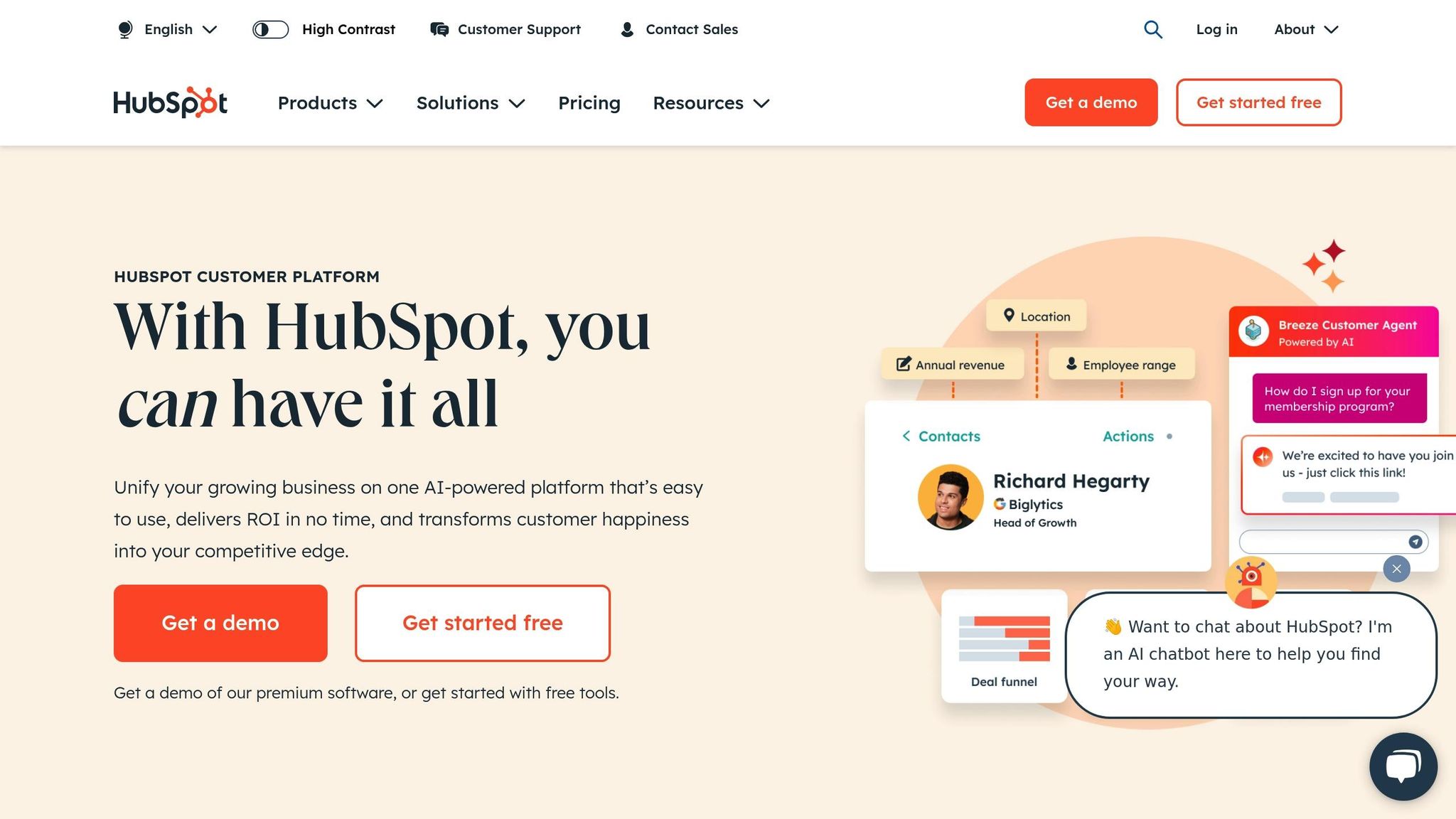
HubSpot’s predictive lead scoring takes lead identification and prioritization to a new level with its AI-driven approach. Unlike traditional methods that often rely on guesswork or subjective criteria, HubSpot uses machine learning to assess hundreds of data points and predict which leads are most likely to convert.
Broad Channel Coverage
HubSpot gathers a wide array of behavioral and demographic data to create a complete picture of each lead. This includes tracking actions like email opens, link clicks, page visits, and content downloads, alongside demographic details such as job title, industry, company size, and location [28]. By capturing interactions across multiple channels – whether through email campaigns, website activity, or downloadable content – HubSpot ensures no opportunity to engage goes unnoticed.
"Consistent messaging across channels reinforces your brand identity and fosters a stronger connection with your audience." – HubSpot [1]
This holistic data collection feeds directly into the platform’s predictive models, providing a solid foundation for accurate lead scoring.
Advanced AI Modeling
At the heart of HubSpot’s predictive lead scoring is a logistic regression algorithm that continuously learns and adapts from customer data. The system assigns each contact a score between 1 and 100, where higher scores indicate a stronger likelihood of conversion [16]. By analyzing both positive and negative attributes, the model delivers a detailed assessment of lead quality.
HubSpot provides two standout predictive metrics:
- Likelihood to close: This represents the percentage probability that a contact will become a customer within the next 90 days.
- Contact priority: This feature categorizes leads into tiers such as Very High, High, Medium, and Low based on their likelihood to convert [29].
While the exact weight of each data point remains hidden in a "black box" scoring system, the model continuously improves as new contacts are added and deals are closed [29][30]. This ensures the scoring remains accurate and relevant over time.
Seamless Integration Options
HubSpot’s predictive lead scoring becomes even more powerful when combined with external tools. It integrates effortlessly with platforms like Segment, which connects CRM and marketing automation systems to enable real-time score updates. Another example is UserMotion, which adds deeper insights into B2B SaaS prospects and customers while syncing with tools like Intercom, Outreach, Slack, and Stripe [32].
For companies looking to refine their lead qualification process, Qualifire offers additional functionality. It integrates with HubSpot’s features, such as contact insights, conversation routing, meeting scheduling, and of course, predictive lead scoring [31]. These integrations enhance HubSpot’s ability to prioritize leads effectively and streamline workflows for sales and marketing teams.
6. Clay Data Enrichment Platform
Clay turns raw prospect data into actionable insights, combining extensive data sourcing with advanced AI to help sales teams focus on high-potential leads.
Broad Channel Coverage
Clay accesses over 75 premium data sources across more than 10 platforms, including Google Maps, GitHub, and industry directories [33]. This wide reach ensures businesses can identify leads wherever prospects are active. The platform supports multi-channel sales efforts, enabling outreach via email, phone, and social media [34]. It also integrates seamlessly with CRMs and marketing tools, keeping prospecting, marketing, and closing activities aligned [33].
Advanced AI Features
Clay’s AI goes beyond simple data gathering by offering intelligent analysis and scoring. It can interpret qualitative data, such as company descriptions and job postings, to identify pain points and buying signals [36]. Users can create custom scoring systems to rank leads based on engagement, company size, funding, and other criteria. Additionally, its AI research agent, "Claygent", extracts unstructured data from websites, PDFs, and search results [33].
The platform has delivered impressive results for its users. For example:
- OpenAI: Increased enrichment coverage from the low 40% range to over 80% [37].
- Anthropic: Tripled coverage while saving four hours per week [36].
- Coverflex: Managed data for over 3 million companies, leading to 200+ monthly demos and a 5× boost in team output [36].
"With Clay, we more than doubled our enrichment coverage from low 40% to high 80%." – OpenAI [37]
Seamless Integration Options
Clay integrates with over 100 data sources and tools, including CRMs like Salesforce, HubSpot, and Pipedrive [35]. It also connects with email tools, CMS platforms, ad managers, and specialized tools like Ocean.io, Crossbeam, and Gong [35]. Flexible integration options, such as webhooks and an HTTP API, make it easy to sync enriched data into daily workflows [38][40]. Additionally, Clay works with Slack and Google Sheets [40], ensuring enriched data fits seamlessly into existing sales and marketing processes [39].
Clay’s multi-channel connectivity and AI-driven enrichment highlight its role in modern lead scoring, helping businesses streamline their sales efforts with smarter data.
7. Infer (Aurea) Predictive Analytics
Infer, now part of Aurea, is a powerful AI-driven tool that uses advanced machine learning and multi-channel insights to pinpoint top prospects and simplify intricate B2B workflows, delivering experiences that feel as seamless as consumer interactions.
Broad Multi-Channel Coverage
Infer takes a smart approach to multi-channel lead scoring, addressing the shift in B2B buyers’ expectations. Today’s buyers want fast, personalized, and consumer-like interactions, even in complex B2B environments [41]. Aurea’s Future of Commerce Cloud is built to meet this demand, balancing the intricacies of B2B purchasing with the simplicity of B2C experiences. This approach helps sales teams prioritize who to contact and determine which communication channels are most effective. By analyzing customer behavior across various touchpoints, Infer suggests the best outreach strategies tailored to each buyer’s preferences.
"Make every interaction meaningful and productive. Replace steak dinners with hyper-personalized, real-time communications that help you have the right conversations, at the right time, in the right channel" – Aurea [41]
With these detailed channel insights, Infer’s AI engine takes lead profiling to the next level.
Advanced AI Capabilities
Infer’s predictive analytics engine uses cutting-edge data science to quickly identify your best prospects, build precise audience segments, and scale personalized outreach efforts. This results in better conversion rates for both inbound and outbound campaigns [43]. By analyzing historical trends, behavioral data, and engagement patterns, the platform creates in-depth lead profiles. Its machine learning algorithms continuously adapt to new data, ensuring predictions stay accurate and relevant. This allows sales teams to focus their energy on the leads most likely to convert.
Aurea CRM integrates Infer’s analytics to streamline lead qualification and accelerate sales cycles by delivering highly targeted segments and personalized outreach strategies.
Seamless Integration with Existing Tools
Infer doesn’t just deliver insights – it integrates effortlessly into your existing tech ecosystem. Designed to work seamlessly with major CRM platforms like Salesforce, Infer provides real-time lead scoring, segmentation, and nurturing workflows [42]. This ensures predictive insights are embedded directly into your sales processes without causing disruption.
Aurea CRM takes integration a step further by connecting with a wide range of systems through numerous APIs [43]. It also links with tools like Workday and ServiceNow via Aurea’s Cloud Integration Hub [44]. This broad integration capability allows businesses to visualize customer data across departments, enabling better collaboration between sales, marketing, and customer success teams. The result? A more unified and effective multi-channel outreach strategy.
Feature Comparison Table
Below is a quick-reference table highlighting the key differences between top AI tools for multi-channel lead scoring. It breaks down their channel coverage, AI capabilities, integration options, pricing, and the ideal company size for each tool.
| Tool | Channel Coverage | AI Capabilities | Integration Options | Starting Price | Ideal Company Size |
|---|---|---|---|---|---|
| Salesforce Einstein | Email, social, web, mobile, phone | Advanced predictive analytics with machine learning | Native Salesforce integration | $80/user/month | Medium to Enterprise |
| 6sense Revenue AI | Web, email, social, advertising, intent data | Deep learning with account-based insights | Works with major CRM and marketing tools | Contact for pricing | Enterprise |
| MadKudu | Email, web, product usage, CRM data | Behavioral scoring powered by machine learning | Connects with Salesforce, HubSpot, and others | Contact for pricing | Medium to Enterprise |
| Zapier | Over 5,000 app integrations across channels | Basic automation with conditional logic | Universal connector for most business tools | $19.99/month | Small to Medium |
| HubSpot | Email, social, web, phone, chat, ads | Predictive lead scoring with contact insights | Broad integrations and robust API | $15/user/month | Small to Enterprise |
| Clay | Email, LinkedIn, web scraping, databases | High-intent lead identification with enrichment | API-based connections and custom automation agents | $134/month | Medium to Large |
| Infer (Aurea) | Email, web, social, mobile, behavioral data | Advanced predictive analytics with segmentation | Integrates with Salesforce, Workday, and ServiceNow via Cloud Hub | Contact for pricing | Medium to Enterprise |
Key Takeaways
- Pricing: HubSpot offers the most affordable entry point at $15 per user per month, making it ideal for small businesses. Zapier follows at $19.99 per month, offering unmatched connectivity across thousands of apps. On the higher end, tools like 6sense, MadKudu, and Infer use custom pricing models to reflect their enterprise-grade features and tailored support.
- Channel Coverage: Zapier stands out for its sheer breadth of integrations – over 5,000 apps – but lacks the deep lead scoring capabilities of more specialized platforms. Meanwhile, 6sense and Infer excel in aggregating multi-channel data, including web behavior and intent signals, for actionable insights.
- AI Capabilities: Tools like Salesforce Einstein, 6sense, and Infer leverage advanced machine learning to refine lead profiles continuously. Salesforce Einstein is particularly effective for businesses already in the Salesforce ecosystem, while Clay focuses on targeted outreach with its API-driven automation.
- Integration Options: HubSpot and Zapier offer broad compatibility with other tools, making them accessible for businesses of all sizes. Conversely, platforms like 6sense and Infer are better suited for companies needing seamless integration with enterprise-grade systems like Salesforce or Workday.
- Business Fit: For small businesses, HubSpot provides a comprehensive feature set at a competitive price. Medium-sized companies may prefer the balance of sophistication and ease offered by Clay or MadKudu. Large enterprises often require the advanced capabilities of 6sense, Salesforce Einstein, or Infer to handle complex, multi-touchpoint buyer journeys.
Each tool has its strengths, from Zapier’s universal connectivity to 6sense’s deep data insights. The right choice depends on your company’s size, budget, and specific needs for lead scoring and integration.
Conclusion
AI-powered multi-channel lead scoring is reshaping how businesses prioritize prospects. With 65% of companies now using CRM systems enhanced by generative AI and reporting a 30% revenue boost from AI-driven sales CRMs [45][47], these tools eliminate guesswork by delivering objective, data-driven insights.
To make the most of these advancements, choosing the right tool is crucial. Instead of focusing on the differences between platforms, think about how they fit into your overall business strategy. Look for solutions that integrate seamlessly with your existing tech stack, align with your scoring needs, and can grow alongside your business. Many platforms offer free trials, giving you the chance to test usability and support before committing. When implemented effectively, AI-powered lead segmentation can deliver a 10–15% revenue increase [46].
Navigating the complexities of AI-CRM integration often requires expert assistance. Poor data quality alone can cost businesses an average of $15 million annually [48], underscoring the importance of getting it right. Consulting services, like those from CRM Experts Online, can help avoid costly errors and ensure smooth integration. They provide strategic implementation, custom development, and ongoing optimization to make sure your AI-powered CRM delivers maximum ROI.
Transitioning from traditional static scoring to dynamic, AI-driven insights empowers sales and marketing teams to achieve better conversion rates, greater efficiency, and a lasting competitive edge. With the right tools and expert guidance, businesses can leverage data-backed lead scoring to drive meaningful growth in today’s fast-paced marketplace.
FAQs
How can AI tools enhance multi-channel lead scoring accuracy and efficiency?
AI tools bring a new level of precision to multi-channel lead scoring by analyzing massive data sets in real-time. With their ability to detect patterns and trends that traditional methods often overlook, these tools provide a more accurate assessment of leads and their potential to convert.
What sets AI apart is its capacity to learn and improve over time. By examining past interactions and outcomes, these tools refine their scoring models, cutting down on bias and minimizing human error. This means sales teams can zero in on the most promising leads with greater confidence. On top of that, AI enhances audience segmentation and allows for highly personalized outreach efforts, simplifying the lead nurturing process and making sales operations more efficient overall.
What should businesses look for when choosing an AI tool for lead scoring?
When choosing an AI tool for lead scoring, there are a few important factors to keep in mind to ensure it meets your business needs:
- Data quality and relevance: The tool should handle accurate and reliable data to deliver precise predictions for lead scoring. Without good data, even the smartest tool can fall short.
- CRM integration: It’s crucial that the tool works seamlessly with your existing CRM and marketing systems. This ensures smoother workflows and makes data sharing effortless.
- Real-time updates: Choose a tool that adjusts lead scores instantly based on the latest customer interactions. This keeps your team working with the most current insights.
- Ease of use and automation: A straightforward interface combined with strong automation capabilities can make lead management simpler, saving time and improving efficiency.
Focusing on these aspects will help businesses pick an AI lead scoring tool that aligns with their objectives and strengthens their sales and marketing strategies.
Can AI tools for lead scoring work with my current CRM and marketing platforms?
Many AI tools for multi-channel lead scoring are built to work seamlessly with existing CRM systems and marketing platforms. They can sync directly with your CRM, analyzing customer data, automating lead scoring, and delivering actionable insights as they happen.
These integrations simplify your workflows by keeping your CRM updated with the latest lead details. This means sales teams can zero in on high-priority leads, increasing efficiency and driving better conversion rates. Plus, most of these tools connect with popular marketing platforms, enabling smooth data sharing and improving the effectiveness of your campaigns.
Related Blog Posts
- 10 Ways AI-Powered CRM Increases Sales Performance
- AI in CRM: Demand Forecasting Basics
- How AI Improves CRM Resource Utilization
- How AI Improves CRM Workflow Efficiency

CRM & ERP Enterprise Technology Expert and Entrepreneurial Executive with 20+ years of leading CRM, ERP, Customer Experience, and Block-chain initiatives and projects across internal and customer facing technologies. Proven success in closing large deals in Pre Sales customer facing engagements and deploying enterprise wide CRM & Customer Experience solutions internationally and domestically.