
 Executive Summary
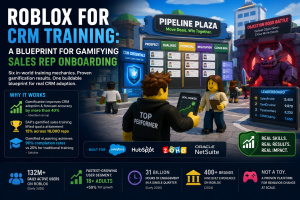
Roblox has evolved from a kids’ game into a mainstream platform where major brands like Chipotle, Nike, and Vans build real, high-performing experiences — and its fastest-growing user segment is now adults, not children. This article lays out a concrete blueprint for applying that same platform, and the independently proven mechanics of gamified training, to one of the most persistent problems in CRM implementation: getting sales reps to actually use the system consistently. Backed by research showing gamification can lift CRM adoption more than 40% and quota attainment by double digits, we outline six specific in-world training mechanics — from a Kanban-shaped “Pipeline Plaza” to objection-handling boss battles — that CRM Experts Online is prepared to design and build for clients rolling out, or struggling to drive adoption of, Salesforce, HubSpot, Zoho, or NetSuite.
In October 2021, Chipotle opened a virtual restaurant inside Roblox for its Halloween “Boorito” promotion — a corn maze where players dodged monsters, collected ingredients, and walked away with codes for real, physical burritos. It sounds like a marketing gimmick. It generated over 8 million visits and 3.5 million unique plays, and it worked well enough that Chipotle built a second permanent experience, Burrito Builder, the following year. Vans, Nike, Ralph Lauren, Tommy Hilfiger, and hundreds of other brands followed the same playbook. If some of the world’s most disciplined marketing organizations are willing to build inside a game engine to change how people behave, it’s worth asking a less obvious question: what if the next thing built inside Roblox isn’t a marketing stunt, but the way your sales team learns to actually use its CRM?
Key Takeaways
- Roblox is no longer a kids’ platform by default — its 18-and-over user segment is growing more than 50% year-over-year and now spends roughly 40% more per session than younger users.
- Gamified training isn’t a novelty metric: SAP’s gamified sales training lifted quota attainment 15% across 10,000 reps, and the Aberdeen Group found gamification improves CRM adoption and forecast accuracy by more than 40%.
- Gamified eLearning hits roughly 90% completion rates versus 25% for traditional training, and Deloitte found gamified programs take 50% less time to complete while improving long-term retention.
- More than 400 brands have built real, working experiences inside Roblox — the engineering and design playbook for building an immersive training world already exists and is well documented.
- A Roblox-based CRM training environment is a genuinely buildable concept today: a private, unlisted training world using sandbox data, not a toy and not a security risk if scoped correctly.
- The biggest CRM adoption failures we see aren’t software problems — they’re behavior-change problems, which is exactly the category of problem gamification research shows the strongest results for.
Roblox Isn’t a Kids’ Platform Anymore — It’s a Brand and Behavior-Change Platform
The lazy assumption about Roblox is that it’s a children’s game and therefore irrelevant to B2B training. The data doesn’t support that anymore. Verified Roblox users as of early 2026 skew younger overall — 35% are under 13, 38% are 13 to 17 — but the 18-and-over segment is the fastest-growing cohort on the platform, expanding more than 50% year-over-year, and those adult users spend about 40% more per session than the platform’s younger users. Roblox recorded roughly 132 million daily active users and 381.8 million monthly active users in early 2026, with 31 billion hours of engagement in a single quarter. This is not a niche audience anymore; it’s a mainstream platform with a rapidly maturing user base, and the sales reps you’re hiring today grew up inside it.
That’s exactly why serious, risk-averse consumer brands have moved past treating Roblox as an experiment. Chipotle’s Boorito Maze wasn’t a one-off — the company followed it with Burrito Builder, the first brand experience to let players earn and redeem an in-game currency for a real-world product. Vans built a permanent skate park. Nike, Ralph Lauren, Tommy Hilfiger, and Forever 21 all shipped branded digital products inside the platform. Industry tracking from GEEIQ’s 2026 State of Brands in Virtual Worlds report found that 88% of all brand activations in virtual worlds now happen on just two platforms — Roblox and Fortnite — and that more than 400 brands had active Roblox experiences by 2024, nearly double the prior year. The infrastructure, the developer talent, and the design patterns for building something real and durable inside Roblox already exist. Nobody has to invent that part.
Why Gamified Training Actually Moves the Needle on CRM Adoption
CRM implementations rarely fail because the software is broken. They fail because reps don’t log activity consistently, skip fields, avoid updating deal stages, and quietly route around the system in a spreadsheet — and no amount of dashboard nagging fixes a behavior problem. This is precisely the category of problem gamification has the strongest, most independently verified track record on.
SAP’s gamified sales training program increased quota attainment by 15% across 10,000 reps, and organizations using sales gamification have reported hitting targets 78% faster than teams that didn’t. The Aberdeen Group found that gamification improves CRM adoption and forecast accuracy by more than 40% — the two metrics that determine whether a CRM investment actually pays for itself. On the training-delivery side, gamified eLearning reaches roughly 90% completion rates against 25% for non-gamified equivalents, and Deloitte found gamified programs take 50% less time to complete while improving long-term retention. AstraZeneca’s gamified training for its agent network hit a 99% completion rate. None of these are marketing statistics from a gamification vendor — they’re independently reported results across pharma, insurance, and enterprise software adoption.
The mechanism is well understood: points, levels, and leaderboards tap directly into autonomy, mastery, and competition — the same psychological drivers a well-designed CRM certification path should already be using, just without the game layer that makes people actually finish it.
What a Roblox-Based CRM Training World Could Actually Look Like
This is the part most vendors skip past with a vague slide about “the metaverse.” Here’s a concrete blueprint for what a purpose-built CRM training experience inside Roblox looks like in practice — the kind of program we’d scope for a client rolling out or struggling to drive adoption of Salesforce, HubSpot, Zoho, or NetSuite:
- The Onboarding Outpost — a tutorial island built as a platforming course where new hires literally jump between physical structures labeled Lead, Contact, Opportunity, and Case, learning the CRM’s core data model spatially before they ever touch a production record.
- Pipeline Plaza — a town square laid out like a physical Kanban board, with a building for each deal stage (Prospecting, Qualification, Proposal, Negotiation, Closed-Won). Reps physically move a deal token between buildings, and each move triggers a matching update in a connected CRM sandbox — building the muscle memory for stage discipline before it matters in a real pipeline review.
- Objection Arena — scripted, boss-battle-style encounters where an NPC customer throws real objections (“it’s too expensive,” “I need to check with my manager”) and the rep chooses a dialogue-tree response, earning XP for de-escalation and discovery-question technique instead of a hard sell.
- The CRM Hygiene Dojo — short daily quests directly mirroring the exact behaviors that make CRM data useful: “log your first call,” “schedule a follow-up task,” “tag a teammate on a deal.” This is the same mechanic behind the Aberdeen Group’s 40%-plus adoption improvement, just built as a game instead of a compliance checklist.
- Platform Islands — separate zones (Salesforce Island, HubSpot Harbor, Zoho Zone, NetSuite Nexus) whose in-game layout visually mirrors that specific platform’s real navigation, so reps build spatial familiarity with the actual tool they’re about to use, not a generic stand-in.
- Demo Derby — a weekly timed leaderboard event where reps build and deliver a 90-second product demo to NPC judges or live peer review, scored on structure and discovery-question usage rather than raw charisma.
None of these mechanics are hypothetical game design — they’re direct translations of tactics already proven in the sales-gamification research above (leaderboards, badges, scenario-based “pitch battles,” points for CRM hygiene tasks) into a persistent, explorable 3D space instead of a flat dashboard.
Comparison: Traditional CRM Onboarding vs. a Gamified Roblox Training World
| Dimension | Traditional Onboarding (slide decks, LMS, shadowing) | Gamified Roblox-Based Training |
|---|---|---|
| Completion rate | ~25% for non-gamified eLearning | ~90% for gamified eLearning |
| Time to complete | Baseline | Up to 50% less, per Deloitte’s findings |
| CRM adoption / forecast accuracy | Baseline | 40%+ improvement, per Aberdeen Group research |
| Risk of practicing on real customers | High — reps often learn objection handling live | None — all practice happens in a sandboxed, private world |
| Appeal to Gen Z / newer sales hires | Often seen as a compliance chore | Native format for a generation raised on the platform |
| Build effort | Low, but recurring facilitator time | Upfront design and development investment, low marginal cost per new hire after that |
Benefits and Challenges
Benefits:
- Dramatically higher completion and retention than slide-based training, backed by independently reported industry data, not vendor marketing
- A genuinely risk-free environment to practice objection handling and demos before a rep is in front of a real prospect
- Strong recruiting and employer-branding signal to a generation of sales hires who already understand the platform
- Reinforces the exact CRM hygiene behaviors (logging activity, updating stages) that determine whether a CRM investment pays off
Challenges:
- Requires real Roblox Studio and Luau scripting expertise — this is game development, not a slide template
- Needs to be built and configured as a private, unlisted experience with proper account controls — this is an internal training tool, not a public-facing game
- Only ever uses synthetic or sandboxed CRM data — real customer or prospect data should never touch a public gaming platform
- Content requires maintenance as the underlying CRM’s UI and workflows change
- Internal buy-in can be an obstacle until leadership sees the completion-rate and adoption data, not just the concept
Implementation Best Practices — and Common Mistakes
Best practices:
- Start with one module — typically new-hire CRM fundamentals — before building a full virtual campus. Prove the completion-rate lift on a narrow scope first.
- Reward behaviors, not just outcomes. The Aberdeen Group’s adoption gains came from gamifying activities like logging calls and updating records, not just final deal wins.
- Connect the experience to a real CRM sandbox so skills built in-game transfer directly to the production tool, instead of teaching a generic simulation that doesn’t match the real interface.
- Loop in IT and legal early on account provisioning, data handling, and experience visibility settings — treat this like any other internal software rollout, not a side project.
- Measure downstream adoption metrics (CRM data completeness, time-to-first-logged-deal) after launch, not just in-game engagement numbers.
Common mistakes:
- Building a purely competitive leaderboard with no mastery or completion-based rewards — this burns out reps who aren’t naturally near the top and undermines the engagement gains gamification is supposed to deliver.
- Treating this as a marketing stunt rather than a training tool, which invites exactly the “is this a serious use of budget” skepticism a well-scoped, metrics-backed pilot avoids.
- Skipping the sandbox-data requirement and connecting the experience to a live CRM instance with real records.
CRM Experts Online’s Perspective
We implement CRM platforms for a living, and the pattern is remarkably consistent across clients: the software almost never fails. The rollout stalls because reps don’t change their behavior — they don’t log calls, they update deal stages days late, and six months in, half the pipeline data is unreliable enough that leadership stops trusting the reports. Every CRM adoption statistic in this article describes a problem we watch happen in real engagements, quarter after quarter.
That’s exactly why we’re actively scoping what a Roblox-based training layer looks like as a companion to a CRM rollout, not a replacement for one. To be direct about where this stands: this is a concept we are prepared to design and build for a client today, using the same implementation discipline we bring to a Salesforce or HubSpot deployment — not a packaged, off-the-shelf product sitting on a shelf. If your organization is rolling out a new CRM, or has one that reps have quietly stopped using correctly, this is worth a real conversation before your next go-live, not after adoption has already stalled.
FAQ
Is this an existing product we can buy today? Not as an off-the-shelf package. It’s a concept we’re prepared to design and build as a custom engagement, scoped to your specific CRM and sales process, the same way we approach any implementation project.
Isn’t Roblox just for kids? Not anymore. Its 18-and-over user segment is growing more than 50% year-over-year and now spends roughly 40% more per session than younger users — and major consumer brands are already building serious, permanent experiences there for exactly that reason.
Does this work with our specific CRM? Yes — it’s a training and onboarding layer, not a CRM replacement, so it can be built around Salesforce, HubSpot, Zoho, NetSuite, or any platform your team uses.
Is it safe from a data security standpoint? Yes, if scoped correctly: the experience runs as a private, unlisted world using synthetic or sandboxed CRM data. Real customer or prospect data should never enter a public gaming platform, and a properly scoped build never asks it to.
How long would something like this take to build? It depends entirely on scope. A single onboarding module is a matter of weeks; a full multi-platform training campus is a larger project. We’d scope it the same way we scope any CRM implementation — starting narrow and proving results before expanding.
What does it cost? It depends on scope and which modules you need first. We’d rather build an honest estimate around your specific CRM and sales process than quote a number that doesn’t mean anything yet — schedule a consultation and we’ll scope it properly.
Conclusion
Chipotle didn’t build inside Roblox because it’s a novelty — it built there because that’s where a very large, increasingly adult audience already spends its time, and because a well-designed game mechanic changes behavior more reliably than a coupon ever could. The same logic applies directly to one of the most stubborn problems in CRM implementation: getting reps to actually use the system consistently. The research on gamified training isn’t speculative — 90% completion rates, 40%-plus adoption gains, quota attainment lifts in the double digits — and the platform and design patterns for building something real inside Roblox are already proven by hundreds of brands. If your sales team’s CRM adoption has stalled, or you’re about to roll out a new platform and want reps to actually use it from day one, let’s talk about what a training program built around real behavior change — gamified, spatial, and genuinely engaging — could look like for your team. Schedule a consultation with CRM Experts Online to start scoping it.
Further Reading
- Roblox Brand Activations: Key Insights and Trends (2026) — Future Commerce
- Chipotle hosts virtual restaurant on Roblox for Halloween experience — Marketing Dive
- Roblox User and Growth Stats You Need to Know in 2026 — Backlinko
- Sales Gamification & CRM Adoption Statistics (2026) — Novigem
- 50+ Gamification Statistics You Need to Know in 2026 — AmplifAI

CRM & ERP Enterprise Technology Expert and Entrepreneurial Executive with 20+ years of leading CRM, ERP, Customer Experience, and Block-chain initiatives and projects across internal and customer facing technologies. Proven success in closing large deals in Pre Sales customer facing engagements and deploying enterprise wide CRM & Customer Experience solutions internationally and domestically.