
Predictive sentiment analysis is transforming CRM systems by analyzing customer emotions to predict behavior, such as churn risks or deal closures. By examining communication tones in emails, chats, and social media, AI can detect subtle emotional shifts well before traditional metrics, allowing businesses to act early.
Key Takeaways:
- What It Does: Analyzes text data (emails, chat logs, etc.) to predict customer sentiment and behavior.
- Why It Matters: Helps identify risks like customer churn or dissatisfaction weeks in advance.
- How It Works: AI-powered models use layers of analysis (word choice, grammar, intent) to assess emotions.
- Business Impact: Companies using sentiment analysis report improved retention (+10–20%), faster sales cycles (20–30% shorter), and higher customer satisfaction scores (+37%).
This technology integrates seamlessly with CRM platforms via APIs, providing real-time insights that improve customer engagement and operational efficiency.
How Predictive Sentiment Analysis Works in CRM
How AI Models Analyze Sentiment
AI models break down customer sentiment through multiple layers of analysis, each focusing on a specific aspect of communication. The Lexical layer zeroes in on word choice, identifying pain points or mentions of specific products. The Syntactic layer evaluates sentence structure and grammar to gauge urgency or emotional intensity. The Semantic layer looks deeper, analyzing context to differentiate between genuine praise and sarcasm. Lastly, the Pragmatic layer interprets the underlying intent, uncovering clues about potential purchases or churn risks [2].
Advanced neural network models, like Recurrent Neural Networks (RNNs) and Transformers, are particularly skilled at processing longer texts by capturing context effectively [1][2]. These systems achieve accuracy levels ranging from 70% to 90%. Fine-tuning with industry-specific language and datasets can push accuracy to the higher end. Additionally, ensemble methods, which combine predictions from multiple models, further enhance reliability [1][2][8].
The benefits of automated sentiment analysis are clear. Companies report a 78% reduction in manual review time, while those using real-time monitoring see a 37% improvement in customer satisfaction scores [8]. As Dr. Jennifer Chen, Chief AI Officer at SentimentTech Solutions, puts it:
"Sentiment analysis isn’t just about understanding what customers are saying – it’s about decoding the emotional DNA of customer experience" [8].
These sentiment insights become the backbone of a well-integrated CRM system.
Integrating Sentiment Analysis into CRM Systems
Once sentiment analysis is fine-tuned, integrating it into CRM systems becomes a smooth and impactful process. Using API-first architectures, businesses can embed sentiment scores and emotional trends directly into customer records without disrupting existing workflows [2][8]. The first step involves preparing data – cleaning and organizing information from sources like emails, chat logs, meeting transcripts, social media mentions, and support tickets [2]. These sentiment scores are then added to customer records, offering actionable insights for decision-making.
Predictive models are deployed as services using tools like REST APIs or serverless functions (e.g., AWS Lambda or Azure Machine Learning). Real-time updates are enabled through webhooks or event triggers, ensuring CRM records reflect sentiment changes instantly [9]. For example, if a high-value deal shows signs of negative sentiment, the system can automatically adjust deal probabilities and notify sales teams to take action [3][8].
The results speak for themselves. Companies using these integrations report a 23% boost in customer lifetime value and a 15% rise in conversion rates [8]. These gains are particularly important as digital customer interactions have surged by 250% since 2019 [8].
sbb-itb-f02ae4e
Impact CRM: Sentiment Analysis and Natural Language Processing
Research Findings: Impact of Predictive Sentiment Analysis on CRM
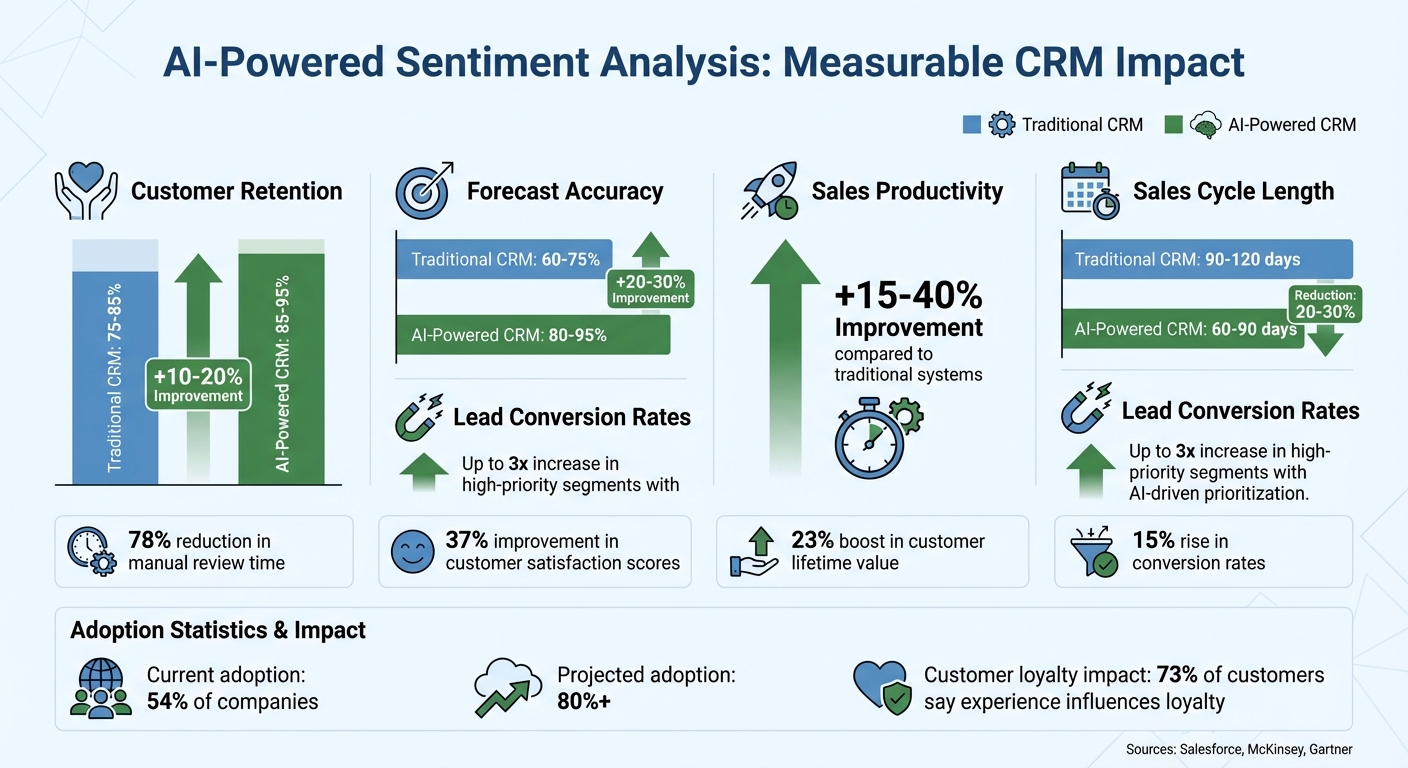
Predictive Sentiment Analysis Impact on CRM Performance Metrics
Key Metrics from Studies
Research highlights the measurable benefits of integrating predictive sentiment analysis into CRM systems. Companies using AI-powered CRM platforms report customer retention rates improving from 75–85% to 85–95%, reflecting a 10–20% increase [10]. Sales productivity also rises by 15–40% compared to traditional systems [10].
Forecast accuracy sees a boost as well. While conventional CRM systems typically achieve 60–75% accuracy, AI-driven platforms reach 80–95%, showing a 20–30% improvement [10]. Lead conversion rates in high-priority segments can triple with AI-driven prioritization [10]. Additionally, sales cycles shorten significantly, dropping from 90–120 days to 60–90 days, a reduction of 20–30% [10].
Real-world applications underline these benefits. Between 2020 and 2026, automotive mobility company Astara utilized the Salesforce Einstein 1 Platform to centralize customer data and implement AI-guided selling. This effort resulted in a 20% increase in lead conversions, a 30% boost in customer loyalty, and a staggering 300% growth in revenue [10]. Similarly, MSX International consolidated 60 systems across 80 countries into a unified AI platform. By incorporating AI-powered call routing and sentiment analysis, they reduced average handle time by 30% [11]. These examples showcase the tangible impact of sentiment analysis on CRM performance.
Adoption of predictive sentiment analysis is growing quickly. Currently, 54% of companies use tools to analyze sentiment from sources like reviews or social media, and this figure is expected to surpass 80% soon [4]. This growth aligns with consumer expectations – 73% of customers report that their experience with a brand directly influences their loyalty [4].
Comparing Research Findings
The table below summarizes key metrics from major studies, reinforcing the significant improvements AI brings to CRM outcomes:
| Study/Source | Metric | Improvement Percentage | CRM Impact |
|---|---|---|---|
| Salesforce/McKinsey | Customer Retention | +10–20% | Retention rates climb to 85–95% [10] |
| Gartner | Forecast Accuracy | +20–30% | Accuracy improves to 80–95% [10] |
| McKinsey/Gartner | Sales Productivity | +15–40% | Noticeable productivity gains for sales teams [10] |
| Gartner | Sales Cycle Length | 20–30% reduction | Sales cycles shorten to 60–90 days [10] |
| Salesforce | Lead Conversion | Up to three times | Dramatic increases in high-priority conversions [10] |
These findings confirm that predictive sentiment analysis delivers consistent improvements across the customer journey, enhancing CRM insights and enabling better business decisions.
Business Outcomes: Benefits of Sentiment Data Analysis
The research highlights how predictive sentiment analysis not only forecasts customer churn but also reshapes how businesses engage with customers across multiple channels.
Preventing Customer Churn
Predictive sentiment analysis works as an early alert system for spotting customer dissatisfaction. By analyzing emails, call transcripts, and social media posts for negative emotional cues, businesses can act before customers decide to leave. This creates a crucial window for intervention.
By combining sentiment scores with CRM data – like reduced purchases, fewer logins, or a rise in support tickets – companies can build a churn risk profile. When negative sentiment is detected, automated systems can notify support teams to step in and rebuild trust. Research confirms that retaining existing customers is far more profitable than acquiring new ones [6]. This proactive strategy not only helps save at-risk customers but also lays the groundwork for more tailored, meaningful interactions.
Personalizing Customer Engagement
Sentiment data enables businesses to customize their communication based on a customer’s emotional state. CRM tools can adapt message tone and style to align with each individual’s emotional preferences [2]. Sales teams, for instance, can analyze which subject lines, offers, or phrases resonate positively and adjust their approach accordingly [2].
One of the most impactful uses is identifying prospects who are emotionally ready to make a purchase. By targeting high-probability leads where sentiment suggests genuine interest, sales teams can focus their efforts more effectively. Additionally, if a long-term customer’s tone shifts from enthusiastic to distant or formal, automated alerts can prompt account managers to act quickly [2][4].
Improving Multi-Channel Customer Experience
Real-time sentiment insights also play a key role in ensuring consistency across communication channels. Sentiment analysis can unify unstructured feedback from emails, calls, chats, social media, and reviews [7]. This creates a cohesive view of customer emotions at every interaction point. AI models operating in real time can assess tone, pitch, and word choice during live conversations, providing immediate guidance for agents to adjust their responses on the spot [12].
For example, in October 2025, InteLogix adopted Balto‘s real-time sentiment tracking to enhance quality assurance and training. The system slashed call review times by over 80% and reduced After-Call Work by more than 50%, leading to a 24% increase in enrollments. While 57% of callers started their interactions with negative sentiment, only 4% ended their calls on a negative note [12].
"In today’s customer-driven world, emotion is the ultimate KPI, and sentiment analysis is how leading contact centers measure it." – Chris Kontes, Co-Founder, Balto [12]
These results are crucial because 86% of consumers will abandon a brand after just two bad experiences [13]. Additionally, 90% of customers expect an immediate response, with 60% defining "immediate" as within 10 minutes [13]. Sentiment analysis ensures businesses can consistently meet these high expectations across all channels.
How to Implement Sentiment Analysis in CRM
Steps to Integrate Sentiment Analysis Tools
To bring sentiment analysis into your CRM effectively, start by clarifying your goals. Are you looking to reduce customer churn, improve support quality, or pinpoint upsell opportunities? Defining these objectives will help you choose the right tools and approach.
Next, gather and clean your data from various sources like social media, emails, and call transcripts. Use data connectors to standardize unstructured text, such as speech data or scanned documents processed through OCR tools [7]. Here’s a staggering fact: businesses analyze only about 2% of their unstructured customer interactions, leaving a wealth of sentiment data untouched [8].
Select AI tools that integrate seamlessly with CRM platforms such as Salesforce Einstein or Zoho AI [14]. Standardizing your data format can significantly cut down implementation time – by as much as 75% [8].
Before rolling it out fully, test the system with sample data. This will help you validate workflows and refine your dashboards. Make sure to embed sentiment scores directly into CRM records, using intuitive visual indicators for quick insights. Additionally, anonymize sensitive data like PII when sending it through external sentiment APIs to ensure compliance with data privacy regulations [7]. To keep up with changes in language and customer behavior, retrain your AI models on a regular basis [14][8].
By following these steps, you’ll set a solid foundation for integrating sentiment analysis into your customer management processes.
How CRM Experts Online Can Help
CRM Experts Online specializes in AI integration services tailored to businesses. They assist in normalizing data, creating custom machine learning models, and designing user-friendly dashboards to present AI-driven insights. Their expertise simplifies the technical challenges of linking sentiment analysis tools with platforms like Salesforce, Zoho, and NetSuite, making emotional intelligence a seamless part of your CRM workflow.
They offer flexible pricing options to suit your needs, from self-guided support plans at $250/month to full-scale implementation services at $4,500/month. Whether you’re just starting out or looking for a comprehensive solution, their team can help you make sentiment analysis an integral part of your CRM strategy.
Conclusion: Using Predictive Sentiment Analysis to Improve CRM
Predictive sentiment analysis takes CRM to the next level by interpreting not just what customers say, but what they mean – their underlying emotions and intentions [2]. This evolution helps businesses stay ahead by spotting potential issues in relationships early and tailoring communication based on real data, not assumptions.
Here’s the reality: 54% of companies are already using sentiment analysis tools, and adoption is projected to soar beyond 80% [4]. With 73% of consumers stating that their experience with a brand directly impacts their loyalty [4], understanding emotions at scale isn’t just helpful – it’s critical. Especially in a CRM industry that’s on track to surpass $145.79 billion by 2029 [4].
"Predictive AI will be the new competitive differentiator. For example, in the year 2026, the businesses that will utilize the power of predicting the behavior of customers… will not only understand the behavior of their customers, they will also influence the behavior of customers." – Editorial Team, OutRightCRM [5]
This insight underlines the value of proactive sentiment analysis. With advanced models, businesses can detect early signs of customer dissatisfaction – weeks or even months before traditional metrics would catch on. This means turning potential churn into opportunities to strengthen loyalty [2].
FAQs
What data sources should I start with for sentiment analysis in my CRM?
Start by focusing on data sources packed with textual information. These include customer feedback, social media interactions, reviews, surveys, emails, chat transcripts, and support tickets. Such sources offer key insights for sentiment analysis, enabling your CRM to better interpret and respond to customer behavior.
How do you handle sarcasm and industry-specific language in sentiment models?
Working with sentiment models gets tricky when sarcasm or industry-specific jargon comes into play. Why? Because sarcasm often flips the literal meaning of words, and specialized terms can confuse models not trained for a specific domain.
To tackle sarcasm, developers use sarcasm detection algorithms. These algorithms look for subtle hints – like tone, context, or mismatched word pairings – that indicate sarcasm. For example, a phrase like "Oh, great job!" can mean the opposite of praise, depending on the surrounding context.
When it comes to industry-specific language, domain adaptation is key. This involves training models with data from the target industry, so they understand unique terms and their correct sentiment. For instance, words like "bullish" or "bearish" in finance have very different meanings than in everyday speech.
By combining these techniques, sentiment models can better grasp nuanced meanings, making them more reliable in complex scenarios.
What privacy steps are needed when sending customer data to sentiment APIs?
When working with sentiment APIs, safeguarding customer data is a must. Here’s how you can ensure data security and stay compliant with regulations:
- Get explicit consent: Always ask customers for clear permission before collecting or analyzing their data.
- Anonymize data: Strip out any identifiable information to protect privacy while still gaining insights.
- Use secure transfer methods: Rely on encryption and other secure protocols to keep data safe during transmission.
- Follow privacy laws: Adhere to regulations like GDPR or CCPA to ensure legal compliance and protect customer rights.
By following these practices, you can uphold customer trust and meet necessary legal standards.
Related Blog Posts
- How AI Improves CRM Resource Utilization
- How Predictive Analytics Improves Revenue Forecasting
- AI-Powered CRM: Predictive Metrics for Retention
- Best Practices for Using Sentiment Analysis in CRM

CRM & ERP Enterprise Technology Expert and Entrepreneurial Executive with 20+ years of leading CRM, ERP, Customer Experience, and Block-chain initiatives and projects across internal and customer facing technologies. Proven success in closing large deals in Pre Sales customer facing engagements and deploying enterprise wide CRM & Customer Experience solutions internationally and domestically.