
AI-powered error handling outperforms manual methods in CRM data integration. Businesses lose $12.9 million annually to data errors, and 71% of B2B sales leaders cite poor data quality as a top challenge. AI systems achieve 99%+ accuracy, reduce downtime by 82%, and automate repetitive tasks, saving time and costs. In contrast, manual methods, with 82–85% accuracy, are slower, labor-intensive, and prone to errors. AI is ideal for dynamic, high-volume environments, while manual processes work for smaller, stable setups.
Key Takeaways:
- AI detects and fixes errors in real-time, adapts to schema changes, and scales efficiently.
- Manual methods rely on human intervention, are reactive, and struggle with large data volumes.
- AI saves resources but requires upfront investment; manual approaches are cost-effective short-term but less efficient long-term.
Quick Comparison:
| Feature | Manual Error Handling | AI-Powered Error Handling |
|---|---|---|
| Detection | Reactive; hard-coded rules | Real-time anomaly detection |
| Resolution | Manual triage and coding | Automated, self-healing workflows |
| Schema Changes | Requires manual re-mapping | Automatically adjusts mappings |
| Scalability | Limited by labor | Effortless scaling |
| Accuracy | 82–85% | 99%+ |
| Cost | Low upfront, high long-term | High upfront, low long-term |
Choosing between the two depends on your data needs, budget, and system complexity.
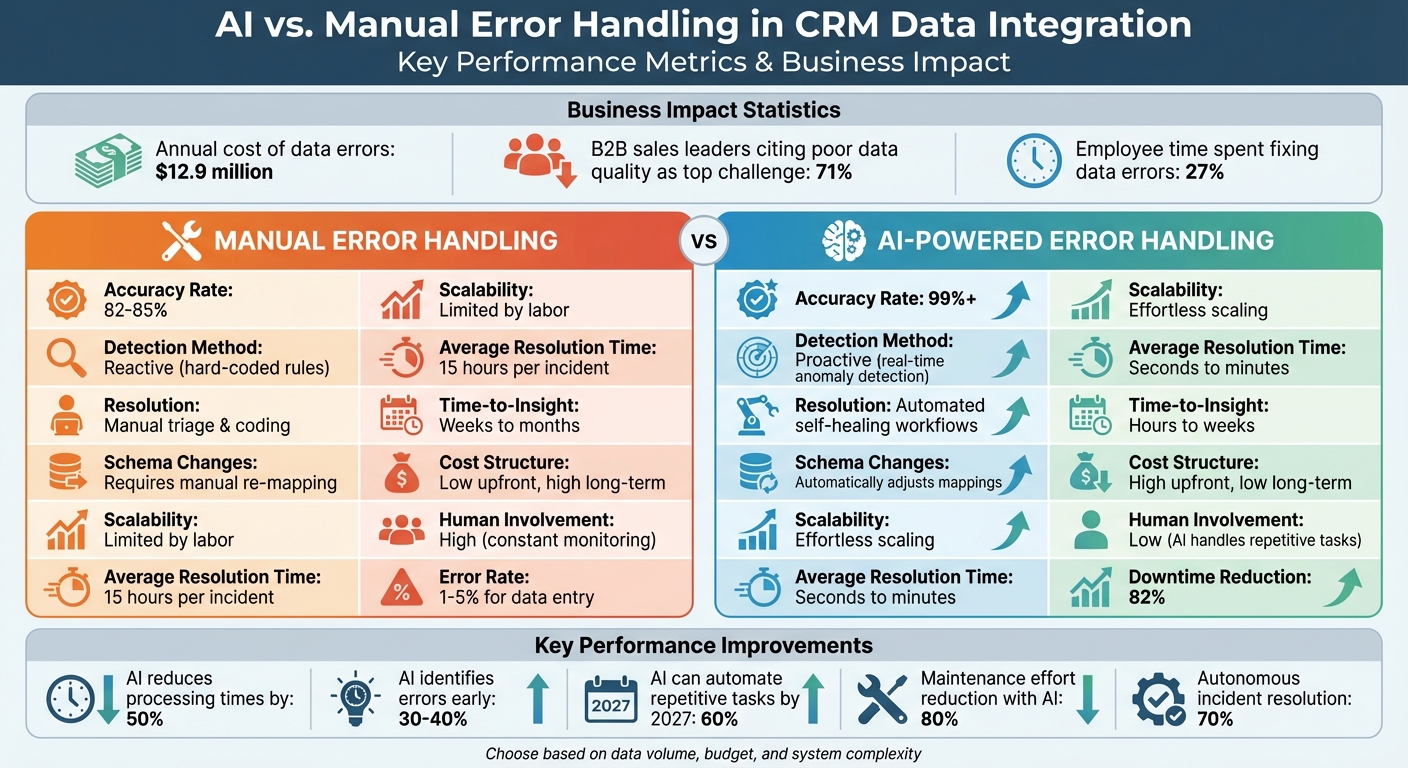
AI vs Manual Error Handling in CRM Data Integration: Key Metrics Comparison
The Hidden Cost of Bad Data in an AI World
sbb-itb-f02ae4e
AI-Powered Error Handling
AI-powered error handling shifts data integration from a reactive process to a proactive one. Instead of waiting for issues to arise and disrupt workflows, AI continuously monitors data flows to catch potential CRM problems before they escalate. For example, AI-enhanced ETL processes can reduce processing times by up to 50% and identify 30–40% of errors early on [3][7][9]. This proactive approach sets modern integration systems apart from older, less efficient methods. Let’s dive into how these systems tackle error detection, automation, and self-healing.
Adaptive Systems for Error Detection
AI brings flexibility to error detection, spotting problems that traditional rule-based systems often overlook. By analyzing statistical baselines – like normal data volumes, value distributions, and field relationships – AI can flag anomalies such as sudden spikes in null values or unexpected data type changes [3][7]. One standout feature is its ability to handle schema drift, where changes in a source system, like adding a new field or altering a data type, can disrupt workflows. AI-powered platforms automatically detect these changes and adjust mappings accordingly [3][8].
Using Natural Language Processing (NLP), these systems go a step further by understanding semantic relationships. For instance, they can recognize that fields like "cust_id" and "customer_identifier" represent the same concept, even if their names differ [7]. A practical example comes from January 2025, when Debut Infotech used AI connectors to streamline data integration across multiple SQL databases. The AI seamlessly adapted to diverse data sources, preserving data integrity and eliminating weeks of manual field-matching effort [10].
Automation of Repetitive Tasks
Repetitive error correction tasks are a time sink, but AI automation can drastically reduce the workload. Consider a healthcare network merger that aligned medical record fields in just three weeks – a process that would have taken 6–8 months manually – while achieving 94% accuracy [10]. Similarly, a regional bank consortium cut its data mapping timeline from 12 months to six weeks, with a 96% accuracy rate for complex financial products [10]. By 2027, it’s expected that 60% of repetitive data management tasks will be automated [3], freeing up teams to focus on more strategic initiatives instead of routine pipeline maintenance.
Automatic Issue Resolution
When errors do occur, AI platforms don’t just log them – they fix them. These self-healing workflows analyze error patterns and diagnose root causes, applying corrective actions like intelligent retries or rolling back partial writes [3][8]. Companies utilizing AI-driven self-healing have reported an 82% reduction in downtime, achieving availability rates as high as 99.999% [8].
The financial stakes are high: downtime in data pipelines can cost businesses between $5,000 and $14,056 per minute [8][9]. AI mitigates these losses by learning from past job metrics to predict resource exhaustion and dynamically scaling compute resources to prevent crashes like "Out of Memory" errors [8]. Instead of engineers spending hours combing through logs to resolve issues, AI can reduce recovery times to mere seconds or minutes [3][8]. This proactive approach eliminates the delays and inefficiencies of manual troubleshooting, ensuring smoother operations.
Manual Error Handling
Manual error handling operates reactively, addressing issues only after they’ve surfaced. This method depends heavily on predefined scripts, detailed logging, and alert systems to identify problems once they’ve entered the workflow [3][11]. When errors occur, skilled personnel must sift through logs to locate the root cause – a process that now averages 15 hours, marking a 166% increase year-over-year [13]. Alarmingly, 74% of data quality issues are first identified by business users rather than technical teams [13]. This reactive approach introduces several challenges, which are explored below.
Rule-Based and Reactive Processes
Traditional manual error handling relies on hard-coded validation rules and multiple checkpoints at both the source and destination to ensure CRM data accuracy [11]. Logging systems record transaction histories and errors, aiding troubleshooting efforts [11]. Companies with robust logging have reduced data inconsistencies by 40%, while well-designed alert systems can shorten resolution times by 30% [11]. However, these systems are far from foolproof. For instance, when source systems update field names or data types, existing scripts often fail, requiring constant manual intervention [3]. Alerts – delivered via email, SMS, or dashboards – are triggered only after an issue has occurred, leaving teams perpetually in a reactive mode [11][12].
Challenges in Manual Approaches
Despite the use of logging and alert systems, manual error handling faces considerable obstacles. Silent failures – errors that go undetected until they impact stakeholders – undermine trust in CRM data [13]. In 2026, data teams dealt with an average of 67 incidents per month, and 68% of organizations reported spending over four hours just to detect a single issue [13]. Manual data mapping achieves an accuracy rate of just 82–85%, lagging behind the 94% accuracy of AI-driven methods [10]. Data professionals now dedicate roughly 40% of their time to addressing "bad data" tasks like quality checks and manual triage, diverting them from more strategic initiatives [13]. Additionally, manual processes are prone to transcription and abstraction errors, with error rates around 1%. As data volumes grow, maintaining pre-processing checks becomes increasingly labor-intensive [3][13]. The financial toll is staggering: poor data quality costs U.S. businesses an average of $15 million annually [10].
Dependency on Human Expertise
The success of manual processes hinges on the expertise and availability of skilled data teams. While humans excel at interpreting ambiguity and making strategic decisions without historical data [5], this reliance introduces significant risks. For example, manual data entry has an error rate of 1% to 5% [14], and 51% of employees report burnout from repetitive manual tasks [14]. Inadequate training or documentation – cited by 65% of teams – further delays issue resolution [12]. Manual workflows also lead to data silos, with information often trapped in isolated spreadsheets, obstructing seamless integration across modern systems [4]. As data volumes increase, scaling manual processes demands more personnel, creating bottlenecks and driving up long-term labor costs [4][5].
Key Differences Between AI and Manual Error Handling
When comparing AI-powered and manual error handling, the differences are striking, especially in how they detect issues, adapt to schema changes, and scale with increasing data volumes.
Manual error handling is largely reactive, relying on predefined validation rules and alert systems that only activate after an error has already occurred [10][3]. On the other hand, AI-driven systems use machine learning techniques – like Isolation Forest for spotting outliers and Clustering for identifying duplicates – to proactively detect anomalies in real-time, preventing errors from spreading through systems like CRMs [10].
Another major distinction lies in how these systems handle schema changes. Manual systems often struggle when schemas evolve, requiring extensive and time-consuming remapping efforts [3][2]. AI systems, however, can automatically detect schema "drift" and either suggest or implement mapping updates within hours, significantly reducing downtime [10][2]. For example, AI connectors have shown the ability to quickly adapt to various data sources [10].
Resolution speed also sets these approaches apart. Manual methods demand human involvement for triage, root-cause analysis, and custom coding, taking an average of 15 hours per incident [13]. In contrast, AI leverages automated repair processes to diagnose and resolve routine issues without human input, addressing about 70% of such incidents autonomously [13]. This automation drastically shortens resolution times compared to manual workflows [10].
The scalability gap becomes more evident as data volumes grow. Manual processes are inherently limited by labor capacity and costs, which average $19.47 per hour in the U.S. [4]. As data increases, these costs rise proportionally. AI, however, scales effortlessly, maintaining consistent performance while processing millions of records without needing additional staff [10][4]. While AI may encounter challenges with unexpected data shifts, human oversight is prone to fatigue and subjective errors [6]. This makes AI a more efficient choice for managing large-scale data operations.
Comparison Table: AI vs. Manual Error Handling
| Feature | Manual Error Handling | AI-Powered Error Handling |
|---|---|---|
| Detection Method | Reactive; relies on hard-coded rules and human review [10][3] | Proactive; real-time anomaly detection and pattern recognition [10][3] |
| Resolution Method | Manual triage, custom coding, and human correction [10][3] | Self-healing workflows and automated corrective actions [3] |
| Schema Changes | Pipelines break; requires manual re-mapping [3][2] | Automatically detects drift and adapts mappings [3][2] |
| Scalability | Limited by manual effort and headcount [10][4] | Automatically scales with data volume [10][4] |
| Accuracy | 82–85% for mapping; prone to human fatigue [10][4] | 94%+ accuracy in mapping and extraction [10][4] |
| Time-to-Insight | Weeks or months for complex integrations [10] | Hours or weeks for the same complexity [10] |
| Human Involvement | High; constant monitoring and intervention required [15] | Low; AI handles repetitive mapping and extraction [2] |
Pros and Cons of Each Approach
Handling errors effectively is critical for smooth CRM data integration, as it plays a key role in operational efficiency. Both AI-driven and manual methods come with their own sets of advantages and challenges, especially when considering factors like cost, accuracy, and adaptability.
AI Error Handling: Pros and Cons
AI systems stand out for their scalability and consistency. They can process large volumes of data without needing more personnel and often achieve accuracy rates above 99% after proper training [4]. This is a significant improvement over manual methods, which generally reach accuracy levels of 85% to 95% and are subject to errors caused by fatigue [16]. AI also operates round-the-clock, ensuring consistent performance [4].
However, AI isn’t without its hurdles. The initial investment can be hefty, covering not just the technology itself but also the preparation of data and the need for specialized expertise [17]. The quality of the input data is another critical factor – poor data leads to poor results, a problem often referred to as "garbage in, garbage out" [1]. Another concern is automation bias, where users overly trust AI outputs, even when errors occur [6]. AI failures also tend to be systematic, meaning that when errors happen, they can affect entire datasets, especially in scenarios the AI wasn’t trained to handle [6].
Here’s a quick breakdown of the pros and cons of AI error handling:
| Pros | Cons |
|---|---|
| Scales easily for large datasets [5] | High upfront costs for setup and technology [17] |
| Minimal error rates for repetitive tasks [4] | Prone to systematic errors in untrained scenarios [6] |
| Processes data and updates in real time [5] | Relies on clean, high-quality data [1] |
| Frees up staff for more strategic tasks [5] | Risk of over-reliance due to automation bias [6] |
On the other hand, manual error handling brings a different set of strengths and weaknesses, especially for tasks that are smaller in scale or require more judgment.
Manual Error Handling: Pros and Cons
Manual methods excel in situations requiring contextual understanding and human judgment. People are better equipped to deal with ambiguous data, make ethical choices, and adapt to unique cases that don’t fit predefined patterns [17]. For smaller tasks or short-term projects, manual approaches avoid the significant financial investment that comes with AI implementation [5].
That said, manual processes are slower, more prone to errors, and expensive to scale. Typical error rates for manual data entry hover around 1% per keystroke [16]. These errors are often random and inconsistent, stemming from factors like fatigue, distractions, or differing skill levels [6]. Poor data quality can be costly – U.S. companies lose an estimated $12.9 million annually due to data issues [5]. Employees also spend about 27% of their time correcting these errors [5]. Additionally, with U.S. data entry workers earning an average of $19.47 per hour (excluding benefits), scaling manual operations quickly becomes financially burdensome [4].
Here’s a summary of the pros and cons of manual error handling:
| Pros | Cons |
|---|---|
| Requires minimal technology investment upfront [5] | High labor and operational costs over time [5] |
| Handles complex, nuanced situations effectively [17] | Prone to random errors caused by fatigue [6] |
| Well-suited for small-scale or unique tasks [5] | Difficult and costly to scale [5] |
| Intuitive decision-making ability [17] | Slower processing speeds create bottlenecks [4] |
Choosing the Right Approach for CRM Data Integration
AI for Dynamic CRM Environments
AI-driven error handling is a game-changer for dynamic CRM setups where data sources and configurations are constantly shifting. This is especially critical when dealing with numerous data sources – a challenge faced by 55% of chief data officers. Manual methods often fall short in environments where schema updates are frequent or when real-time synchronization across systems like ERPs and SQL databases is necessary [10].
In practice, AI has proven to significantly cut down the time required for mapping and boost accuracy.
It also offers a cost-effective solution for teams burdened with administrative tasks. For instance, sales reps spend as much as 28% of their week on manual CRM data entry, which is equivalent to losing an entire workday. For a team of 10 reps earning an average salary of $75,000, this inefficiency translates to over $210,000 in wasted labor annually [18]. If your team dedicates more than 20% of its capacity to data entry and cleaning, AI automation could deliver immediate ROI [1].
Manual for Stable or Budget-Constrained Integrations
For smaller or more stable CRM environments, manual error handling may still be a practical choice. If your CRM system experiences minimal changes and handles low data volumes, the upfront cost of implementing AI might not be justified. Manual methods are particularly effective when human judgment and contextual understanding are necessary. This approach works well in scenarios where data structures remain static over long periods and workloads are manageable [10].
For businesses prepared to embrace AI, there are tailored solutions available to meet their needs.
CRM Experts Online‘s AI Solutions

CRM Experts Online offers AI-powered CRM solutions designed to tackle the complexities of modern data integration. Their enterprise CRM platforms feature AI-driven error detection and automated resolution, customized for industry-specific challenges. Whether you’re dealing with frequent schema updates, large data volumes, or intricate multi-platform integrations, their systems can cut maintenance efforts by up to 80% [10].
Their service plans include:
- Comprehensive Support Plan: Priced at $4,500 per month, this plan includes full-scale AI integration, a dedicated support team, unlimited live training, and ongoing optimization.
- Managed Support Plan: At $1,300 per month, this option provides a balanced approach with AI assistance and support from a shared project manager.
For more details on how their AI-driven solutions can streamline your CRM data integration, visit https://crmexpertsonline.com.
Conclusion
Deciding between AI-driven and manual error handling boils down to aligning the solution with your business needs. AI shifts data integration from a reactive, rule-based process to a proactive system capable of identifying and fixing issues like duplicates and missing values in real time. With accuracy rates exceeding 99%, AI-powered tools significantly outperform manual methods, which typically achieve 82–85% accuracy [4][10]. That said, manual handling remains valuable in stable environments with low data volumes or when human judgment is critical for addressing complex exceptions.
The stakes are high – poor data quality costs U.S. businesses an average of $15 million annually, with employees dedicating 27% of their time to fixing data issues [10]. For organizations managing high-volume, repetitive tasks or frequent schema changes, AI can slash maintenance overhead by as much as 80% [10]. On the flip side, companies with minimal data changes and tighter budgets may find manual processes more cost-effective in the short term. This cost contrast underscores the potential benefits of combining both approaches for maximum efficiency.
A hybrid strategy takes advantage of AI for high-volume automation while relying on human oversight for validation and handling exceptions. This approach blends the speed and consistency of automation with the nuanced understanding that only human expertise can offer [4][6]. As we’ve seen, tailoring the solution to your specific integration needs is the key to boosting both performance and cost savings.
For businesses navigating modern data challenges, CRM Experts Online offers AI-powered CRM solutions designed to tackle these issues head-on. Their enterprise platforms combine automated error detection with industry-specific customization, helping organizations eliminate productivity bottlenecks and control costs. Whether you’re managing complex data transformations or multi-platform integrations, their solutions grow with your needs while maintaining the accuracy your business depends on.
FAQs
When is AI error handling worth the upfront cost?
AI error handling can be a game-changer when its advantages – such as better accuracy, faster processes, and improved real-time data quality – justify the upfront costs. By cutting down on manual work, reducing mistakes, and streamlining workflows, it frees up teams to tackle more strategic priorities. For companies dealing with large amounts of data or needing quick, precise integration, the long-term savings and efficiency boosts often make the investment well worth it.
How does AI handle schema changes without breaking pipelines?
AI handles schema changes seamlessly by identifying and adjusting to updates on its own. Using self-healing capabilities and adaptive systems, it maintains consistent data flow without interruptions. This eliminates the need for manual adjustments, ensuring operations stay efficient and uninterrupted.
What should humans still review in an AI-driven workflow?
In workflows powered by AI, it’s essential for humans to step in and review key aspects such as data accuracy, merge policies, source precedence, and exception handling. These checks help ensure the system runs smoothly and can effectively tackle complex situations that AI might struggle to handle independently.
Related Blog Posts
- How to Scale AI Features in Enterprise CRMs
- Best Practices for CRM Data Integration Workflows
- AI in CRM Cloud Migration: Benefits Explained
- Best Practices for AI Issue Resolution in CRM

CRM & ERP Enterprise Technology Expert and Entrepreneurial Executive with 20+ years of leading CRM, ERP, Customer Experience, and Block-chain initiatives and projects across internal and customer facing technologies. Proven success in closing large deals in Pre Sales customer facing engagements and deploying enterprise wide CRM & Customer Experience solutions internationally and domestically.