
AI-powered audit trails are reshaping financial compliance by automatically recording every action, decision, and interaction in real time. Unlike traditional logs, these systems capture detailed context – who did what, when, and why – ensuring transparency and regulatory compliance. Here’s what you need to know:
- What they do: Track invoice workflows, approvals, and anomalies with rich detail.
- Why they matter: U.S. regulations like SOX and HIPAA require accurate, tamper-proof records to avoid fines and audits.
- Key benefits: Faster audit preparation (60% quicker), improved fraud detection, and seamless compliance checks.
- How they work: AI maps invoice workflows, collects data across systems, enriches records with context, and stores them securely.
How to Build Audit Trails for AI Agents
Core Components of AI Audit Trails
Grasping the essentials of AI-powered audit trails reveals why they offer a deeper, more detailed record than a simple activity log. These systems go beyond just tracking actions – they capture every interaction tied to an invoice to provide a complete, contextual picture.
What Data an Audit Trail Captures
AI audit trails compile a wealth of information, including user actions, device details, AI model versions, confidence scores, and human approvals. These elements are critical for meeting regulatory standards. By 2026, auditors are increasingly requiring organizations to document invoice histories that encompass AI prompts, outputs, and human approvals [7].
Consider this example: In March 2026, a consultancy using Gmail AI to rewrite invoice descriptions faced a VAT audit. When asked for documentation of the AI edits, they couldn’t provide it. This failure resulted in a fine and a requirement to retain detailed records for all future invoices [7].
"AI-powered audit trails create a living, tamper-evident log of who did what, when, and why, across your finance stack." – AI Accountant [4]
This level of detail turns basic logs into dynamic, comprehensive records, laying the groundwork for AI to streamline and improve the audit process.
How AI Improves on Traditional Audit Logs
Traditional logs often lack context, capturing events in isolation. AI audit trails, on the other hand, integrate all actions across the invoice workflow into a continuous, context-rich narrative. This approach has enabled finance teams to cut audit preparation time by 50% [1]. As Vantage Point explains:
"Organizations that invest in comprehensive, well-architected audit trail systems resolve audits faster, detect fraud earlier, and demonstrate the kind of data governance maturity that builds trust with regulators." [3]
AI also plays a proactive role, monitoring transactions in real time to flag issues like duplicate invoices or unusual pricing patterns. This continuous oversight not only simplifies audits but also strengthens fraud detection and compliance efforts.
How AI Creates Real-Time Audit Trails
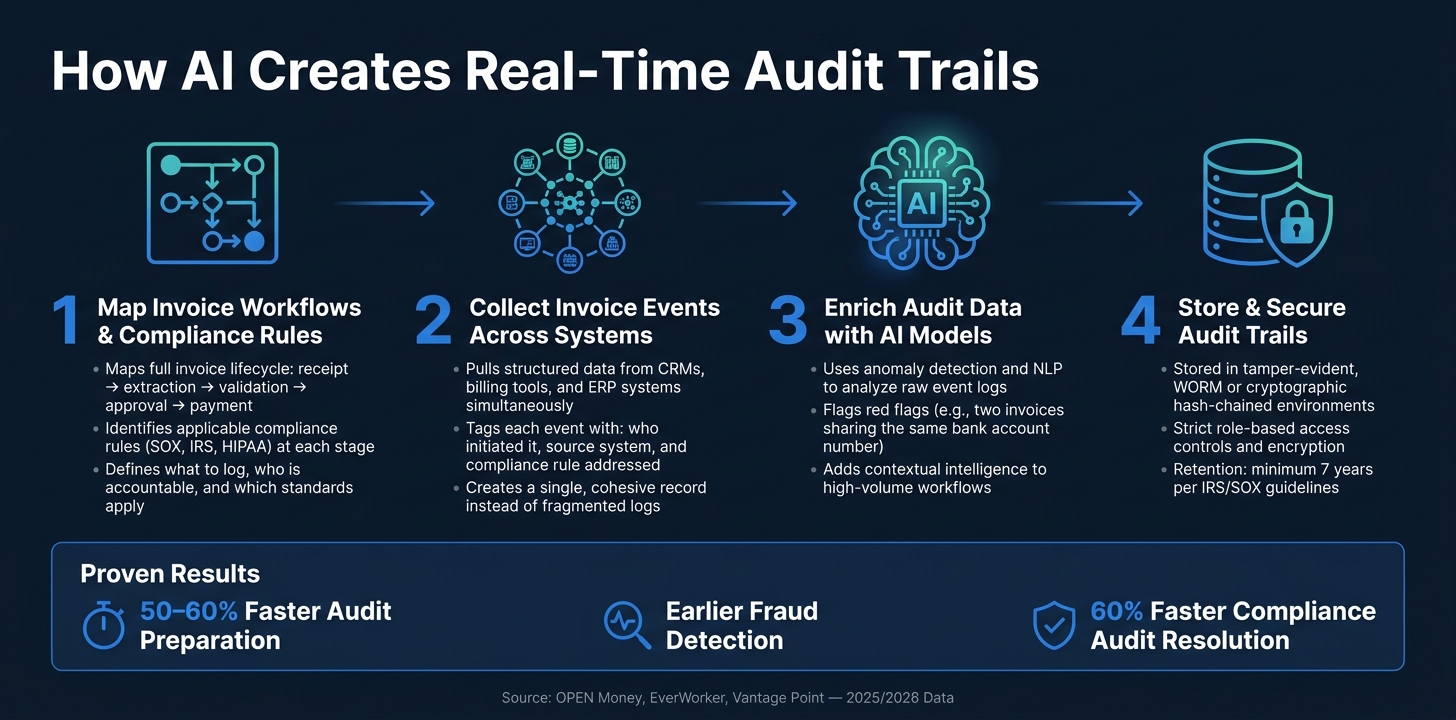
How AI-Powered Audit Trails Work: 4-Step Process
Understanding what AI audit trails capture is only part of the story. Equally important is knowing how they’re built – step by step, across every system involved in processing an invoice.
Mapping Invoice Workflows and Compliance Rules
The process begins with the AI system mapping the entire invoice lifecycle. This includes every stage, from receipt and data extraction to validation, approval, and payment. Along the way, it identifies the compliance rules that apply at each step.
This mapping determines what needs to be logged, who is accountable at each stage, and which regulatory standards apply, such as SOX controls or IRS documentation requirements. Once these rules are established, the AI system knows exactly what to monitor and record in real time. By defining these parameters, the system can seamlessly gather data across multiple platforms.
"AI-enabled audit trail creation uses intelligent, policy-aware systems to automatically capture every action, decision, and source document across finance workflows." – Christopher Good, Author at EverWorker [2]
Collecting Invoice Events Across Systems
Invoices rarely stay confined to a single platform. They often pass through CRMs, billing tools, and ERP systems before payment is finalized. To unify event logging across these platforms, AI audit pipelines are built to collect structured data from all sources simultaneously. This ensures a single, cohesive record rather than fragmented logs.
Each event – whether it’s a data extraction, a validation check, or an approval timestamp – is tagged with essential context: who initiated it, which system it originated from, and which compliance rule it addressed. For instance, in March 2026, OPEN Money implemented an AI-powered accounts payable system that tracked every step from receipt to payment. The result? A 50% reduction in audit preparation time and improved adherence to tax regulations [1].
Using AI Models to Enrich Audit Data
While raw event logs are helpful, AI takes them a step further. Using techniques like anomaly detection and natural language processing (NLP), AI models analyze the logs to add context and flag potential issues. For example, an AI system might notice that two invoices from different vendors share the same bank account number – a red flag that might otherwise go unnoticed in high-volume workflows. Once enriched, this data is securely stored to ensure its accuracy and reliability.
"AI creates living audit trails: Instead of static, after-the-fact logs, AI automatically records the context of every validation, match, and approval in real time." – Gowsika Vadivel, Finance Expert, OPEN Money [1]
Storing and Securing Audit Trails
The reliability of an audit trail hinges on how it’s stored. AI-generated records must be housed in secure, tamper-evident systems – where any attempt to alter a record is logged and flagged. Strict access controls are also critical, ensuring that only authorized personnel can view or export sensitive audit data.
Retention policies must comply with U.S. regulations, which typically require businesses to keep invoice audit records for at least 7 years to meet IRS guidelines. By combining secure, tamper-evident storage with encryption and role-based access, businesses can ensure that their audit trails remain dependable and protected over time.
sbb-itb-f02ae4e
Practical Use Cases: Compliance and Transparency in Action
Using real-time data capture, these examples showcase how compliance and transparency can be seamlessly integrated into business processes.
Enforcing Controls in Invoice Processing
AI audit trails do more than just record actions – they actively ensure that internal controls are followed, keeping invoice processing both accurate and compliant. For example, every time an invoice progresses through the workflow, the system logs whether proper approval thresholds were met and confirms that duties were separated between the person submitting the invoice and the one approving it. This automated documentation is especially critical for companies adhering to SOX regulations, where maintaining consistent internal controls is non-negotiable. Instead of relying on manual checklists or post-process reviews, AI audit trails provide a real-time record, verifying that all required controls were followed at every step.
Making Internal and External Audits Easier
One of the standout advantages of AI audit trails is how much they simplify audit preparation. Instead of spending days digging through records, finance teams can gather audit evidence in just minutes.
"AI audit trails create a living operational record rather than a static log, allowing finance teams and auditors to trace the full history of an invoice without relying on manual documentation." – Gowsika Vadivel, Finance Expert, OPEN Money [1]
Organizations have reported cutting audit preparation time by 30–60% [2]. For external auditors, this means instant access to timestamped and attributed records. Internally, this efficiency reduces last-minute stress, as companies with reliable AI audit trails resolve compliance audits 60% faster and demonstrate due diligence with confidence [4].
Proving Consistent Invoice Handling and Data Integrity
Auditors frequently need evidence that invoices are handled consistently. AI audit trails automatically document every action, ensuring uniform processing across thousands of invoices. If an invoice’s pricing seems out of line with historical trends or if vendor processing patterns show unexplained anomalies, the system flags and logs these irregularities. This helps businesses detect potential errors or fraud early while providing auditors with indisputable proof of data integrity. These capabilities make integration with systems like CRM Experts Online straightforward and effective.
Implementing AI Audit Trails with CRM Experts Online

Setting up AI audit trails isn’t just about capturing data in real time – it’s about ensuring that the system is built to meet compliance standards and operates smoothly over time. This requires a solid foundation and ongoing maintenance.
Preparing Your CRM and Finance Systems
Start by configuring your systems with unique, vendor-neutral IDs like lead_id, quote_id, invoice_id, and payment_id to ensure every transaction can be traced from start to finish. It’s also critical to check that your CRM and finance tools support:
- Stable, signed webhooks.
- Robust APIs.
- Authenticated NTP clock synchronization to prevent timestamp drift.
Why is this important? Even a few seconds of clock skew can disrupt the chronological order of your audit log, which is a big no-no for ISO 27001:2022 and PCI DSS v4.x compliance [8][9]. For storage, use WORM (Write Once, Read Many) environments or cryptographic hash-chaining to meet SEC Rule 17a-4 and SOX requirements [8].
How CRM Experts Online Handles AI Audit Trails
CRM Experts Online specializes in U.S. compliance-focused AI audit trail setups for platforms like Salesforce, Zoho, and NetSuite. Their process follows a structured 30-60-90 day rollout plan:
- Day 30: The team starts with read-only integration and discovery, mapping data flows and pinpointing gaps in logging.
- Day 60: Automated reconciliations are tested in "shadow mode." This means the system validates AI-captured events against existing records without interfering with live workflows.
- Day 90: Full orchestration goes live, including automated evidence packs that auditors can request as needed [2][10].
Each logged event is built on a detailed 12-field schema, capturing everything from the timestamp (in UTC) to the cryptographic integrity proof. This ensures precise user attribution – no generic service accounts here – making it easier to comply with SOX and HIPAA rules.
"The time to build your audit trail is before the auditor requests it, not after." – David Cockrum, Vantage Point [4]
CRM Experts Online offers a Comprehensive Support plan at $4,500/month (with a 12-month minimum). This plan covers everything – AI integration, a dedicated team, and unlimited live training. For context, enterprise-level custom audit trail systems can cost anywhere from $25,000 to over $150,000 [4].
Once the system is live, keeping it effective requires ongoing care and attention.
Maintaining Audit Governance Over Time
Regular maintenance is the backbone of a reliable audit trail. Here’s what you should focus on:
- Quarterly mock audits: Choose a random invoice and reconstruct its full audit trail within 30 minutes. If it takes longer, your system might need adjustments [4][5].
- Routine checks: Rotate encryption keys, review user access roles to enforce the Principle of Least Privilege, and conduct restore drills to ensure archived logs can be retrieved with their chain of custody intact [6][8][11].
- Real-time alerts: Set up notifications for anomalies like bulk data exports, unauthorized deletions, or suspicious logins.
Retention policies should align with regulatory requirements. Here’s a quick guide:
| Framework | Minimum Retention | Primary Focus |
|---|---|---|
| SOX | 7 years | Internal controls and financial reporting |
| HIPAA | 6 years | Protected health information security |
| GDPR | Duration of processing + 3 years | Data subject rights and accountability |
| SOC 2 | 12 months | Trust services criteria |
| PCI DSS | 1 year | Payment data security |
As Kognitos noted in 2026, "AI audit trails stop being a best practice and start being a regulatory requirement with teeth" [9]. Staying ahead with proactive governance isn’t just smart – it’s essential for business compliance and success.
Conclusion
Key Points Recap
AI-powered audit trails go beyond traditional logs by recording the what, who, when, and why of every action in real time throughout the invoice-to-pay process. These records are cryptographically sealed, making them tamper-evident and providing a solid foundation for compliance.
The stakes for compliance are higher than ever. For example, GDPR-related fines have exceeded €4 billion as of 2026 [4]. A 2023 study revealed that 78% of compliance audits flagged gaps in audit trails as a critical control deficiency [5]. Organizations with advanced audit infrastructure resolve compliance audits 60% faster compared to those relying on manual or fragmented logs [4].
"Auditable AI has moved from a differentiator to a baseline requirement." – Katie Cavanaugh, Trullion [3]
These trends underscore the urgency for U.S. businesses to strengthen their audit processes now.
Next Steps for U.S. Businesses
Start by reviewing all systems tied to your CRM, ERP, and payment processing platforms to pinpoint any logging gaps. Double-check that your retention policies align with the regulatory minimum of seven years, as many systems default to much shorter periods – typically 90 days to 18 months [4] [12].
From there, take these actions to upgrade your audit trail infrastructure:
- Standardize transaction identifiers for consistent tracking.
- Implement immutable storage to ensure records cannot be altered.
- Conduct quarterly mock audits aimed at reconstructing invoice trails in under 30 minutes.
This structured approach not only strengthens compliance but also improves operational transparency. For additional guidance, CRM Experts Online provides a detailed 30-60-90 day implementation plan tailored to U.S. compliance requirements. Their program covers everything from system preparation to deploying live AI-audit capabilities.
FAQs
What makes an AI audit trail different from a regular log?
An AI-powered audit trail offers more than just a basic log – it provides a comprehensive, automated record that outlines the reasoning behind actions. While standard logs might simply note who accessed a system and when, AI audit trails dive deeper. They connect outputs to their original source data (like invoices), document the logic used, keep a version history, and record any human reviews involved. CRM Experts Online specializes in assisting businesses in adopting these tools, helping to improve both transparency and operational efficiency.
Do AI audit trails need to record AI prompts and outputs?
AI audit trails need to record both prompts (inputs) and outputs (results) to meet compliance and maintain transparency. This is particularly crucial under regulations like the COSO 2026 guidance and the EU AI Act, which emphasize the importance of documenting these elements.
To address privacy concerns and manage costs, many organizations opt for alternatives to storing raw data. Common approaches include:
- Using identifiers: Assigning unique IDs to track prompts and outputs.
- Applying hashes: Storing cryptographic representations instead of full data.
- Leveraging prompt templates: Capturing structured references that represent the original input.
These methods ensure that even without storing raw data, the decision-making process can still be accurately reconstructed when needed.
How can we prove audit logs haven’t been changed?
Audit logs can be protected by storing them as an append-only event stream. Each entry is linked to the previous one using a cryptographic hash chain combined with digital signatures. This setup ensures that any attempt to edit or delete an entry disrupts the chain, as the hashes will no longer align.
To verify the integrity of the logs, hashes are recalculated starting from the very first entry up to the most recent one. If a link in the chain is broken, the verification process will flag the discrepancy.
Related Blog Posts
- Ultimate Guide to AI CRM Customization by Sector
- AI in Legal CRM: Transforming Client Relationships
- AI in Role-Based CRM: Smarter Customization
- How to Ensure GDPR Compliance in AI-CRM

CRM & ERP Enterprise Technology Expert and Entrepreneurial Executive with 20+ years of leading CRM, ERP, Customer Experience, and Block-chain initiatives and projects across internal and customer facing technologies. Proven success in closing large deals in Pre Sales customer facing engagements and deploying enterprise wide CRM & Customer Experience solutions internationally and domestically.