
Most actuarial consulting engagements start with a public event, not a referral. Examples include an acquisition with reserves to value, an employer moving toward self-funding, a captive feasibility study, or a pension valuation RFP. The firms that win the work tend to be the ones that notice the event first and reach out with something relevant to say. The Actuarial Growth Program from CRM Experts Online does that noticing for you. AI agents watch the filings, procurement portals and industry news where actuarial demand first shows up. Our team then turns the relevant signals into coordinated email and LinkedIn conversations, and your actuaries take the replies.
Key Takeaways
- Actuarial demand is announced in public, just in scattered places. Form 5500 filings, SEC disclosures, captive licensing news, insurer job postings and government procurement portals all hint at upcoming actuarial work. Almost no firm has the time to read all of them every day.
- Timing beats volume. A feasibility study or claims projection is commissioned before a funding decision is made. If you hear about it afterward, you have missed it.
- The program has three parts. CRMCoPilot.AI detects signals, researches each prospect and runs contextual email. OutreachCoPilot.AI runs LinkedIn outreach with the same context. Our team configures the targeting, reviews every signal and writes the messaging.
- A signal is a reason to look closer, not proof of need. Each opportunity carries its source and a confidence indicator, and nothing reaches a prospect without human review.
- Your actuaries do what only they can do: the conversations and the proposals. Everything before the reply is handled for you.
Why Actuarial Business Development Is So Hard to Scale
Actuarial firms sell judgment, and judgment does not scale through cold lists. A generic email to a CFO saying “we do pension valuations” gets ignored because it arrives with no reason attached. The same email sent the month a company discloses a frozen defined benefit plan, or the week a county retirement board posts a valuation RFP, reads as useful rather than intrusive.
The trouble is that the events which create actuarial demand are spread across dozens of sources, and none of them is built for prospecting:
- Benefit plan filings sit in the Department of Labor’s EFAST2 Form 5500 search. You can filter by plan type, participant count, asset value and location, but nobody alerts you when a filing changes.
- Federal solicitations are posted on SAM.gov. State, municipal and pension-system bids are spread across separate state contract reporters, city records and procurement platforms.
- Acquisitions and reserve or capital changes surface in SEC EDGAR filings and press releases.
- Captive formations show up in domicile regulators’ reports and trade news.
- Insurer hiring, such as a new Chief Actuary or an open valuation role, shows up on LinkedIn and job boards.
A partner can scan some of this some of the time. What usually happens is the pattern we describe on the landing page: most business development time goes into finding out what happened, not acting on it. RFP deadlines get missed, and the firm hears about the captive after another firm has already scoped the feasibility study.
The Signals That Actually Predict Actuarial Work
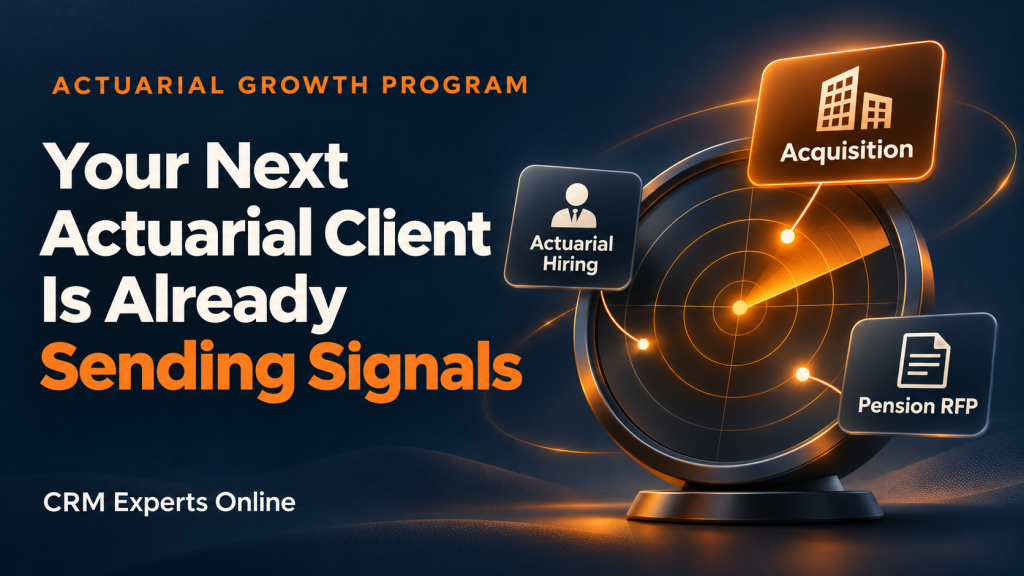
Not every piece of news is a buying signal. The program focuses on five insurance-industry signals plus a set of employer and public-sector signals. Each one maps to a specific service a firm can offer.
| Signal | Where it surfaces | Actuarial work it can point to |
|---|---|---|
| Acquisition announced | SEC filings, press releases, deal news | Due diligence, reserve review, valuation, post-close integration |
| Actuarial role posted | Insurer job postings, LinkedIn | Interim valuation or modeling capacity while they recruit |
| New regulatory requirement | Regulator notices, reporting cycles | Regulatory reporting projects, model updates |
| New product or market | Product filings, expansion announcements | Product pricing, reserve modeling, capital analysis |
| New insurance leader | Leadership announcements, LinkedIn | A new Chief Actuary or CRO reviewing outside advisors |
| Self-funding evaluation | Form 5500 filings, benefits job postings | Feasibility studies, claims forecasting, stop-loss analysis |
| Captive interest or formation | Captive regulatory records, industry news | Feasibility, capital modeling, reserve analysis |
| Pension or OPEB decision | Board minutes, GASB reporting cycles, RFPs | Pension valuations, plan terminations, OPEB analysis |
Some of these markets are larger than they look. Vermont, the world’s largest captive domicile, licensed 51 new captive insurance companies in 2025, bringing its total to 707. Every formation was preceded by a feasibility study, and every captive that exists needs ongoing reserve work. In the public sector, pension accounting standards keep valuation work recurring. Under GASB Statement 68, a total pension liability valuation is generally expected at least every two years, and in agent multiple-employer plans each participating employer needs its own valuation. That steady cycle is exactly what a procurement-monitoring agent is designed to catch.
How the Actuarial Growth Program Works
The program pairs two products with a managed service. You don’t have to learn a new tool, and your actuaries don’t have to become marketers.
1. CRMCoPilot.AI: signals and email
CRMCoPilot.AI monitors insurance-industry and employer events and researches each prospect behind a signal. It scores fit against the services your firm actually sells and runs a contextual email sequence that refers to the event that triggered it.
2. OutreachCoPilot.AI: LinkedIn
OutreachCoPilot.AI runs LinkedIn outreach using the same prospect and business context, so the email and the connection request tell one consistent story instead of two unrelated ones.
3. The managed program around them
Our team configures the targeting for your specialty, reviews whether each signal is genuinely relevant, develops the messaging, coordinates the campaigns, and routes interested responses to you. Your firm’s experts handle the conversations and the proposals.
From One Signal to One Conversation: A Worked Example

Here is the shape of the workflow. This is an illustrative example, with a fictional insurer and messages, not a real campaign.
- Signal detected. A life and annuity insurer posts a Valuation Actuary role that requires Prophet experience.
- Research card. The agent notes the potential relevance (valuation, reporting and modeling capacity) and attaches the source posting.
- Contact identified. The Chief Actuary.
- Email. “Could additional valuation capacity be useful while you recruit?”
- LinkedIn note. “I work with life and annuity teams on valuation and modeling. It would be good to connect.”
- Response routed. An interested reply goes straight to your firm, and your actuaries take it from there.
Nothing in that sequence claims the insurer needs help. It offers capacity at a moment when capacity is plainly short. That is the difference between signal-based outreach and spam, and it is why replies to this kind of message tend to be conversations rather than unsubscribes.
Matching Signals to Your Practice Area
The services your firm sells determine which events are worth watching. A P&C reserving shop and a public-pension practice should not receive the same alerts. When we configure the program, targeting starts from your practice area:
- Property & Casualty: approved loss-cost changes in a client’s class and state, new captive licenses and feasibility discussions, carrier acquisitions carrying long-tail reserves, and risk management leadership changes.
- Health & Benefits: Form 5500 filings showing a fully insured plan at scale, benefits roles naming stop-loss or self-funded administration, and rapid headcount growth crossing funding thresholds.
- Pension & Retirement: retirement system procurement and valuation RFPs, filings showing frozen defined benefit plans, board minutes referencing termination studies, and GASB 67/68 reporting cycles.
- Life Insurance: carrier acquisitions and block transactions, SEC filings disclosing reserve or capital changes, new product filings, and Chief Actuary or appointed actuary appointments.
What We Deliberately Don’t Do
Actuarial firms are rightly careful about their reputations, so it’s worth being explicit about the guardrails:
- No unreviewed outreach. Every message is reviewed before it goes out. Nothing reaches a prospect on autopilot.
- No overclaiming from industry data. An industry-wide rate trend is evidence about a market, not about a particular employer. We report the two separately and never write to a company as if a sector statistic described them.
- No collapsing of states. A company exploring a captive needs feasibility work, while one that has already formed a captive needs something else. Prospective and completed events are tracked as different signals.
- No client or plan data required. The program runs on permitted public sources. You don’t hand over confidential engagement data to get started.
CRM Experts Online’s Perspective
We build CRM systems and AI agents for a living, and the lesson we keep relearning with professional-services firms is that the bottleneck is rarely the CRM. It is the top of the funnel. Firms with excellent technical reputations still rely on referrals and conference season because nobody has time to watch the market systematically. Agents are very good at that watching. People remain better at judging which signals matter and at writing a message a Chief Actuary will respect. The Actuarial Growth Program splits the work along that line.
We also integrate rather than replace. Qualified opportunities land in the CRM your team already uses, whether that is Zoho CRM, HubSpot, Salesforce, Pipedrive or GoHighLevel, with the evidence and outreach history attached. If you want the agent layer without the managed program, we can build custom actuarial prospecting agents around your specific services instead.
FAQ
Who is the Actuarial Growth Program for? Actuarial consulting firms that want a steady flow of timely conversations with insurers, employers and public plans, without hiring a business development team. Firms specializing in P&C, health and benefits, pension and retirement, or life insurance are all a fit. Targeting is configured around your specialty.
Do our actuaries have to manage the software? No. Our team runs CRMCoPilot.AI and OutreachCoPilot.AI, reviews signals and coordinates campaigns. Your experts step in when an interested prospect replies.
Where does the data come from? Permitted public sources: government filings such as Form 5500 and SEC EDGAR, procurement portals such as SAM.gov and state and local bid sites, regulatory records, industry news, and public job postings. Some procurement platforms are monitored subject to their access and licensing terms.
Will prospects feel spammed? Every message references a real, documented event and is reviewed before sending, and volumes are targeted rather than broad. A message about valuation capacity sent to an insurer that is visibly recruiting for valuation reads as relevant, not random.
Can it find RFPs as well as private-sector prospects? Yes. RFP discovery covers federal, state, local and pension-system solicitations, and each alert arrives with the agency, specialty, submission deadline and qualification details so your team can make a bid/no-bid decision quickly.
Do we need to change CRMs? No. Opportunities sync into the CRM you already use. We scope the integration for your environment and tell you what is involved before you commit.
What should we bring to the demo? Your practice area, the services you most want to sell more of, and a sense of your ideal client. No client or plan data is needed.
Conclusion
Your next actuarial client is already making decisions that create demand for your expertise. They are announcing an acquisition, evaluating self-funding, forming a captive or putting a valuation out to bid. The question is whether your firm hears about it while the work is still being scoped or after it has been awarded.
See the insurance signals that match your practice. Book an Actuarial Growth Program demo. Tell us your specialty, and we’ll walk through the signals our agents would watch for your firm, show what an opportunity looks like when it reaches your CRM, and say plainly which signals are realistic for your practice and which aren’t. It’s a working session, not a sales pitch. Prefer to look first? Explore the Actuarial Growth Program and watch the 60-second overview.
Further Reading
- CRM Experts Online: AI Agents for Actuarial Consulting and the Actuarial Growth Program
- U.S. Department of Labor: EFAST2 Form 5500 filing search
- U.S. Department of Labor EBSA: Form 5500 Series
- SAM.gov: Federal contract opportunities
- SEC EDGAR full-text search
- Captive.com: Vermont captive domicile summary
- Texas Pension Review Board: GASB Statements 67 and 68 summary
- Journal of Accountancy: GASB pension changes

CRM and ERP Expert
Founder of CRM Experts Online.Com
Founder of CRMCoPilot.AI