
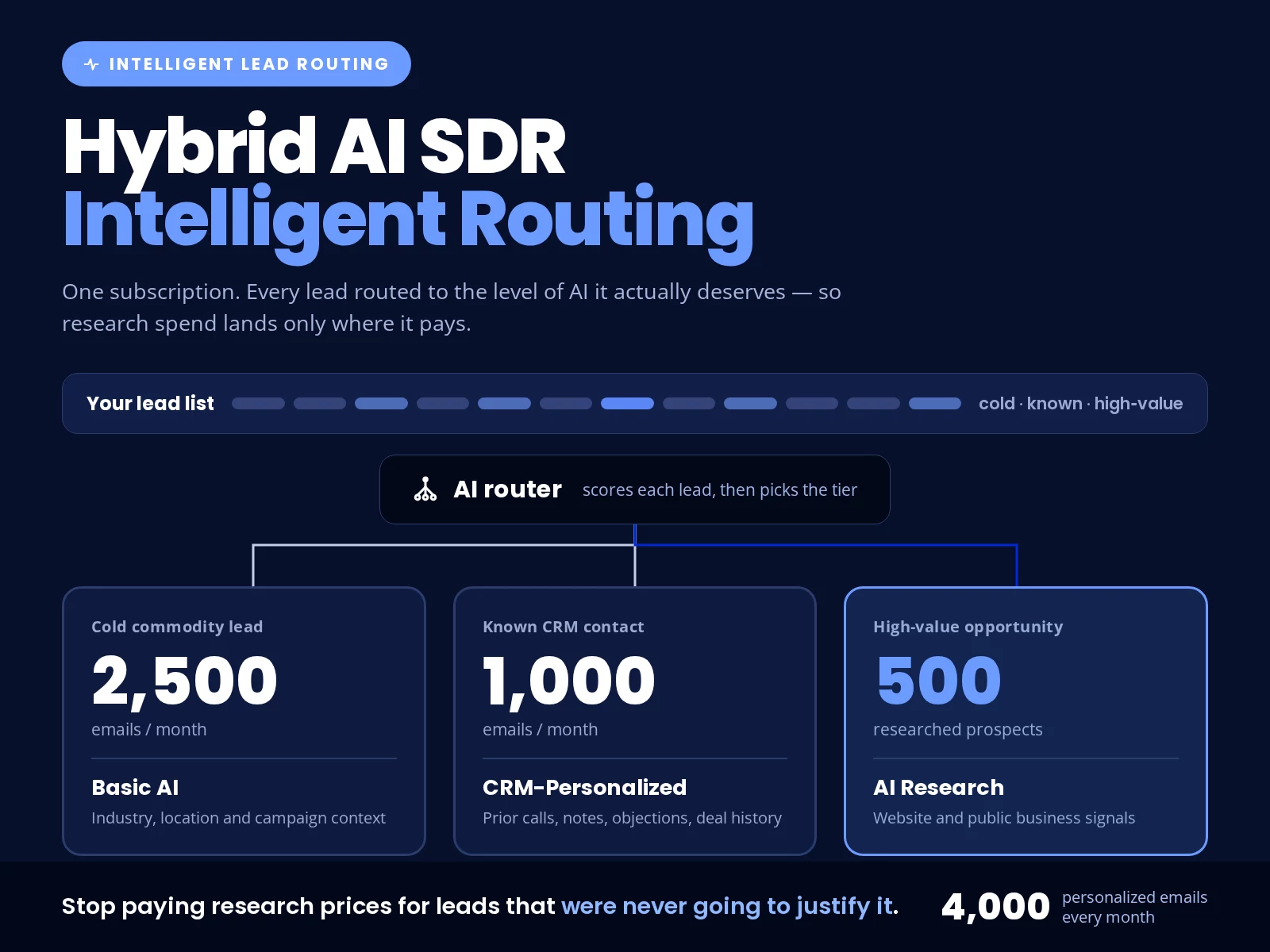
One Agent. Three Levels of Intelligence. Routed Automatically.
A cold name on a purchased list and a strategic account you have chased for a year should not cost the same to reach out to. Hybrid AI SDR decides which is which, and spends accordingly.
Every lead — new arrivals and the records already sitting in your CRM — is read, classified against your own rules, and routed to the cheapest level of AI that will still produce a credible email. One subscription covers all three levels, so nobody has to decide campaign by campaign which tool to use.
Every lead entering the agent is assessed and routed to the cheapest level of AI that will still produce a credible, relevant email. You buy one subscription instead of three, and the routing happens before a single word is drafted.
What Routing Looks Like
Basic AI Personalization
2,500 emails / month
No CRM history, no research budget. Personalized on industry, location, company type and campaign context — fast and inexpensive.
CRM-Personalized AI
1,000 emails / month
The agent already has history worth using — prior calls, notes, objections, deal and application status — so the email continues the relationship instead of restarting it.
AI Research & Opportunity Intelligence
500 researched prospects / month
Worth the research spend. The agent studies the company website and public business signals to find a credible reason to reach out now, then writes to it.
Routing rules are configured to your definitions of cold, known and high-value — by lead source, lifecycle stage, deal size, CRM presence or your own scoring. You can also override the routing for any campaign.
What Happens When a New Lead Arrives
Nothing changes about how leads reach you. The agent sits behind your CRM and acts on each record as it lands.
The lead lands in your CRM
From a web form, list upload, partner feed or an integration you already run. The agent does not replace your lead capture — it reads what arrives.
The agent reads the record
It checks what is actually on that contact: is there any prior history, an earlier application, a funding record, rep notes, a lifecycle stage, a lead source, a company website.
It classifies the lead against your rules
Cold, known, or high-value — using your definitions, not ours. This is the routing decision, and it happens before a single word is written.
It draws from that tier’s monthly allowance
A cold lead consumes one of your 2,500 Basic emails. A known contact consumes one of the 1,000 CRM-personalized. A high-value opportunity consumes one of the 500 researched. You can see what each campaign is spending.
It gathers only the context that tier permits
Basic never touches CRM history. Research is the only level that goes out to the public web. A lead routed to Basic costs you a Basic credit, not a research one.
It drafts, your rules gate the send
Subject line, opening, body, CTA and follow-ups where configured. Suppression lists, opt-outs, campaign eligibility and human review all still apply. Activity is written back to the CRM record.
How the Router Decides
The router does not guess or invent a score. It reads fields you already maintain and applies rules you set during implementation.
Signals it can route on
- Whether a CRM record exists at all
- Lifecycle stage
- Prior application or funding history
- Deal or opportunity value
- Lead source
- Last contact date and recency
- Engagement history
- Industry, size or territory
- Your own lead score field, if you keep one
- Whether there is anything available to research
If the data a tier depends on is missing, the lead routes down, never up. The agent will not spend a research credit on a record with nothing to research, and will not claim CRM history that is not there.
What that looks like in practice
| The lead | What the record actually shows | Routed to |
|---|---|---|
| Purchased list, never contacted | Name, company, industry, location. No history. | Basic AI Nothing to personalize beyond firmographics |
| Spoke to a rep 6 months ago, no deal | Call notes, a recorded objection, lifecycle stage, last contact | CRM-Personalized Real history exists and is worth using |
| Previously funded, renewal window open | Funding history, amount, rep, prior product | CRM-Personalized The relationship is the strongest asset |
| Inbound request from a target account | Matches your ICP, live website, public business signals | AI Research Value justifies the research spend |
| Old lead, email bounced, opted out | Suppression flag set | Not contacted Excluded before routing |
What About the Leads Already in Your CRM?
For most teams this is the bigger opportunity. The leads you already paid to acquire outnumber the ones arriving this week, and they are the ones generic campaigns handle worst.
A one-time classification pass at implementation
The agent reads your existing database and sorts it into the same three buckets, using the same rules — without sending anything.
You review the segments before anything goes out
You see how many records landed in each bucket and can adjust the rules until the split reflects how your team actually works.
Campaigns draw down against your monthly allowances
The backlog is worked in batches at whatever pace you choose, rather than a single blast. A 12,000-record database does not need to be contacted in one month.
Suppression and eligibility still govern every record
Opt-outs, do-not-contact flags, communication preferences, internal policy and campaign rules all apply to aged records exactly as they do to new ones.
Old does not automatically mean contactable. The classification pass identifies what is eligible and what is worth prioritizing — it is not permission to email everyone in the database.
Why This Is Usually the Right Shape
Most lists are mixed. Sending every lead through deep research wastes money on prospects that were never going to justify it; sending every lead through basic personalization under-serves the handful that matter most. Hybrid sizes the spend to the opportunity.
- 4,000 personalized emails per month in total
- Research budget deliberately capped at 500 prospects
- One subscription, one invoice, one workflow
- Same CRM write-back and human review as every tier
- Same approved offer, compliance language and messaging constraints
- Reallocate the mix as you learn which segments convert
What routing actually saves you
The comparison that matters is not Hybrid against a cheaper plan — it is Hybrid against giving every lead the same treatment. Using the published rates for a single level at the nearest listed volume of 5,000 emails per month:
| If every lead got the same treatment | Published price | The problem |
|---|---|---|
| Everything at Basic AI | $799/mo | Cheapest option, but your best opportunities get the same generic message as a purchased list. |
| Everything at CRM-Personalized | $1,499/mo | You pay relationship-level pricing on cold records that have no relationship to draw on. |
| Everything at AI Research | $3,999/mo | You pay research prices to research names that were never going to justify it. |
| Hybrid AI SDR routing | $1,499/mo | 4,000 emails: 2,500 handled cheaply, 1,000 using real CRM history, 500 fully researched. |
Hybrid includes 4,000 emails per month; the single-level rows above are priced at the nearest published volume of 5,000, so this is a comparison of approach rather than an exact like-for-like quote.
How It Works
Connect your CRM or lead source
The agent works from lead and account information in the systems you have approved.
Define what cold, known and high-value mean
Routing follows your rules — lead source, lifecycle stage, deal size, CRM presence, or your own scoring model.
The agent routes each lead
Every lead is assigned a personalization level before drafting, and the monthly allowances are drawn down accordingly.
The AI builds context and drafts
It gathers only what the assigned level permits, then generates the subject line, opening, body, CTA and follow-up copy where configured.
Human review or automated workflow
Drafting and personalization are AI-assisted while human review and approval stay in your control before outreach is sent. Final sending behavior depends on your implementation.
Prefer to Buy a Single Level?
If your list is uniform — a large cold campaign, or a reactivation push across known CRM contacts — a single tier may suit you better, with volumes from 1,000 to 10,000 emails per month.
Compare the three individual tiers of the AI SDR Email Drafting Agent, or request a custom blend if these allowances are not the right mix for your team.
Reviews
There are no reviews yet.