
Viewer data is now a revenue problem, not just a reporting problem. If your media data sits in separate systems, you miss churn signals, target the wrong audiences, and act too late. The fix is simple in theory: connect streaming, app, web, support, subscription, and consent data into one viewer record, then use AI to score behavior and trigger action fast.
Here’s the short version:
- Most media firms still have disconnected data. Nearly 48% do not connect systems in a consistent way, and only 5% say their systems are fully connected.
- Bad identity data leads to bad CRM. Duplicate profiles, household account mix-ups, and missing records make churn scoring, targeting, and reporting less accurate.
- AI helps join the dots. It can match viewers across devices, clean records, update scores within seconds, and trigger outreach based on live behavior.
- Personalization has a clear revenue link. Consumers can spend about 34% more with personalized experiences, and firms that do personalization well can see 40% more revenue from those efforts.
- Privacy cannot be separate from activation. Consent, opt-outs, retention rules, and access controls need to live inside the CRM record.
- Rollout works best in stages. Audit data sources, set identity rules, test one content area, then connect core systems and turn on scoring and journey flows.
If I boil the article down to one idea, it’s this: media CRM works when viewer data is clean, connected, current, and tied to action. Everything else – retention, ad sales, recommendations, and reporting – comes from that.
The State of Viewer Data in U.S. Media and Streaming
U.S. media companies collect viewer data from streaming apps, subscriptions, email, support, and ad platforms. The problem is that most of this data still sits in separate places. Each system holds its own version of the viewer record.
That split hurts engagement, monetization, and reporting. Without one unified viewer record, CRM teams can’t personalize fast enough, keep viewers around, or report on performance when it matters. This goes beyond messy dashboards. It disrupts identity, personalization, and compliance workflows.
Data Silos Across Devices and Teams
These silos didn’t appear overnight. They built up as teams added more tools over time. Playback data, metadata, subscription status, and ad metrics often live in separate systems [2].
Viewers also jump across Roku, Apple TV, mobile apps, and smart TVs. Each device comes with its own identifiers and data models [2][6]. So a show that starts on one device can show up as a brand-new session on another unless the data is stitched together fast.
Once data is split like this, duplicate profiles and missing records are almost impossible to avoid.
Duplicate Profiles, Identity Gaps, and Missing Records
A single subscriber can end up spread across several profiles. When that happens, watch history gets harder to read, churn risk gets fuzzier, and offer targeting starts to slip.
Shared household accounts add another layer of mess by mixing behavior from different people. That weakens recommendations, ad targeting, and churn detection. 43% of companies report struggling to maintain accurate, up-to-date customer data [3], and 29% say they lack a single source of truth for customer information [3]. Those gaps can turn into wasted campaign spend and weaker viewer experiences fast.
They also make consent tracking and deletion requests much harder to handle.
Consent Management and Viewer Privacy Compliance
Viewing data is sensitive, and U.S. media companies are under more pressure to handle it with care. State privacy laws, led by the California Consumer Privacy Act (CCPA), have made opt-outs and data retention a serious operational issue.
When consent data and retention rules live in separate systems, opt-outs and deletion requests often become manual. That’s slow, risky, and easy to get wrong. It also makes privacy promises harder to keep.
sbb-itb-f02ae4e
How AI-Powered CRM Creates a Unified Viewer Record
AI-powered CRM brings subscription history, viewing events, support interactions, engagement signals, and consent status into one viewer profile. Instead of leaving data scattered across tools, it pulls those pieces together and keeps them up to date. That base is what makes identity matching and deduplication work.
AI Identity Resolution and Data Cleaning
People don’t watch on just one device. They jump from phone to web to connected TV, sometimes in the same day. AI identity resolution ties those sessions together.
Using a mix of probabilistic matching and deterministic matching, the CRM can merge anonymous activity with logged-in behavior into a single record. It can also flag mismatches, standardize fields, and merge duplicate records automatically [5]. Once the system resolves identities, it can refresh segments and scores as new behavior comes in.
Near Real-Time Data Unification for Streaming Teams
For streaming teams, stale data is a problem. Viewer behavior can shift fast, so timing matters just as much as accuracy.
Modern AI-powered CRMs use streaming pipelines to ingest app clicks, ad interactions, viewing starts, and support signals within seconds [5]. So a churn-risk score can reflect what a viewer did a few minutes ago, not what they did yesterday. For teams running retention campaigns or real-time personalization, that gap can mean the difference between a message that lands and one that shows up too late.
That’s when unified data stops being just a clean database and starts becoming something teams can actually use for analytics and personalization.
Where CRM Experts Online Fits in the Architecture

A unified viewer record doesn’t happen by accident. It needs a data model built for how media companies work in practice.
CRM Experts Online can design and implement media-specific CRM systems that support household accounts, territory-based rights, AI integration, and custom workflows. That setup gives teams the structure they need for the analytics layer that comes next.
AI Analytics and Personalization That Turn Viewer Data Into Revenue
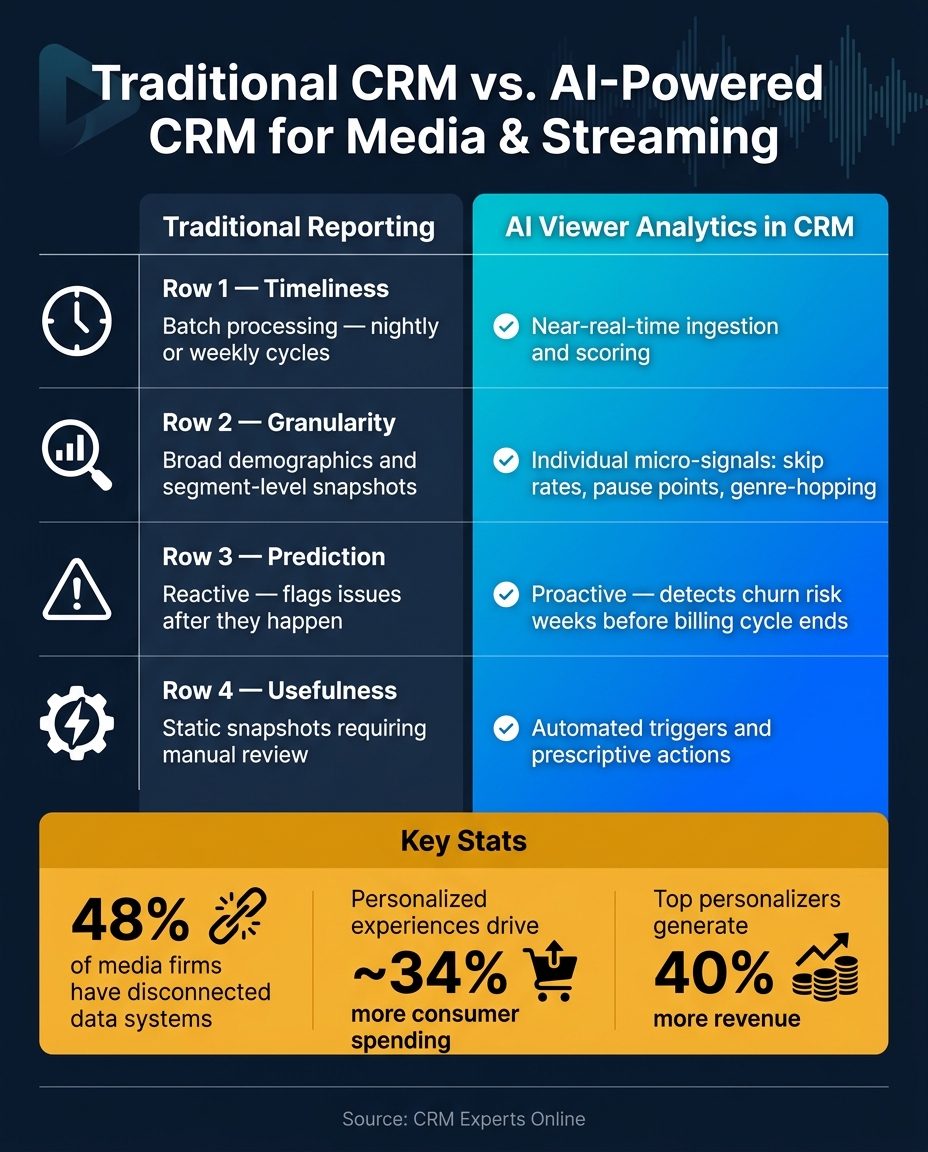
Traditional CRM vs. AI-Powered CRM for Media & Streaming
Once identity is sorted out and data updates fast, CRM can stop acting like a cleanup crew and start driving results. A clean viewer record gives AI what it needs to turn analytics into revenue moves: retention, recommendations, and ad yield. That same record fuels prediction, personalization, and pricing decisions. You can see the difference in four areas:
| Feature | Traditional Reporting | AI Viewer Analytics in CRM |
|---|---|---|
| Timeliness | Batch processing, nightly or weekly cycles | Near-real-time ingestion and scoring [5] |
| Granularity | Broad demographics and segment-level snapshots | Individual micro-signals, including skip rates, pause points, and genre-hopping [8] |
| Prediction | Reactive – flags issues after they happen | Proactive – detects churn risk weeks before a billing cycle ends [7][8] |
| Usefulness | Static snapshots requiring manual review | Automated triggers and prescriptive actions [4][7] |
Behavioral Segments and Churn Prediction
AI groups viewers based on how they watch: watch time, genre affinity, device mix, and login frequency. Then it builds churn scores and upgrade propensity scores for each person, not just for a broad segment.
This is where early warning signs matter. If someone used to open the app every day and now shows up once a week, AI can catch that drop early and trigger a retention offer before the subscription lapses [7]. For ad-supported tiers, it can also trigger a timed upgrade offer for an ad-free plan based on ad-load tolerance and interest in premium catalog titles [4][5].
Content Performance, Ad Yield, and Audience Insights
CRM analytics can show which titles or sports packages connect with certain audience groups and which ones fall flat. That helps shape both programming and ad sales.
With unified first-party data, ad sales teams can go to market with first-party audience segments – adults 25–54 who watch live sports on CTV, for example – instead of leaning on third-party estimates [5][4]. That move from estimation to verification can support stronger CPMs and better inventory pricing. As third-party cookies keep losing relevance, first-party CRM data becomes a main asset for yield optimization [4].
Cross-Channel Journey Orchestration: Email, Push, In-App, SMS, and CTV
AI scores and unified profiles help coordinate journeys across email, push, in-app, SMS, and CTV. A viewer in their first 30 days should get onboarding content, not a renewal offer. A subscriber nearing their billing date with a declining engagement score should get a retention message, not some off-target promotion [5].
AI-powered send-time optimization figures out when each viewer is most likely to engage, and unified data helps keep recommendations tied to recent viewing behavior across devices instead of old activity [7][5]. Used this way, orchestration turns data into repeat engagement instead of random outreach. Companies that get personalization right generate 40% more revenue from those activities than average players [7], and personalized experiences lead consumers to spend roughly 34% more overall [3].
Those actions only work when consent, suppression, and retention rules are built into the CRM. Next, those same actions need privacy controls and rollout rules.
Governance, Privacy, and a Practical Path to Implementation
Cross-channel journeys only work when the data underneath them is clean, approved, and under control. If governance isn’t built into the CRM, personalization can shift from a growth tool to a risk.
Privacy-by-Design Controls Inside the CRM
An AI-powered CRM stores consent inside the viewer record, so opt-outs can stop activation on their own [5][9].
Role-based access controls make sure ad ops, editorial, and subscription teams only see the data tied to their jobs. Audit trails log who viewed or changed records and when. That helps support GDPR and CCPA compliance without slowing down daily work [4][5]. Retention policies also keep data from stacking up for no good reason.
The day-to-day upside is pretty clear: faster data, fewer duplicate records, built-in consent controls, and activation you can trust more [1][5][9].
When consent and access are locked down, the CRM can support deployment without putting the organization in a risky spot.
A Phased Rollout Plan for Media Teams
Rolling out AI CRM in phases is the smart way to do it. With privacy controls already in place, media teams can move step by step without throwing live campaigns off track.
- Audit sources and define identity rules. Start by mapping each first-party source. Then set identity resolution rules that connect anonymous and logged-in sessions across web, mobile, and CTV [5][9].
- Pilot one content vertical and test the unified model. Define the viewer data model, assign field ownership, and run a pilot. This gives teams room to test recommendation models and A/B experiments before a full launch [5].
- Connect core systems, enable AI resolution, and turn on real-time scoring and orchestration. Focus first on high-volume workflows that reduce manual work and mistakes. From there, use AI-powered identity resolution to remove duplicates, then activate real-time scoring and cross-channel journeys based on behavioral signals [5][9][10].
CRM Experts Online supports implementation, automation, and AI integration, so teams can roll this out inside the systems they already use.
FAQs
How does AI match viewers across devices?
AI matches viewers across devices with identity resolution rules that link anonymous and logged-in sessions across web, mobile, and connected TV.
That gives media companies a single customer profile and a persistent record of viewer behavior across screens. CRM Experts Online supports these AI-powered CRM capabilities to help build a single-subscriber view.
What data should be unified first in media CRM?
Start by building one shared customer data foundation. Audit your current sources, assign clear data ownership, and standardize data ingestion so you can fix mismatched schemas and inconsistent consent tagging.
Then bring together the audience signals that matter most: browsing behavior, subscription history, and viewing patterns. When streaming platforms, web analytics, and subscription databases connect, they form a shared viewer profile. That profile makes segmentation more accurate and supports real-time personalization – without forcing a full system overhaul.
How can media teams improve personalization without risking privacy?
Media teams can improve personalization without putting privacy at risk by leaning on first-party data from their own websites, apps, and email campaigns. That cuts dependence on third-party cookies and helps support compliance with standards like the CCPA.
When teams keep customer records unified and compliant, use clear consent tagging, and honor opt-out preferences, they can deliver relevant experiences while building trust.
Related Blog Posts
- How AI Improves CRM Resource Utilization
- How CRM Data Enhances Ad Personalization
- How AI Improves Customer Segmentation in Retail
- AI-Driven Personalization: Overcoming Scalability Barriers

CRM & ERP Enterprise Technology Expert and Entrepreneurial Executive with 20+ years of leading CRM, ERP, Customer Experience, and Block-chain initiatives and projects across internal and customer facing technologies. Proven success in closing large deals in Pre Sales customer facing engagements and deploying enterprise wide CRM & Customer Experience solutions internationally and domestically.