
When planning a CRM project, identifying the right stakeholders is critical to success. Over 70% of CRM failures are caused by team misalignment, and 55% fail to meet goals due to people-related issues. Proper stakeholder involvement can save time, reduce costs, and ensure the system meets user needs. Here’s how:
- Define your CRM vision, scope, and objectives: Set clear goals, success metrics, and governance roles to guide the project.
- Identify stakeholder groups: Include executives, sales, marketing, IT, compliance, and more, ensuring no key perspectives are missed.
- Analyze and prioritize stakeholders: Use tools like the Power-Interest Grid to focus efforts on those with the most influence and interest.
- Gather and document needs: Conduct workshops, map workflows, and prioritize requirements using structured methods.
- Validate and maintain the stakeholder model: Continuously update your stakeholder list and resolve conflicts to keep the project on track.
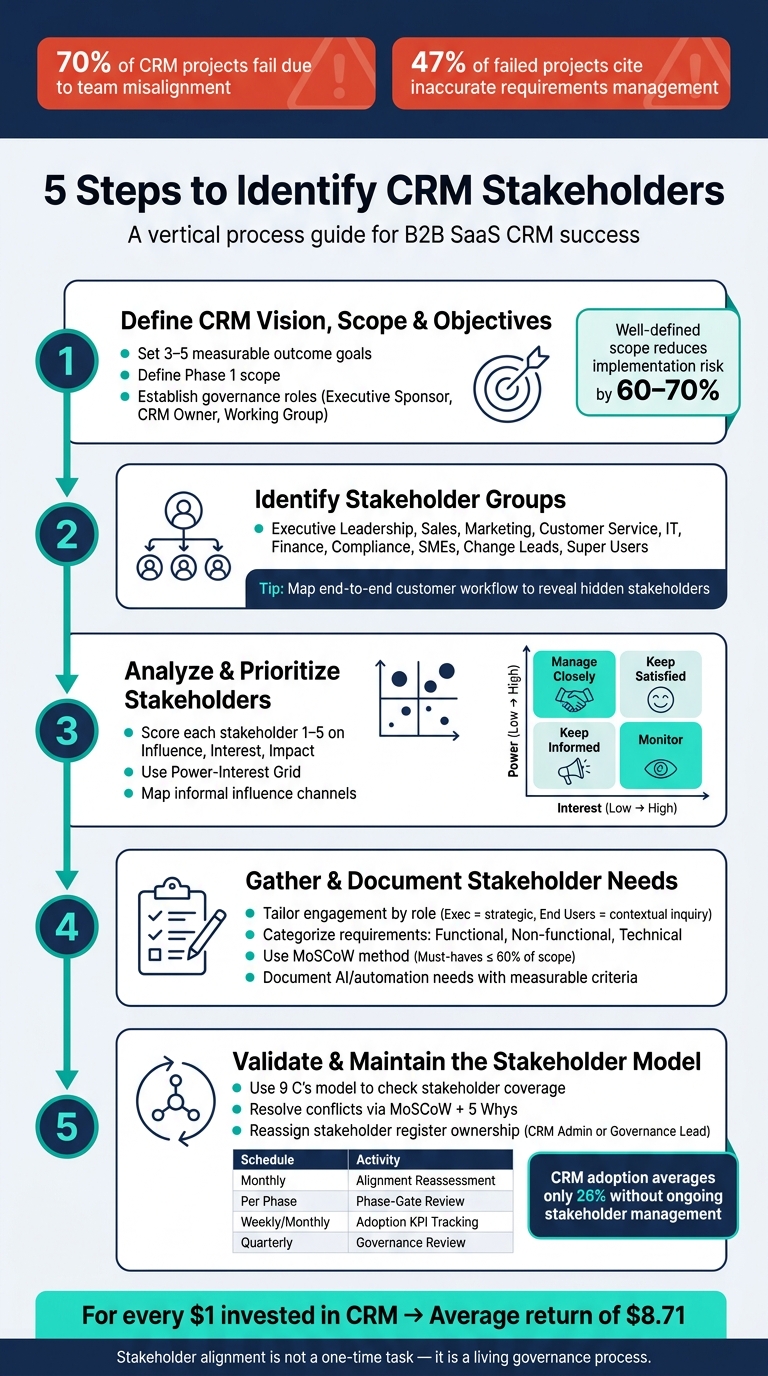
5 Steps to Identify CRM Stakeholders (+ Key Stats)
6 Steps to Stakeholder Assessment & Mapping, with Free Checklist
sbb-itb-f02ae4e
Step 1: Define the CRM Vision, Scope, and Objectives
Before diving into stakeholder identification, it’s crucial to establish clear objectives for your CRM initiative. A well-defined vision ensures the right people are involved from the start.
Set Business Goals and Success Metrics
Start by asking yourself: Why are we implementing or improving this CRM? Pinpoint a specific business challenge – like inconsistent follow-ups, lengthy sales cycles, or disorganized customer data. Once the problem is clear, translate it into measurable outcomes.
Craft 3–5 outcome statements using this format: "We will improve [Metric X] by doing [Action Y], measured by [Metric Z] within [N] days after go-live." For example: "We will improve lead-to-opportunity conversion by 15% through automated lead scoring, measured by pipeline reports within 90 days after go-live" [6].
These goals don’t just guide your CRM strategy – they also reveal which stakeholders to involve. For instance, if you aim to shorten sales cycles, Sales Operations must be at the table. A focus on customer retention? Bring in Customer Success. In essence, your goals double as a stakeholder map.
"The gap between what a business assumes a CRM will do and what the system actually delivers is where most implementations fail." – Tirth Patel, Sr. Business Analyst, SolGuruz [5]
Clarify Project Scope and Constraints
Is this a new CRM implementation, a migration from another system, or an optimization of your current setup? Each scenario comes with its own risks and requires different stakeholders.
Define the boundaries of Phase 1 clearly. This keeps the project focused and avoids scope creep. For example, if a self-service portal isn’t part of the initial rollout, document that decision. Research shows that organizations with well-defined scopes reduce implementation risks by 60–70% [9]. Additionally, companies that allocate 10–15% of their budget to the discovery phase achieve 3–5x higher ROI and 40% faster time-to-value [9].
Don’t forget to audit your existing tech stack early in the process. If your CRM will integrate with systems like an ERP, billing platform, or email tool, IT and data leaders must be involved from the start. Their input isn’t optional – it’s essential.
Set Up Governance Structures
Establish clear accountability for every major decision. Without defined governance, disagreements can derail progress – and they will happen.
At a minimum, set up these three roles before gathering requirements:
| Governance Role | Responsibility | Typical Title |
|---|---|---|
| Executive Sponsor | Approves budget, ensures strategic alignment, removes blockers | CEO, COO, or VP of Sales |
| Product/CRM Owner | Oversees system definitions and daily decisions | Sales Operations Manager |
| Cross-functional Working Group | Aligns departmental processes and contributes requirements | Marketing Leads, Support Managers, IT Director |
A RACI matrix (Responsible, Accountable, Consulted, Informed) is a simple tool to map roles for recurring decisions. Identify the top 10 decisions your team will face – like defining pipeline stages, account ownership, or key data fields – and assign responsibilities to avoid repeated debates. This keeps the project on track [6].
"A CRM rollout succeeds or fails long before the software is configured. Most ‘CRM problems’ are really readiness problems." – Talantir Guides [6]
Once your vision, scope, and governance are in place, you’re ready to identify the stakeholders who will drive your CRM’s success.
Step 2: Identify Stakeholder Groups Across the Organization
With your CRM vision and governance structure in place, the next step is figuring out exactly who needs to be involved. Research highlights that 47% of unsuccessful projects fail due to inaccurate requirements management [2], often because the right voices were left out early in the process. To avoid this, it’s crucial to group stakeholders by their functions to ensure all perspectives are accounted for.
Group Stakeholders by Function
A CRM project impacts multiple departments – there’s no way around it. Here’s how different groups contribute:
- Executive leadership: They define the strategic direction and approve the budget.
- Sales teams: They outline how leads, pipelines, and opportunities should function.
- Marketing: They bring requirements for automation and campaign tracking.
- Customer service: They focus on case management and maintaining customer history.
- IT and data teams: They handle integrations, security, and system architecture while identifying hidden dependencies.
- Finance: They weigh in when CRM overlaps with billing, commissions, or forecasting.
- Compliance officers or Data Protection Officers (DPO): In regulated industries like healthcare or finance, their input is essential.
Additionally, project-specific roles are key to success:
- Subject Matter Experts (SMEs): These individuals translate real-world workflows into system requirements.
- Change Management Leads: They tackle adoption challenges.
- Super Users or "Evangelists": These are the go-to people who champion the system among their peers and provide practical feedback [2][11].
As Brian Gardner, Founder of SalesProcess360, explains:
"There has to be one point person, an executive champion, a person responsible for the success of CRM. In this regard, I call this person the ‘CEO for CRM.’" [11]
Don’t forget external partners – like CRM consultants, third-party integrators, and implementation specialists. They bring an objective, technical perspective that internal teams might lack [11]. By following this structured approach, you can ensure every critical stakeholder is included.
Use Org Charts and Process Maps to Build a Stakeholder List
After defining stakeholder groups, validate your list using visual workflow maps. While org charts show formal authority, a better approach is to map the end-to-end customer workflow – from the first interaction to closing the deal and ongoing service. This method often reveals "hidden" stakeholders, like:
- The coordinator manually updating a shared spreadsheet.
- The operations manager handling exceptions.
- The billing rep reconciling data at the end of the month [12][2].
As Moxo puts it:
"The org chart tells you who has authority. The process tells you who has gravity." [12]
Once you’ve mapped the process, audit existing workarounds within your organization. The people managing these workarounds are often your most critical stakeholders because those workarounds represent undocumented requirements [2]. Compile everything into a stakeholder register – a simple table listing names, departments, roles, and where they fit into the workflow. This document will serve as your go-to reference throughout the project.
Step 3: Analyze and Prioritize Stakeholders
In this step, you’ll evaluate and rank stakeholders based on their influence, interest, and potential impact on the project. Considering that nearly 30% of project failures are tied to poor stakeholder engagement [14], this process is crucial for ensuring success.
Assess Stakeholder Influence, Interest, and Impact
For each stakeholder, determine their ability to influence decisions, the extent to which they are affected by CRM outcomes, and how much their work will be impacted. Using a 1–5 scoring system can help maintain objectivity in this prioritization process [20].
Additionally, assess their attitude toward the project – whether they are supportive, neutral, or resistant. This analysis highlights the "engagement gap", or the difference between their current stance and the level of support needed for project success [15]. For instance, a compliance officer who seems low-interest but is quietly resistant could cause as much disruption as an openly opposed executive.
Direct conversations can be particularly revealing. Questions like "What does project success look like to you?" or "What concerns you most about this project?" can uncover motivations and concerns that might otherwise remain hidden [14].
"Scope creep doesn’t start with a missed requirement. It starts with a missed person." – James McCann, PMP [15]
Map Stakeholders Using Visual Frameworks
The Power-Interest Grid is a practical tool for organizing stakeholders into four categories, each with a tailored engagement strategy:
| Quadrant | Stakeholder Type | Engagement Strategy |
|---|---|---|
| High Power / High Interest | Sponsors, CFO, Sales VP | Manage closely: weekly syncs, direct involvement in key decisions [16][17] |
| High Power / Low Interest | Legal, Compliance, Regulators | Keep satisfied: milestone updates, avoid over-communicating [16][17] |
| Low Power / High Interest | End-users, Frontline Staff | Keep informed: demos, office hours, transparent updates [16][17] |
| Low Power / Low Interest | Peripheral departments | Monitor: minimal updates, watch for position shifts [16][17] |
In more complex scenarios, like a CRM rollout in healthcare or financial services with overlapping governance structures, the Salience Model adds depth by considering two additional factors: legitimacy (the stakeholder’s recognized right to influence the project) and urgency (how immediate their concerns or needs are) [18][19]. Though more detailed, this approach can prevent underestimating stakeholders with low formal power but significant legal or operational roles.
To further refine accountability, the RACI matrix is an excellent complement. It clarifies who is Responsible, Accountable, Consulted, and Informed for each task. As Jane Suchan, PMP at Microsoft, explains:
"Stakeholder management is synonymous with relationship management: the goal is to gain and sustain commitment to your project." [13]
Another critical yet often overlooked step is to map informal influence channels. For example, a senior solutions architect without budget authority might still significantly shape the CIO’s perception of project risks. Identifying these informal "hubs" of influence can be the difference between a smooth rollout and a last-minute roadblock [21].
With stakeholders thoroughly assessed and prioritized, the next step is to dive into documenting their specific CRM needs.
Step 4: Gather and Document Stakeholder Needs
Now that you’ve prioritized your stakeholders, the next step is to extract actionable insights from them and organize this information into a clear, structured format.
Plan Stakeholder Engagement Activities
Different stakeholders require different approaches to uncover their needs effectively. For instance:
- Executive sponsors benefit from concise, strategic discussions that align with high-level goals.
- Process owners need detailed sessions focused on mapping workflows and identifying inefficiencies.
- End users are best engaged through methods like contextual inquiry, where observing their daily tasks can reveal hidden pain points that surveys might miss [2].
When conducting workshops, consider using tools like a "Parking Lot" to capture off-topic issues for later discussion. To streamline decision-making, try dot voting for prioritization. Also, implement a strict no-devices rule during sessions – this alone can boost productivity by as much as 50% [22].
"A CRM project’s value isn’t in its features, but in its ability to change user behavior to improve a core business metric." – AeroLeads [22]
Structure and Prioritize CRM Requirements
Once you’ve gathered input, organize the requirements into three categories:
- Functional: What the system needs to do (e.g., lead conversion workflows, pipeline management).
- Non-functional: Performance standards, like response times under 2 seconds or 99.9% system uptime.
- Technical: Details like architecture, security protocols, and system integrations [2].
For functional requirements, use user stories to clarify needs. For example: "As a sales rep, I want AI-suggested next steps so I can prioritize follow-ups." Then, apply the MoSCoW method to prioritize tasks, ensuring that "must-have" features account for no more than 60% of the project scope. This approach helps avoid scope creep and minimizes the risk of costly defects introduced during the early stages [2].
Finally, ensure that emerging technologies like AI and automation align with these documented requirements.
Account for AI and Automation Needs
AI features such as predictive lead scoring, automated data entry, and next-best-action recommendations are becoming standard in CRM systems [8]. However, these features depend heavily on data quality to function effectively.
To prepare for AI-driven requirements, involve IT and data teams early in the process to conduct an AI readiness assessment. If your data is incomplete, inconsistent, or siloed, AI tools will likely underperform. Treat data cleansing and migration as non-negotiable steps before implementing AI features [10].
When documenting AI requirements, use measurable criteria rather than vague descriptions. For instance, instead of writing "AI-powered insights", specify: "The AI must suggest a next-best action for 95% of open opportunities based on historical win patterns." This level of detail ensures the requirements are testable and holds vendors accountable [2].
"AI is no longer optional. Look for tools that suggest next-best actions, score leads based on likelihood to convert, or surface churn risks based on behavioral trends." – Gestisoft [8]
Step 5: Validate and Maintain the Stakeholder Model
With your requirements in place, the next step is to double-check that nothing has been overlooked and to keep the stakeholder model accurate as the project progresses. This involves verifying that every key stakeholder and their needs are accounted for.
Review Stakeholder Coverage and Requirements
Before diving into configuration, conduct a structured review with your project leads and executive sponsors. The goal is to ensure that all critical roles are represented. To make this process thorough, use the "9 C’s model" – a framework that identifies nine stakeholder categories: Commissioners, Customers, Collaborators, Contributors, Channels, Commentators, Consumers, Champions, and Competitors [23]. This approach helps identify any stakeholders you might have missed during earlier mapping efforts.
During this review, look for requirements that lack measurable criteria. For example, replace vague terms like "user-friendly" with something more specific, such as "dashboard loads in under 2 seconds for 95% of users" [2][5].
"Requirements gathering is the single most leveraged activity in a custom CRM project. Every hour invested here saves many more hours of rework, re-scoping, and retrofit later." – BespokeCRMs Team [2]
Resolve Conflicting Requirements
Conflicting requirements are almost inevitable. For example, sales might prioritize fast lead entry, while compliance insists on detailed data capture. Similarly, IT may prefer lightweight integration, while finance demands a comprehensive audit trail. To address these conflicts, use methods like the MoSCoW framework to rank requirements by priority and the "5 Whys" technique to uncover the root business needs behind each request [2]. Often, you’ll find that different teams are working toward the same goal but from different perspectives.
For conflicts that can’t be resolved at the team level, escalate them to your steering committee.
"Disagreements that surface in a scoping session cost nothing to resolve. The same disagreements surfaced mid-build cost weeks." – SolGuruz [5]
"The steering committee exists to make decisions that the project team cannot make alone. If it is not making decisions, it is not functioning correctly." – James McCann, PMP, Project Management Formula [24]
Document all trade-offs clearly. For instance, if a "Should have" requirement is deferred, note the reason and who approved the decision. This transparency prevents recurring debates later in the project.
Keep Stakeholder Engagement Current Over Time
Once immediate requirements and conflicts are addressed, it’s essential to maintain an up-to-date stakeholder register throughout the project lifecycle. Stakeholders’ roles, priorities, and regulations can shift over time. Poor stakeholder engagement is a common issue, contributing to nearly 30% of project failures [14]. Additionally, CRM adoption rates average just 26% when no one takes responsibility for maintaining the system and its users [3].
Assign a specific individual – such as a CRM Administrator or Governance Lead – to oversee the stakeholder register on an ongoing basis. The table below outlines a practical schedule for maintaining stakeholder alignment:
| Maintenance Activity | Frequency | Responsibility |
|---|---|---|
| Stakeholder Alignment Reassessment | Monthly | Project Manager / CRM Owner |
| Phase-Gate Review | Per Project Phase | Executive Sponsor |
| Adoption KPI Tracking | Weekly/Monthly | Business Analyst |
| Governance & Health Reviews | Quarterly | Steering Committee |
Pay close attention to the first 30 to 90 days after the go-live phase [4]. This period is critical for spotting adoption challenges and addressing incorrect assumptions. If you notice fewer logins, emerging workarounds, or rising complaints, treat this as a signal to revisit and adjust the stakeholder register – not just as a technical issue to fix.
"Stakeholder analysis is not a kickoff exercise. It is a living governance tool." – Profit.co [14]
Conclusion: Aligning Stakeholders for a Successful CRM Project
A successful CRM project starts with a strong foundation of stakeholder alignment. By following the five steps outlined here – defining your CRM vision, identifying and prioritizing stakeholders, analyzing their needs, and continuously validating your approach – you set your project up for success. These steps aren’t just procedural; they can determine whether your CRM becomes a powerful tool for growth or ends up underutilized.
The numbers speak for themselves: over 70% of CRM projects fail due to misalignment across teams [3]. Yet, for every $1 invested in CRM, businesses see an average return of $8.71 [1]. These stats highlight how critical it is to ensure all stakeholders are on the same page with the CRM strategy.
Engaging stakeholders effectively is one of the best predictors of CRM success [2]. Identifying key individuals early, documenting their needs clearly, and addressing potential conflicts before the configuration phase can save time and reduce costs, making the implementation process smoother and more efficient.
For those seeking structured guidance, CRM Experts Online offers consulting services tailored to align technology with your business objectives. Their offerings include stakeholder discovery sessions, business process audits, and AI-driven implementation roadmaps. Prices range from $4,500 for focused audits to $18,000+ for enterprise-level engagements, with CRM selection packages starting at $1,650 [7][25].
"The right CRM becomes your growth engine. The wrong one becomes expensive shelfware." – CRM Experts Online [7]
FAQs
Who should own stakeholder management for a CRM project?
A successful CRM project thrives when there’s an internal champion, often referred to as the "CEO for CRM", steering the effort. This role is usually filled by a sales leader who has a deep understanding of both the company’s business processes and the team’s needs. While a project manager focuses on the technical aspects, close collaboration with this sponsor ensures that the initiative stays aligned with overarching goals. At the end of the day, it’s the business teams – those who own the processes and data – who bear the responsibility for adoption and ongoing governance.
How do I find ‘hidden’ CRM stakeholders outside the org chart?
To find hidden CRM stakeholders, look beyond the official org chart and pinpoint influential individuals who shape processes informally. These might include the people creating workarounds, those who naturally lead training sessions, or individuals who play a critical role during handoffs. Ask targeted questions like, Who else needs to be involved? or Who has the final say on these decisions? Once identified, document their roles – whether they act as influencers, gatekeepers, or something else – in your CRM system. Make it a habit to revisit and update this process to keep your stakeholder map accurate and effective.
How do we handle conflicting CRM requirements between teams?
During the discovery and scoping phase, it’s crucial to address conflicting CRM requirements upfront. Structured sessions – such as workshops or one-on-one interviews – can help capture and document everyone’s needs. These sessions create space to identify discrepancies and align workflows with overarching business goals.
When conflicts persist, consider bringing in an executive sponsor. They can mediate discussions, enforce accountability for data governance, and help prioritize decisions based on the impact on the organization. Sorting out these issues early saves time and money by preventing costly rework later. Plus, it ensures the CRM system is set up to support actual business operations effectively.
Related Blog Posts
- CRM Implementation Checklist: 12 Steps to Success
- 5 Steps for Cross-Functional CRM Onboarding
- Leadership Roles in CRM Change Management
- CRM Change Management: Engaging Key Stakeholders
CRM & ERP Enterprise Technology Expert and Entrepreneurial Executive with 20+ years of leading CRM, ERP, Customer Experience, and Block-chain initiatives and projects across internal and customer facing technologies. Proven success in closing large deals in Pre Sales customer facing engagements and deploying enterprise wide CRM & Customer Experience solutions internationally and domestically.