
CRM retargeting is the process of leveraging first-party data – like email addresses, subscription histories, and content preferences – to re-engage known users with personalized ads. This strategy is especially critical for media companies as third-party cookies become obsolete. Unlike cookie-based tracking, CRM retargeting focuses on real individuals, enabling precise targeting that can boost conversion rates by up to 300%.
Key Takeaways:
- Why It Matters: 98% of media site visitors leave without taking action. CRM retargeting helps bring them back.
- How It Works: Platforms like Google, Meta, and LinkedIn match your CRM data with their user profiles, bypassing cookie limitations.
- Benefits: CRM-driven campaigns convert at 3x the rate of new audiences and extend targeting windows to 90–180+ days.
- Use Cases:
- Re-engage lapsed readers with tailored ads.
- Convert paywall visitors or abandoned checkouts with targeted offers.
- Reduce churn by identifying early signs of disengagement.
Why Now?
With third-party cookies declining, first-party data is now the backbone of effective retargeting. Investing in clean, actionable CRM data ensures your campaigns stay relevant and cost-efficient.
This guide covers everything you need to know – from setting up data infrastructure to launching campaigns and measuring success.
What Is CRM Retargeting?
How CRM Retargeting Works in Media Campaigns
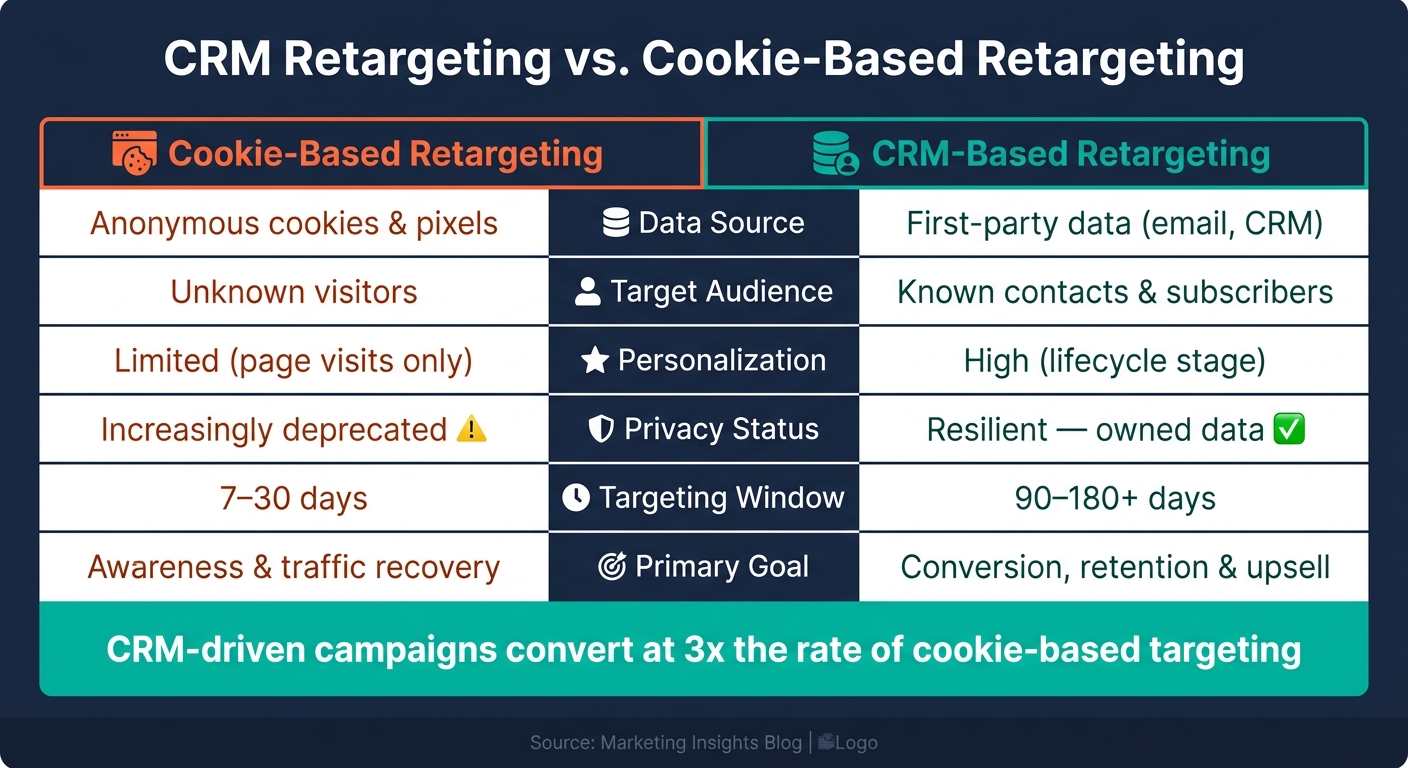
CRM Retargeting vs. Cookie-Based Retargeting: Key Differences
The Mechanics of CRM Retargeting
CRM retargeting uses the first-party data you already have – like email addresses, phone numbers, or subscription IDs – and uploads it to ad platforms such as Google Customer Match, Meta Custom Audiences, or LinkedIn Matched Audiences [4][11]. These platforms match your records with their user profiles, enabling you to target ads specifically to people you already know. This process happens server-side, bypassing issues like cookie blocking or ad blockers entirely [10]. For platforms like TikTok, however, you’ll need at least 1,000 matched users before starting a CRM-based campaign [11].
Once matched, you can create audience segments based on real actions. For instance, you can target users who frequently visit pricing pages, engage with premium content but haven’t subscribed, or even former subscribers who recently canceled. Each group gets tailored messaging instead of generic ads, making it easier to achieve specific goals.
Business Goals for CRM Retargeting in Media
With these mechanics in place, media companies can focus on three main objectives: growing subscriptions, boosting engagement, and reducing churn. By turning dormant user data into actionable insights, CRM retargeting helps maximize revenue potential.
For subscription growth, the aim is to reach "hand raisers" – those who visited your pricing page, started filling out a subscription form but didn’t finish, or repeatedly hit paywalls [2][11]. These users have shown interest and might just need a well-placed nudge, like a limited-time discount or a clearer explanation of your value.
When it comes to engagement, CRM retargeting helps identify early-stage readers who haven’t yet committed. By serving them awareness-focused content or personalized editorial suggestions, you can keep your brand in their minds as they explore their options [4][9]. Sean Nowlin, CEO of SpotlightIQ, emphasizes the importance of this approach:
"Strong CRM data is nonnegotiable… Understanding who your prospects are and bringing them into your digital funnel early in the buying journey using placements as powerful as TV ads is a smart move." [8]
Reducing churn is another area where CRM retargeting shines. AI-driven CRM systems can identify early warning signs of disengagement, such as fewer logins, shorter session times, or ignored emails. A timely win-back campaign or personalized content recommendation can help turn things around. As Nick Nickolovski, CEO of Vector Labs, explains:
"By the time a subscriber hits the cancel button, you’ve already lost the argument. The decision was made days or weeks earlier. It happened quietly, in the gap between logins." [14]
CRM vs. Cookie-Based Retargeting
The key difference between CRM and cookie-based retargeting lies in how data sources impact campaign effectiveness and longevity. While cookie-based retargeting relies on anonymous tracking through browser pixels, CRM retargeting uses first-party data for a more precise, lifecycle-focused approach [7][11].
Cookie-based retargeting typically lasts 7–30 days and struggles with browser updates, whereas CRM retargeting can extend to 90–180+ days – perfect for subscription cycles that take longer to convert [7]. Here’s a quick comparison:
| Dimension | Cookie-Based Retargeting | CRM-Based Retargeting |
|---|---|---|
| Data Source | Anonymous cookies & pixels | First-party data (email, CRM) |
| Target Audience | Unknown visitors | Known contacts & subscribers |
| Personalization | Limited (page visits) | High (lifecycle stage) |
| Privacy Status | Increasingly deprecated | Resilient (owned data) |
| Typical Window | 7–30 days | 90–180+ days |
| Primary Goal | Awareness & traffic recovery | Conversion, retention & upsell |
For media companies, the durability of first-party data makes it a critical tool for retargeting. It’s immune to the disruptions caused by browser privacy changes and platform updates [4][7]. Niklas Kreck, Founder of Leadanic, puts it succinctly:
"Those building first-party data now and implementing server-side tracking set themselves apart from competitors still hoping for third-party cookies." [7]
For future campaigns, this resilience isn’t just helpful – it’s the backbone of successful retargeting strategies.
Building a CRM Data Infrastructure for Media Retargeting
To make CRM retargeting work, you need clean, connected, and actionable data. Before launching any campaigns, it’s crucial to set up an infrastructure that consolidates subscriber data from multiple sources, resolves identities across devices, and complies with U.S. privacy regulations. The first step? Identifying the key data sources that will fuel your retargeting efforts.
Key Data Sources for Media CRM Retargeting
Accurate and unified data is the backbone of effective CRM retargeting. Media companies often hold large amounts of data, but it’s scattered across various systems. Here’s a snapshot of what you might already have:
- Subscription Platforms: Information like subscription tiers, renewal dates, and billing history.
- Content Interaction Logs: Metrics such as page views, scroll depth, and video completion rates.
- Email Platforms: Data on email opens, clicks, and periods of inactivity.
- Customer Support Systems: Insights from ticket history, sentiment analysis, and recent customer issues.
One major hurdle? More than 80% of publisher traffic is typically anonymous [17]. Without connecting the dots, you can’t directly target much of your audience. A unified customer data layer – often built using a Customer Data Platform (CDP) or cloud data warehouse – brings all these pieces together into one cohesive subscriber view, enabling meaningful segmentation.
| Key Data Source | Data Points Collected | Retargeting Application |
|---|---|---|
| Subscription Platforms | Tier, renewal date, billing history | Churn prevention, renewal reminders, upsells |
| Content Interaction Logs | Page views, scroll depth, video completion | Content affinity scoring, dynamic paywalls |
| Email Engagement | Opens, clicks, inactivity duration | Re-engagement sequences, newsletter personalization |
| Customer Support | Ticket history, sentiment, recent incidents | Retention offers, personalized support outreach |
How to Prepare and Segment CRM Data
Once you’ve identified your data sources, the next step is to clean and unify them. Start with an audit of all data fields in your CRM, email, and billing systems to uncover any gaps. Then, normalize your records – standardize email formats, remove unnecessary spaces, and apply SHA-256 hashing to protect personal information before it leaves your environment [19].
Segmentation is where the magic happens. Group your audience based on engagement and lifecycle stages. For example, frequent readers who hit your paywall multiple times belong in a different segment than someone who opened a newsletter six months ago. Publishers using CRM-driven dynamic paywalls – adjusting free content limits based on user engagement – have seen 15–30% increases in subscription conversion rates [17].
One often-overlooked step? Automate your suppression lists. As soon as someone converts, they should be removed from retargeting campaigns. This prevents wasted ad spend and avoids irritating new subscribers with irrelevant ads.
Here’s a real-world example: In 2026, French media group Bayard (publisher of La Croix and Astrapi) replaced its traditional DMP with the DinMo composable CDP. By connecting it directly to their data warehouse, they excluded current subscribers from acquisition campaigns, built lookalike audiences, and set up platform connections in under an hour. This saved time and boosted their acquisition performance [15].
"Our mission is to make business teams fully autonomous when it comes to activating their data." – Oussama Ghanmi, CEO, DinMo [15]
Once your manual segmentation is complete, advanced AI tools can take it to the next level by refining audience groups in real time.
Using AI in CRM for Media Retargeting
Manual segmentation lays the groundwork, but AI can uncover patterns you might miss. By analyzing browsing habits, engagement levels, and content preferences, AI can identify high-conversion clusters that aren’t immediately obvious [21]. It also enables real-time updates between your CRM and ad platforms – syncing as often as every 15 minutes – eliminating the delays and errors of weekly manual exports [20].
Predictive modeling is another game-changer. AI can flag subscribers at risk of canceling 30–60 days before they churn, triggering retention ads early enough to make a difference [20]. On the acquisition side, automated bid modifiers can focus your budget on the most promising leads, increasing bids for high-scoring prospects by 200–300% [20]. Businesses using integrated CRM-advertising systems report 34% higher conversion rates and 27% lower acquisition costs on average [20].
For media companies with constantly evolving content, it’s essential to retrain AI models weekly to keep recommendations accurate [16]. While this requires ongoing effort, the payoff is a stronger foundation for advanced retargeting strategies.
CRM Retargeting Strategies for Media Companies
With detailed CRM data segmentation ready to go, it’s time to apply targeted strategies tailored to different audience tiers. These approaches align with key goals for media companies: re-engaging disengaged readers, converting paywall visitors into subscribers, and keeping streaming audiences engaged.
Re-Engaging Lapsed Visitors and Readers
Bringing back lapsed readers is essential. Returning visitors are two to three times more likely to convert than first-time visitors [5], making this group a valuable focus.
Start by dividing your lapsed audience based on their intent and apply frequency caps. For instance, upload hashed email lists from your CRM into platforms like Meta, Google, or LinkedIn [4]. Limit exposure to 3–5 impressions per week over a 31–90 day recency window for those showing cooling interest. Once someone re-subscribes or converts, immediately remove them from this segment to avoid redundancy.
Creativity in messaging is just as important as precise targeting. Avoid repetitive ads – opt for a short sequence instead. Begin with a top-performing story, follow up with a reader testimonial or editorial highlight, and finish with a low-barrier offer like a free newsletter or trial. Darren Lee, Principal Digital Marketing Strategist at Zenith Digital Group, explains it perfectly:
"Retargeting isn’t about convincing someone new; it’s about reminding someone who already knows you." [3]
From here, shift your focus to converting high-intent users who encounter paywalls or abandon subscriptions.
Paywall and Subscription Conversion Campaigns
While re-engaging past readers is crucial, converting users who show strong intent – like those hitting a paywall or abandoning a checkout – is just as important. These moments signal high conversion potential. In fact, segmented retargeting campaigns can boost click-through rates by 76% and conversions by 147% [12].
Tailor your approach to the specific drop-off point. For paywall visitors, emphasize editorial value and social proof. For those abandoning at checkout, address potential barriers by highlighting security, simplifying the process, or offering a short trial.
Use a 7–10 day window with 2–4 daily impressions to target users right after they drop off [2]. After this initial period, scale back to 1–2 impressions per day for up to three weeks for those who still haven’t converted. Synchronizing messaging across platforms – like pairing a follow-up email with a matching Instagram or Google Display ad – can amplify results.
| Audience Tier | Intent Level | Recommended Message | Frequency |
|---|---|---|---|
| Paywall Hitters | High | Editorial value, reader testimonials, trial offer | 2–4 impressions/day (7–10 days) |
| Checkout Abandoners | Very High | Simplified pricing, security features, friction removal | 2–4 impressions/day (7–10 days) |
| Repeat Section Readers | Mid | Content-specific value, section highlights | 1–2 impressions/day (14–21 days) |
| Active Subscribers | N/A | Exclude from acquisition; focus on upsells | – |
When done right, retargeting campaigns can recover 10–15% of lost subscription sign-ups [3], making it a lucrative strategy for media companies.
Content-Based Retargeting for Streaming Platforms
Streaming platforms have a wealth of behavioral data – like watch history, completion rates, genre preferences, and device usage – that can be combined with CRM data to create highly targeted campaigns.
Segment your audience based on engagement levels. For example, users who watch 50–75% of a video are ideal for ads promoting "new episodes" or "season finales." Those exploring multiple genres in one session may respond well to curated recommendations. For viewers who’ve been inactive for 30+ days, a win-back campaign featuring new releases or tailored "pick up where you left off" messages can work wonders.
For ad-supported tiers, use CRM viewership data to identify prime moments for promoting an ad-free upgrade – like after a user streams a high volume of content. Dynamic ads referencing specific titles a user has watched can boost click-through rates by up to 70% compared to static ads [3]. To ensure efficiency, deploy server-side tracking tools (like Meta’s Conversions API) to feed viewership data directly from your backend into ad platforms [10]. Once a user upgrades or completes a series, exclude them from further campaigns to avoid wasting ad spend.
sbb-itb-f02ae4e
Activating CRM Segments Across Channels
After setting up your CRM data and segmentation strategies, the next step is putting those segments to work across different channels. This is where you turn audience engagement into measurable results. Activating CRM segments effectively means reaching your audience at the right time, on the right platform, with consistent messaging powered by real-time data. In fact, CRM-advertising systems using AI report 34% higher conversion rates and 27% lower cost per acquisition [20]. Below are actionable tactics tailored to specific channels to help you make the most of your CRM segments.
Channel-Specific Activation Tactics
Each marketing channel brings unique opportunities, so your approach should align with the strengths of each one:
- Social platforms (like Meta and TikTok): Upload hashed CRM lists to create Custom Audiences. This strategy helps you target your most valuable users with precision.
- Search ads: Use Remarketing Lists for Search Ads (RLSA) and Google’s Customer Match to bid more aggressively on broad keywords when a known subscriber or past visitor is searching. Google now allows Customer Match on search campaigns with as few as 100 users [6].
- Display ads: Dynamic remarketing enables you to serve ads featuring content or subscription tiers that users have already interacted with. These ads achieve click-through rates up to 10 times higher than standard display ads [6].
- Email and push notifications: These are best for users already in your ecosystem. Retargeted users engage with emails 40% more often than cold leads [5]. Triggered sequences tied to CRM events, like a lapsed user’s last login, can drive re-engagement.
- Direct mail: For high-value prospects who don’t respond to digital outreach, some teams use REST APIs to send personalized postcards, adding a tangible touchpoint [18].
One essential rule across all channels: once a user converts, remove them from acquisition segments immediately. Shift them into retention or upsell flows to avoid wasting ad spend or sending redundant messages [5][18].
| Channel | Activation Tactic | Best Use Case |
|---|---|---|
| Social | Custom/Matched Audiences | Prospecting with high-LTV subscriber lists [4][22] |
| Search | RLSA & Customer Match | Bidding on broad keywords for known past visitors [6] |
| Display | Dynamic Remarketing | Showing specific content previously viewed [6] |
| Triggered Sequences | Re-engaging lapsed readers based on CRM events [5] | |
| Direct Mail | API-Triggered Postcards | Reaching high-value leads unresponsive to digital [18] |
Once your segments are active, the next step is to focus on sequencing your creative to guide users through their journey.
Sequencing Creative and Offers
Using the same ad repeatedly over a month can drain your budget and annoy your audience. Instead, adapt your messaging as users progress through their journey. A phased approach works well:
- Phase 1 (Days 1–3): Start with gentle reminders that highlight the content or offer the user showed interest in. Avoid pushing for a sale at this stage [24].
- Phase 2 (Days 4–10): Add social proof, editorial highlights, or testimonials to address any doubts or hesitation [23][24].
- Phase 3 (Days 11–21): Use direct calls to action with urgency, such as limited-time discounts, free trials, or simplified pricing [23][24].
This sequenced strategy can double conversion rates compared to single-message campaigns [24]. Match your landing pages to the user’s stage in the journey: early-stage traffic should go to content hubs or editorial showcases, while late-stage users should be sent directly to pricing or checkout pages [23].
"Retargeting strategy 2026 is not about following every site visitor around the internet until they surrender. It is about deciding which warm prospects deserve another touch, in which channel, with which message, and for how long." – Prose Media [2]
Retargeting Windows and Frequency Management
The length of your retargeting windows and the frequency of your ads should align with user intent and your sales cycle. For high-intent actions, like visiting a subscription pricing page, a short window of 1–7 days with 2–4 daily impressions keeps your brand top of mind while interest is fresh [23]. For broader awareness campaigns, a 14–30 day window with 2–5 weekly impressions is enough to maintain visibility without overloading users [2][1].
To avoid ad fatigue, cap total ad exposure at 4–6 impressions per user within a given window [5]. Performance tends to peak at 5–7 impressions per week but drops sharply after 12–15 exposures [24]. For smaller CRM segments with fewer than 2,000 events per week, consolidate them into broader 30-day windows to ensure consistent delivery [1]. Also, keep your Customer Match lists updated. Google enforces a 540-day maximum membership duration, so regular updates (monthly or quarterly) are essential to maintain eligibility [6].
Measuring and Optimizing CRM Retargeting Campaigns
To truly understand what drives success in CRM retargeting, it’s crucial to measure performance across three layers: platform truth (conversions tracked within the platform), business truth (metrics like revenue quality and close rates), and incremental truth (determining if ads genuinely influenced a conversion or simply claimed credit for an organic one) [2]. These layers provide the foundation for interpreting the key metrics outlined below.
Key Metrics for CRM Retargeting in Media
When it comes to CRM retargeting, metrics are grouped into three main categories:
- Subscription/Conversion Metrics: These include conversion rates, revenue recovery, and ROAS (Return on Ad Spend). For example, retargeting users who abandoned sign-ups can recover 10–30% of lost revenue [26].
- Engagement Metrics: Metrics like dwell time (over 60 seconds), pages per session, and video view percentages (50% or higher) help identify users who are most likely to take action.
- Efficiency Metrics: Blended CAC (Customer Acquisition Cost), CPL (Cost Per Lead), and CPA (Cost Per Acquisition) track cost-effectiveness. Retargeting campaigns often reduce CPA by 40–70% compared to targeting cold audiences [27].
Attribution and Incrementality Testing
One common mistake in retargeting is relying solely on platform-reported conversions. Retargeted users are already familiar with your brand, and many may convert even without seeing an ad. Studies show that 20–40% of retargeting conversions are often non-incremental [13]. To avoid overestimating results, consider these testing methods:
- Holdout Testing: Exclude 10–20% of your CRM segment from ads to compare their organic conversion rates with those of the exposed group [2][13]. If the difference is small, it may signal overspending on retargeting.
- Geo-Based Testing: For programmatic and search campaigns, pause ads in specific regions for 2–4 weeks to measure the true lift in conversions [13].
- Server-Side Tracking: Tools like Meta’s Conversions API or Google Enhanced Conversions help maintain accurate tracking as browser-based signals become less reliable [27][13].
"Every retargeting dollar that’s non-incremental is a dollar you could have spent on acquisition." – Rabah Rahil, Growth Lead, FERMÀT [13]
AI-Driven Campaign Optimization
AI technology takes CRM retargeting to the next level by refining audience targeting and enhancing creative testing. Here’s how:
- Audience Optimization: AI can analyze your CRM contacts and predict user intent, helping you focus your budget on those most likely to churn, renew, or upgrade [4]. For prospecting, high-value CRM segments – like long-term subscribers – can act as "seed" audiences, enabling AI to find similar users with shared behaviors [4][28].
- Creative Optimization: AI-powered tools dynamically assemble ads using headlines, images, and content feeds. This ensures that messaging aligns with users’ prior interactions, replacing slow manual A/B testing with continuous, real-time adjustments [6][25].
- Real-Time Syncing: Automated data bridges prevent wasted ad spend by ensuring you don’t target users who have already converted [4].
Compliance and Workflow Best Practices
Privacy and Consent Management
The privacy landscape in the U.S. has shifted significantly. By June 2026, 20 states have enacted comprehensive privacy laws, and enforcement has become a reality. For instance, in September 2025, regulators from California, Colorado, and Connecticut conducted their first joint investigative sweep targeting companies that ignored opt-out signals [29]. For media companies running CRM retargeting campaigns, compliance is no longer optional – it’s a core operational priority.
Currently, 12 states, including California, Texas, Colorado, Connecticut, and Maryland, mandate businesses to honor the Sec-GPC: 1 header as a valid opt-out signal. Implementing both server-side and client-side detection of this signal ensures compliance with the Universal Opt-Out Mechanism (UOOM) across these states [29].
In addition to honoring opt-out signals, companies must secure explicit opt-in consent for using sensitive personal information (SPI) in retargeting efforts. SPI includes data like precise geolocation, health details, and racial or ethnic origin [29][30]. The California Privacy Protection Agency‘s Q2 2026 guidance outlines specific requirements for handling such data, with enforcement starting in October 2026 [30].
"The Q2 2026 guidance moves CPRA from abstract obligation to concrete configuration. Advertisers running default 2024 audience setups should treat the October enforcement window as a hard deadline." – AuditSocials California privacy brief [30]
On the vendor side, updating data processing addenda (DPAs) with retargeting partners is now critical. These agreements must specify "limited and specified" activities, as generic terms like "any business purpose" no longer meet legal standards under the IAB’s Multi-State Privacy Agreement (MSPA), effective June 2, 2026 [31]. As Michael Hahn, IAB’s General Counsel, explained:
"It is no longer practical to take a state-by-state approach to compliance… The MSPA makes nationwide compliance with state privacy laws more efficient and scalable." [31]
Strong privacy practices lay the foundation for effective team collaboration in CRM retargeting.
Team Workflows for CRM Retargeting
Once compliance measures are in place, establishing clear team workflows is essential for maintaining data accuracy and ensuring campaign success. Well-defined roles prevent issues like outdated audience lists, missed suppression lists, or compliance oversights. Here’s a breakdown of key responsibilities that should be assigned before launching any campaign:
| Role | Responsibility | Main Task |
|---|---|---|
| Revenue Ops | Commercial Strategy | Approving segment definitions and audience logic |
| Data Engineering | Technical Pipeline | Handling PII normalization, SHA-256 hashing, and server-side ingestion |
| Ad Ops | Campaign Execution | Managing deal setup, line-item targeting, and audience size QA |
| Legal & Privacy | Compliance | Validating consent and reviewing vendor contracts |
| Security | Data Protection | Rotating API keys, maintaining audit logs, and enforcing access controls |
The CRM should function as the single source of truth for all contact data. When a user converts, withdraws consent, or subscribes, those updates should automatically trigger or suppress related ad campaigns without manual intervention [18][5]. Automating suppression lists in real time not only reduces wasted ad spend but also builds trust with your audience.
Data security is equally critical in this workflow. Teams managing CRM data for retargeting must use service accounts with rotated API keys and two-factor authentication (2FA). Access should follow a least-privilege model [19]. Additionally, automated data exports – scheduled nightly or hourly – can keep audience lists updated without exposing sensitive data through manual file uploads [4].
How CRM Experts Online Supports Media Retargeting
With compliance and workflows in place, the right CRM partner can take your retargeting efforts to the next level. CRM Experts Online specializes in enterprise CRM solutions designed for organizations that demand more than just contact storage. Their tools power compliant, high-performing retargeting campaigns, offering features like server-side data pipelines and automated audience syncing across platforms like Meta, Google, and programmatic networks.
Their AI-driven integration services go beyond static audience lists. By embedding predictive models directly into the CRM, CRM Experts Online enables real-time audience scoring. This ensures your retargeting budget targets users most likely to subscribe, renew, or re-engage, instead of spreading resources across an entire lapsed-visitor list. Additionally, their automation tools seamlessly handle suppression logic, removing converted users from active campaigns as soon as a transaction is recorded.
For teams navigating the compliance challenges discussed earlier, CRM Experts Online offers implementation and consulting services that include built-in consent management workflows and data governance protocols. Whether you’re a regional publisher or a large streaming platform managing millions of records, their solutions provide the infrastructure you need to stay compliant and effective.
Conclusion and Key Takeaways
CRM retargeting has shifted from being optional to becoming a critical tool for media companies looking to drive growth. The numbers speak volumes: retargeted customers are 70% more likely to convert than new visitors [32], and campaigns powered by CRM data cost 77% less than cold acquisition efforts [32]. On top of that, businesses with advanced first-party data strategies often achieve 25–35% better ROAS [5]. For publishers, streaming platforms, and digital media brands navigating shrinking budgets and the challenges of a cookieless world, these stats underscore the necessity of tapping into first-party data.
Unlike cookie-based approaches that rely on tracking anonymous users, CRM retargeting focuses on known individuals – like a reader who checked out your pricing page, a trial user who stopped engaging, or a subscriber nearing renewal. This level of precision ensures your ad spend goes toward meaningful interactions rather than wasted impressions.
"CRM retargeting isn’t just another marketing tactic – it’s a strategic way to maximize the value of every lead that enters your database." – Salesso [32]
To build an effective CRM retargeting strategy, three key principles stand out:
- Segment by intent, not just recency: A visitor exploring your pricing page has different needs than a lapsed reader. Tailor your messaging accordingly.
- Automate critical processes: Real-time syncing, suppression logic, and consent management help ensure campaigns remain efficient and accurate.
- Measure what drives results: Metrics like subscription starts, renewal rates, and cost per acquisition provide a clearer picture of success than click-through rates.
"Those building first-party data now and implementing server-side tracking set themselves apart from competitors still hoping for third-party cookies." – Niklas Kreck, Founder, Leadanic [7]
Media companies that treat their CRM as a dynamic, intelligent audience engine – delivering compliant, high-intent segments to every paid channel in real time – can turn CRM retargeting into a long-term competitive edge.
FAQs
What minimum CRM data do I need to start retargeting?
To kick off CRM retargeting, the bare minimum you’ll need is an email address for each contact in your list. This allows you to match your records with advertising platforms. However, adding more identifiers – like full names and phone numbers – can significantly boost match rates.
Before uploading your data, make sure it’s cleaned up. This means removing duplicates, invalid entries, and contacts who haven’t opted in. Not only does this help with privacy compliance, but it also ensures better campaign performance. Ideally, you should have a list with at least 1,000 subscribers to see meaningful results.
How do I stay compliant with US privacy laws in CRM retargeting?
When it comes to CRM retargeting in the U.S., staying compliant with privacy laws is all about prioritizing transparency, consent, and responsible data management. Here’s how to approach it:
- Follow State Laws: Regulations like the California Consumer Privacy Act (CCPA) set the standard. Make sure your practices align with these requirements.
- Use Opted-In Contacts Only: Your CRM list should include ONLY individuals who have explicitly given their consent to be contacted.
- Respect Opt-Out Requests: Always honor opt-out requests, including those flagged through tools like Global Privacy Control (GPC).
- Implement Server-Side Consent Systems: These systems help you maintain user preferences consistently across platforms, ensuring compliance and building trust.
For businesses looking to simplify these processes, CRM Experts Online provides AI-driven tools designed to handle compliance efficiently and effectively.
How can I prove retargeting actually caused more subscriptions?
To demonstrate that retargeting directly contributed to new subscriptions, it’s essential to look beyond basic click-through metrics. One effective approach is incrementality testing. Tools like Meta’s Conversion Lift or other third-party platforms allow you to run holdout tests. These tests compare revenue generated by ads to what might have occurred naturally, without ad influence.
Another key step is integrating your CRM with ad platforms. This enables you to track post-click conversions and attribute value to completed subscriptions. By doing this, you can clearly connect your marketing spend to the actual profit it generates.
Related Blog Posts
- How CRM Data Enhances Ad Personalization
- AI in Cross-Channel Retargeting: How It Works
- How AI Improves Customer Segmentation in Retail
- How Behavioral Targeting Platforms Improve Retargeting

CRM & ERP Enterprise Technology Expert and Entrepreneurial Executive with 20+ years of leading CRM, ERP, Customer Experience, and Block-chain initiatives and projects across internal and customer facing technologies. Proven success in closing large deals in Pre Sales customer facing engagements and deploying enterprise wide CRM & Customer Experience solutions internationally and domestically.