
Social media metrics can transform how businesses manage customer relationships.
By integrating these metrics into CRM systems, companies gain a complete view of customer interactions across platforms. This helps sales teams identify prospects, equips support teams with full customer histories, and enables marketing teams to deliver personalized campaigns.
Key Takeaways:
- Why it matters: 70% of social followers are likely to buy, and 64% prefer messaging businesses on social media.
- Top metrics: Engagement rates, conversion rates, sentiment analysis, reach, and ROI.
- CRM benefits: Unified customer profiles, faster responses, lead scoring, and automated workflows.
- Impact on business: Better customer retention, improved campaign results, and increased revenue.
Social media metrics are no longer just numbers – they’re tools that directly link to business growth.
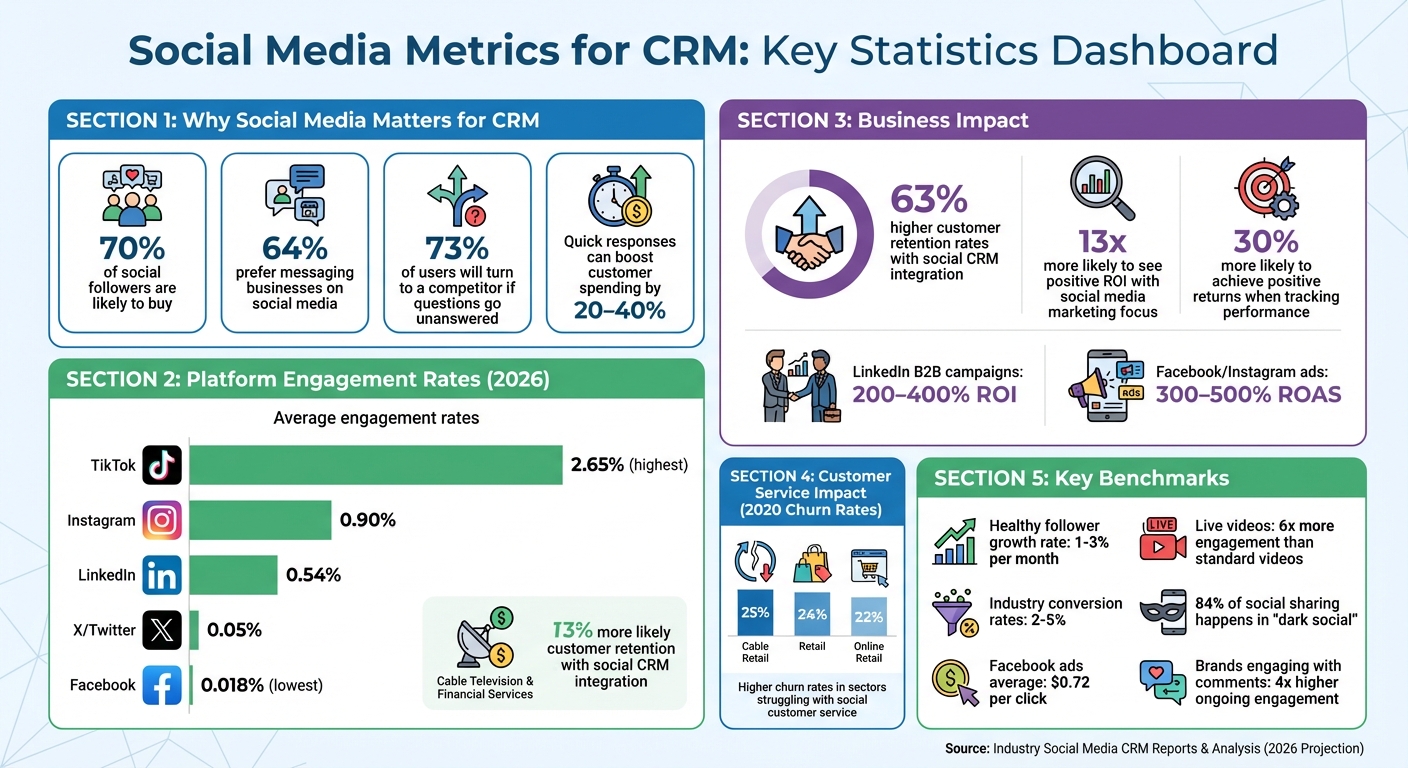
Social Media Metrics for CRM: Key Statistics and Platform Performance
SOCIAL MEDIA ANALYTICS | Complete Guide to Understand Your Metrics
sbb-itb-f02ae4e
Key Social Media Metrics for CRM Success
Tracking the right metrics can turn social media data into insights that directly impact CRM performance. When these measurements align with your CRM strategy, they connect to outcomes like better customer engagement, audience growth, and increased revenue. At CRM Experts Online, we focus on using these metrics to refine strategies, improve customer relationships, and achieve long-term growth.
Engagement Metrics
Engagement metrics show how actively your audience interacts with your content. They go beyond simple numbers, offering a deeper look at what resonates with your CRM prospects.
Key engagement indicators include likes, comments, shares, saves, and retweets. Each action signals a different level of interest. For instance, a like might show passive approval, while a share suggests your content is valuable enough for someone to recommend to others. Saves indicate users want to revisit your content later.
Video content requires special attention. Metrics like completion rate and average watch time reveal how engaging your videos are. If you see high views but low watch times, your content might need improvement. On the other hand, strong completion rates suggest your audience is engaged. Live videos, in particular, drive 6x more engagement than standard videos [3].
Engagement rates also vary by platform. As of 2026, TikTok leads with a 2.65% average engagement rate, followed by Instagram at 0.90%, LinkedIn at 0.54%, X/Twitter at 0.05%, and Facebook at 0.018% [4]. Knowing these benchmarks can help set realistic goals and spot underperforming content.
Customer service metrics tied to engagement also play a role in CRM retention. Metrics like average reply time, total response volume, and Customer Satisfaction Scores (CSAT) measure the quality of service offered through social platforms. Poor customer service had a significant impact in 2020, with churn rates reaching 25% in cable television and financial services, 24% in retail, and 22% in online retail [6].
While engagement is critical, understanding audience growth and reach is just as important.
Audience Growth and Reach
Metrics like growth and reach focus on the broader expansion of your audience, providing insight into the success of your awareness strategies.
The follower growth rate is calculated by dividing new followers by total followers, then multiplying by 100. For established accounts, a healthy rate usually falls between 1% and 3% per month [3]. A lower rate might signal that your content isn’t attracting enough new followers, while a higher rate points to strong momentum.
"Reach" refers to the unique users who see your content, while "impressions" measure the total number of views. Comparing these metrics helps you understand how often the same users are seeing your posts, which can reinforce your message during the consideration phase of the CRM journey.
Demographics like age, location, and interests within your reach data can help refine CRM segmentation. This information enables you to target new audience groups, improve lead generation, and ensure your content aligns with your ideal customer profile. Additionally, tracking audience retention – the percentage of followers who stay over time – offers insight into content effectiveness. A declining retention rate could indicate that your strategy isn’t keeping long-term interest.
Conversion and ROI Metrics
Conversion metrics directly link social media efforts to revenue, proving their value and guiding budget decisions.
The conversion rate measures the percentage of users who complete a desired action – like making a purchase, signing up, or downloading – after interacting with social content. For most industries, conversion rates range from 2% to 5% [10]. Using UTM parameters on social links helps identify which posts and campaigns are driving these conversions.
Customer Acquisition Cost (CAC) is calculated by dividing total marketing expenses by the number of new customers acquired. This metric evaluates how cost-effective your campaigns are. For example, Facebook ads average $0.72 per click [5], but CAC also includes costs like creative development, management, and tools.
Customer Lifetime Value (CLV) estimates the total revenue expected from a single customer acquired through social media. Calculating CLV (average order value multiplied by purchase frequency) helps prioritize high-value CRM leads and set sustainable acquisition budgets.
Return on Investment (ROI) offers a full view of financial performance. It’s calculated by subtracting costs from revenue, dividing by costs, and multiplying by 100. Companies that focus on social media marketing are 13 times more likely to see a positive ROI [10], and those that track performance are 30% more likely to achieve positive returns [10].
For B2B organizations, lead quality matters as much as quantity. Monitoring conversion rates for Marketing Qualified Leads (MQL) and Sales Qualified Leads (SQL) helps measure how well social traffic aligns with your target audience. For example, well-planned LinkedIn campaigns in B2B technology often achieve ROI between 200% and 400% [7].
| Metric | Formula | What It Tells Your CRM |
|---|---|---|
| Social Media ROI | (Revenue – Costs) / Costs × 100 | Financial value of social media efforts [8] |
| CAC | Total Ad Spend / New Customers | Efficiency of acquiring new CRM contacts [9] |
| Conversion Rate | (Conversions / Total Clicks) × 100 | Effectiveness of social traffic in achieving goals [8] |
| CLV | Avg Order Value × Purchase Frequency | Long-term profitability for CRM segmentation [9] |
| Cost Per Lead | Total Spend / Qualified Leads | Efficiency of lead generation for B2B [9] |
Attribution modeling helps determine which social interactions contribute most to conversions. First-touch attribution credits the initial interaction, while last-touch focuses on the final one. Multi-touch models provide a more complete view, showing how different social engagements work together throughout the customer journey.
These metrics offer a clear picture of how social media efforts enhance CRM performance.
Integrating Social Media Metrics with CRM Systems
Bringing social media data into your CRM connects public interactions – like comments, DMs, and likes – with purchase history and support tickets. This creates a unified timeline of customer behavior, offering deeper insights into their journey.
Data Collection and Aggregation
Many CRM platforms now come with built-in connectors for major social networks like Facebook, LinkedIn, Instagram, and Twitter. These integrations use API keys to automatically pull social interactions – such as comments, mentions, and direct messages – straight into customer profiles. For platforms without direct support, tools like Zapier, Make, or Pabbly can step in as middlemen, automating the flow of social data into your CRM.
Browser extensions also play a role by capturing real-time social interactions and feeding them into your system. Once imported, this data enriches customer profiles. For example, if a customer commented on your LinkedIn post last week and opened an email yesterday, both actions are now visible in one place. This gives your sales and support teams the context they need to engage effectively.
After gathering this data, the next step is to align these metrics with specific CRM goals.
Mapping Metrics to CRM Goals
The real value of integration comes from linking social metrics to business objectives. For lead generation, focus on metrics like link clicks, profile visits, and direct messages. When it comes to customer retention, track brand sentiment, response times, and engagement rates from current customers. Quick responses to social media inquiries can even boost customer spending by 20% to 40% [11].
Lead scoring becomes more precise when you assign higher points to impactful actions – like shares instead of views – and use sentiment analysis to flag at-risk customers. Businesses that integrate social metrics into their CRM see 63% higher customer retention rates compared to those sticking with traditional approaches [11]. To make this work, create custom CRM fields to store social handles, engagement history, and sentiment scores. This ensures your data supports the entire customer journey, from initial discovery to long-term loyalty.
| CRM Goal | Relevant Social Media Metrics |
|---|---|
| Lead Generation | Link clicks, profile visits, lead form completions, DMs |
| Customer Retention | Brand sentiment, response time, engagement rate (comments/shares) |
| Brand Awareness | Reach, impressions, share of voice, follower growth |
| Sales/Conversion | Conversion rate from social referrals, average deal size from social leads |
Automation and AI in Integration
Once your data is structured and metrics are mapped, automation and AI can take your integration to the next level. These tools streamline processes and turn raw social data into actionable insights.
AI-powered systems remove the need for manual data entry and surface hidden patterns in customer behavior. Real-time syncing ensures your CRM always reflects the latest social interactions. For example, automated workflows can create new customer profiles from Facebook form submissions or Instagram comments, assigning scores based on how often they engage and how complete their profiles are.
Sentiment analysis tools use AI to gauge the tone of social interactions – positive, neutral, or negative – so support teams can step in before small issues become big problems. Some advanced systems even use image recognition to detect your brand’s logo or products in user-generated photos, helping track your brand’s visual presence across platforms. AI-powered solutions, like those offered by CRM Experts Online, automate everything from data collection to predictive analytics. This proactive approach transforms social listening into a competitive edge, cutting response times and boosting customer satisfaction across all touchpoints.
Best Practices for Optimizing Social Media Metrics in CRM
To truly benefit from social media data, you need clear goals, regular monitoring, and the ability to adapt based on insights. When integrated into your CRM, social metrics can become a powerful tool for driving your business strategy.
Setting Clear Goals and KPIs
Once you’ve integrated social data into your CRM, it’s time to define specific goals. The key is to focus on KPIs that directly impact your business outcomes. For example, tracking follower counts is meaningless unless tied to objectives like increasing brand awareness or influencing your sales pipeline [13][14].
Make your goals SMART – specific, measurable, achievable, relevant, and time-bound. Instead of saying, "We want to grow our LinkedIn presence", aim for something like, "We want to increase LinkedIn-sourced leads by 12% in Q3" [13]. This kind of clarity not only keeps your team aligned but also helps you demonstrate ROI to leadership – an area where 65% of marketing leaders often struggle [1].
"A KPI isn’t just any number you can measure. It’s the number that tells you whether your work is moving the needle in the right direction." – Hootsuite [15]
Your KPIs should align with different stages of the business funnel. For brand awareness, focus on metrics like reach and share of voice. For conversion goals, track cost per lead and conversion rates from social referrals. For retention, monitor sentiment scores and response times. This ensures that every metric serves a functional purpose, rather than being a vanity number.
| CRM Goal | Primary KPI | Why It Matters |
|---|---|---|
| Lead Generation | Conversion Rate / Cost Per Lead | Evaluates how cost-efficiently you acquire leads [12][13] |
| Customer Retention | Sentiment Score / NPS | Helps predict churn and measures loyalty [12][1] |
| Brand Awareness | Share of Voice | Tracks your brand’s visibility versus competitors [1][14] |
| Customer Support | Resolution Rate / First Response Time | Assesses how effectively you resolve issues [12][1] |
| Sales Growth | Pipeline Influence | Links social interactions to revenue outcomes [12] |
Regular Monitoring and Reporting
Consistency is more important than frequency when it comes to monitoring. Establish a reporting schedule that aligns with your business needs – weekly for quick adjustments, and monthly or quarterly for deeper strategic reviews [12][13]. This rhythm helps you catch trends early and address issues before they escalate.
To avoid confusion, create a shared glossary of metric definitions. For instance, when your CMO mentions "engagement", does that mean likes, shares, or something else? Clear definitions ensure everyone interprets the data the same way [1]. Automate your reports using tools to maintain accuracy and make data delivery seamless. Regularly share these reports with stakeholders to keep social metrics top of mind [1].
Social listening tools can uncover untagged mentions of your brand – conversations that don’t include direct tags. This is crucial since up to 84% of social sharing happens in "dark social" channels like private messages and Slack [13]. By using UTM parameters and dedicated landing pages, you can track conversions from these hard-to-measure sources.
Using Insights to Improve Strategy
When you notice a spike in engagement, dig into the details. Was it due to a trending topic? A specific type of content? Or perhaps a particular visual style? Understanding these patterns helps you refine your future content [2].
"Keeping engagement rate in mind means I constantly assess visuals and copy and ask ‘why would anyone care?’" – Rebecca Broad, Freelance Social Media Marketer [2]
Pay close attention to high-intent signals like saves on platforms such as Instagram and TikTok. These actions often carry more weight than likes, as they indicate long-term interest and influence algorithm rankings [13][14]. If you’re seeing plenty of saves but low conversions, it might be time to tweak your call-to-action.
To identify weak spots in your funnel, use a Conversion Efficiency Index. Calculate it as (Click-Through Rate × Landing Conversion Rate) ÷ Cost per Conversion. For instance, a low CTR suggests your creative needs improvement, while a low landing conversion rate points to issues with your landing page [12].
Another strategy is to correlate social engagement with CRM results. For example, do customers who interact with your social posts renew their contracts more often? Do they purchase additional products? These connections demonstrate the deeper value of social engagement beyond surface metrics [12]. In fact, companies that integrate social data into their CRM see 63% higher customer retention rates compared to those using older methods [11].
One final note: ignoring customer inquiries on social media can be costly. Around 73% of users will turn to a competitor if their questions go unanswered [13]. Use your CRM to flag response times and ensure every customer gets a timely reply. Brands that engage with comments see up to four times higher ongoing engagement rates [13]. This kind of responsiveness is a cornerstone of any successful CRM strategy.
Conclusion
Social media metrics have evolved far beyond simple numbers; they now serve as critical business insights. By linking these metrics to your CRM, you can create a seamless customer journey – from the first interaction to the final purchase. This connection allows you to send tailored messages at the perfect moment, identify and prioritize valuable leads, and address customer concerns before they escalate.
Take LinkedIn, for instance. Well-planned campaigns on the platform often yield a 200–400% ROI. Similarly, Facebook and Instagram ads can deliver a 300–500% return on ad spend [7]. These numbers highlight why integrating social metrics with your CRM isn’t just helpful – it’s essential.
The focus should be on metrics that drive real business results. Instead of obsessing over vanity metrics like follower counts, track conversion rates, Customer Acquisition Cost (CAC), and Customer Lifetime Value (CLV). Tools like sentiment analysis can help you keep a pulse on brand perception, while automation can handle repetitive tasks like logging support tickets, leaving your team free to focus on more strategic efforts.
"Social media metrics are the essential ingredients… they reveal if it’s helping your business grow." – Sprout Social [1]
As AI tools become increasingly advanced, the divide between businesses that embrace social CRM integration and those that don’t will only grow. To stay ahead, start by adding UTM tracking to all your social links, syncing social interactions with customer records, and setting clear KPIs that align with your goals. This approach will help you strengthen customer relationships, streamline operations, and achieve measurable growth that’s impossible to overlook.
FAQs
Which social media metrics should I prioritize for CRM?
When evaluating your efforts, prioritize metrics that give insight into customer engagement, the quality of your relationships, and the overall impact on your business. Here are some key areas to track:
- Engagement rates: Keep an eye on likes, comments, and shares – these show how actively your audience interacts with your content.
- Audience growth: Monitor how your follower count or subscriber base is expanding over time.
- Reach and impressions: Understand how many people see your content and how often it appears on their screens.
- Conversion rates: Measure how effectively your efforts turn engagement into tangible actions, like purchases or sign-ups.
Beyond these, it’s also important to assess customer experience and your social CRM’s performance. Metrics like customer satisfaction scores (CSat), response times, and viral rates can highlight how well you’re meeting customer needs and sparking meaningful interactions.
These insights don’t just help you tweak your strategies – they lay the groundwork for deeper connections with your audience and measurable business growth.
How do I connect social media data to my CRM records?
Integrating social media platforms with your CRM system lets you connect engagement data – like likes, comments, and shares – directly to individual customer records. This setup makes it easier to track interactions, turn engaged users into leads, and refine your campaign targeting. Whether you use CRM-specific integrations or third-party tools, syncing this data helps streamline your workflow and provides deeper insights to enhance your marketing strategies.
How can I prove social media ROI in my CRM?
To demonstrate the ROI of social media within your CRM, start by integrating social media data to monitor customer interactions and assess results. Pay close attention to metrics such as revenue generated from social campaigns compared to their costs.
Here’s a simple formula to calculate ROI:
(Revenue − Cost) / Cost × 100
Leverage dashboards and analytics tools to connect social engagement data with CRM insights. This approach helps clearly illustrate how your social media efforts contribute to conversions and drive revenue growth.
Related Blog Posts
- How to Measure CRM ROI with Key KPIs
- Best Practices for Using Sentiment Analysis in CRM
- How Sentiment Analysis Improves Customer Insights
- Social Media ROI Strategies for CRM Teams

CRM & ERP Enterprise Technology Expert and Entrepreneurial Executive with 20+ years of leading CRM, ERP, Customer Experience, and Block-chain initiatives and projects across internal and customer facing technologies. Proven success in closing large deals in Pre Sales customer facing engagements and deploying enterprise wide CRM & Customer Experience solutions internationally and domestically.