
AI-powered customer journey orchestration helps businesses deliver personalized, connected experiences by managing every customer interaction across all channels. Unlike static methods, AI dynamically adjusts to customer behavior in real time, predicting needs and offering tailored solutions. This approach boosts satisfaction, retention, and revenue, making it essential for businesses aiming to stay competitive.
Key Highlights:
- What It Does: Aligns customer interactions across platforms like mobile, desktop, and support for a unified experience.
- How AI Helps: Predicts intent, eliminates friction, and makes instant decisions to optimize journeys.
- Results: Companies see 20-30% higher satisfaction and 15-25% better conversion rates.
Why It Matters:
- Manual processes can’t keep up with fast-changing customer preferences.
- AI-powered solutions address data silos, outdated optimization methods, and ineffective segmentation.
Businesses adopting this technology gain a competitive edge, with early users reporting significant growth in customer loyalty and sales.
From IVR To Orchestration: Building AI-First Customer Journeys
sbb-itb-f02ae4e
Core Components of AI-Powered Customer Journey Orchestration
Creating an effective AI-powered orchestration system hinges on three essential components. Each one works in tandem to craft a dynamic and personalized customer experience.
Unified Customer Data
Unified customer data serves as the foundation for AI orchestration. When customer details are scattered across multiple systems – like CRM tools, support platforms, or e-commerce databases – AI can generate inconsistent recommendations and miss critical context. The key to solving this is identity resolution, which consolidates fragmented records into a single, comprehensive Customer 360 view. This approach helps avoid mishaps, such as sending a cart abandonment email for an item already purchased in-store, while enabling real-time responses to signals like browsing activity or support tickets. Companies with fewer data silos have been shown to outperform their peers by nearly three times in total shareholder returns [5].
To achieve this, organizations must clean their data by eliminating duplicates, automating validation processes, and enforcing strict data governance. This unified view ensures the AI system can deliver accurate insights in the next stage.
AI-Driven Analytics and Insights
AI takes raw customer data and converts it into actionable insights by identifying intent, predicting behavior, and recommending the next best action. For instance, AI can analyze behavioral patterns – like clicks, searches, or pauses – to quickly understand customer goals and deliver relevant content. Advanced models can even evaluate hundreds of potential steps in milliseconds to determine the most effective next action.
In November 2025, HSBC introduced a real-time journey orchestration system that slashed customer abandonment rates by 48% [6]. Similarly, Ambuja Neotia doubled its hot-lead conversion rates from 40% to 80% by using AI-powered agent-assist tools [6].
A critical aspect of this process is establishing a feedback loop. Every customer interaction – whether they click on a product suggestion or ignore an offer – provides data that helps refine the AI model. This continuous learning is especially valuable in high-friction scenarios like cart abandonment recovery or onboarding new customers. These insights pave the way for smooth omnichannel execution.
Omnichannel Coordination
Omnichannel coordination ensures that customers enjoy a seamless experience as they move between different touchpoints, such as websites, mobile apps, emails, phone calls, social media, or physical stores. AI acts as a central hub, identifying customer intent and triggering the most appropriate interaction. This eliminates the frustration of having to repeat information – a pain point for 71% of consumers who expect companies to collaborate internally [7].
To implement this effectively, businesses need to map all customer touchpoints to identify friction points, centralize data into a single source of truth, and establish AI-driven rules for personalized responses. For example, in 2025, energy provider Vattenfall cut operating costs by 35% by using a visual IVR orchestration platform that routed calls to the best resolution paths [7]. Similarly, Angel One, a brokerage firm, integrated all service channels into a single AI-powered platform with guided workflows, leading to an 18–20% boost in first-call resolution and a 30% drop in average handle time [6].
Real-time synchronization is crucial here. If a customer updates their preferences on your website, that change needs to reflect instantly across all systems to avoid sending irrelevant messages. This coordinated, real-time approach ties together the entire customer journey orchestration strategy.
Benefits of AI-Powered Customer Journey Orchestration
Once the core components are in place, AI-powered orchestration offers three clear advantages that directly impact your bottom line.
Better Personalization
By leveraging unified data and AI-driven insights, businesses can craft highly tailored customer experiences. AI takes personalization to the next level, moving beyond simple segmentation to deliver one-to-one interactions that adjust in real time. It deciphers behavioral patterns to identify individual intent – whether someone is just browsing or ready to make a purchase. This intent recognition, powered by real-time AI analytics, enables businesses to respond with contextually relevant offers [4].
The traditional, rigid customer funnel is being replaced by adaptive flows. For instance, in February 2026, Amazon Fresh implemented a customer journey orchestration strategy that used generative AI to create on-brand campaign visuals. By repurposing existing assets, their marketing team cut production time by an impressive 93% [9]. Similarly, Coca-Cola‘s Latin America division unified fragmented third-party data to personalize shopping experiences, achieving an 89% conversion rate among re-engaged shoppers. When this approach was expanded to the U.S., it resulted in a 36% revenue boost [9].
"AI-powered ‘next best experience’ capabilities can deliver 5-8% revenue increases through reduced friction and intelligent personalization" [1].
On average, businesses that focus on strategic personalization see a 10-15% revenue increase. Companies using AI-powered journey orchestration report 20-30% higher customer satisfaction rates [1][3]. Additionally, AI systems maintain shared memory across channels, ensuring that if a customer switches from a mobile app to a phone call, their context is preserved – eliminating the frustration of repeating themselves [8].
Higher Customer Retention and Satisfaction
AI can identify friction points through subtle signals, such as repeated clicks or extended inactivity, and trigger timely interventions to prevent churn. Natural Language Processing (NLP) also plays a key role, analyzing interactions for signs of frustration or negative sentiment. When needed, the system automatically routes customers to human retention specialists, complete with their full interaction history.
Aligning brand communication with a customer’s perceived value has been shown to reduce churn by 25% [8]. Contact centers that adopt AI report a nearly 30% reduction in average handle time and a 15-25% increase in overall customer satisfaction [3]. According to Forrester’s 2025 CX Index, only 7% of brands have managed to improve their customer experience quality, highlighting the competitive edge for those that successfully implement AI orchestration [8].
AI also evaluates real-time context to determine the best next step. For example, it might recommend a training webinar to a stalled user or offer a personalized discount to a customer at risk of leaving. This dynamic, real-time decision-making replaces static rules, ensuring actions are tailored to individual circumstances. Beyond improving retention, AI also helps streamline operations, lowering costs significantly.
Increased Efficiency and Lower Costs
AI-powered automation simplifies workflows by removing manual steps, auto-populating data, and proactively addressing objections. This saves time and reduces costs, allowing teams to focus on more creative, high-value tasks [10].
In February 2025, Investec adopted Microsoft 365 Copilot for Sales to automate routine tasks and gain real-time insights into customer journeys, saving approximately 200 hours annually [10]. Similarly, Zurich Insurance Group used Dynamics 365 Customer Insights to manage growing volumes of customer data and optimize journey planning, which led to a 40% improvement in lead quality [10].
AI-powered orchestration can cut the time spent on customer journey development by 75% and physical marketing expenses by 50% through actionable insights [10]. In the insurance industry, it has reduced document review times by 80%. Financial services have also seen onboarding times drop dramatically – shrinking from weeks to mere minutes [1].
How to Implement AI-Powered Customer Journey Orchestration with CRM Experts Online
To bring AI-powered customer journey orchestration to life, you need to integrate intelligent automation into your existing systems. CRM Experts Online provides a phased strategy that focuses on four key areas: data integration, AI automation, omnichannel coordination, and continuous optimization.
Data Integration for Unified Customer Profiles
Clean, consolidated customer data is the backbone of personalized AI-driven experiences. CRM Experts Online tackles this with Low-Code Data Enrichment Pipelines, using tools like n8n, Zapier, and Make. These pipelines link your CRM – whether it’s NetSuite, Microsoft Business Central, or Zoho – to third-party data sources like Apollo API, Clearbit, People Data Labs, and Hunter.io. The result? A unified data source that eliminates silos across your organization.
For businesses requiring real-time lead intelligence, CRM Experts Online offers CRMCoPilot.AI, which uses SmartCrawl AI to search LinkedIn directly within your CRM. This ensures highly accurate, targeted leads – a critical need, considering that 74% of CRM databases typically contain outdated or incorrect data within a year without maintenance [11].
Here’s a breakdown of potential costs and timelines:
- A basic low-code pipeline can be set up in 15–25 hours, starting at around $1,900.
- For more complex setups, Hybrid Web + API Data Aggregators start at $5,225, while AI Entity Mapping begins at $5,700+. These advanced tools uncover hidden customer data connections, laying the groundwork for predictive analytics and personalized automation.
Setting Up AI Predictive Analytics and Automation
Once your data is unified, predictive analytics can turn customer behavior signals into actionable insights. CRM Experts Online uses behavioral prediction models to analyze patterns like browsing time, email engagement, and purchase frequency. These models can predict outcomes such as churn risk or buying likelihood, enabling businesses to act proactively rather than reactively.
For example, you can set up decision rules to trigger automated actions: invite a prospect to a demo after they repeatedly visit your pricing page, or start a retention workflow when engagement drops. These strategies can increase engagement by 4×–8× [11].
CRM Experts Online recommends starting small – focus on high-impact use cases like personalized email campaigns or churn alerts. Over time, you can scale to more complex workflows, such as cross-channel orchestration. They also offer an AI agent that gathers decision-maker contacts and prospect intelligence, cutting down prospecting time by over 90%.
Omnichannel Orchestration and Personalization Rules
To deliver consistent and personalized experiences across all touchpoints, omnichannel coordination is key. Create rules that synchronize updates across channels – for instance, preventing a cart abandonment email from being sent right after a purchase on another platform.
"Customer journey mapping in 2026 is not a whiteboard exercise – it is a data engineering problem." – Digital Applied [11]
By replacing static flowcharts with real-time "next-best-action" logic, your system can evaluate customer sentiment and behavior in real time, determining the most effective interaction. This is especially vital in B2B, where 57% of the buyer’s journey is completed before contacting sales [11]. Robust data governance, including encryption and clear retention policies, ensures compliance with GDPR, CCPA, and other regulations.
Monitoring, Optimization, and Support Plans
AI-powered orchestration isn’t a one-and-done effort – it requires ongoing monitoring and optimization to stay aligned with evolving customer behaviors. CRM Experts Online performs regular system checks and audits to ensure your data and AI models remain accurate and effective. This continuous support helps maintain the efficiency and personalization achieved through AI.
CRM Experts Online offers three support plans to fit different business needs, all with a 14-day free trial:
- Comprehensive Support: $4,500/month for full-scale implementation, including CRM development, consulting, AI services, and unlimited live training (12-month contract required).
- Managed Support: $1,300/month for balanced support with CRM development, consulting, limited AI services, and a shared project manager (6-month contract required).
- Self-Guided Support: $250/month for basic CRM support, limited training, and access to a knowledge base (3-month contract required).
| Plan | Monthly Price | Description | Features | Limitations |
|---|---|---|---|---|
| Comprehensive Support | $4,500/month | Full-scale implementation | CRM development, support, consulting, AI services, dedicated team, unlimited live training | 12-month minimum contract |
| Managed Support | $1,300/month | Balanced assistance | CRM development, support, consulting, limited AI services, shared project manager | 6-month minimum contract |
| Self-Guided Support | $250/month | For self-sufficient teams | Basic CRM support, limited training, access to a knowledge base | 3-month minimum contract |
CRM Experts Online Pricing Plans and Features
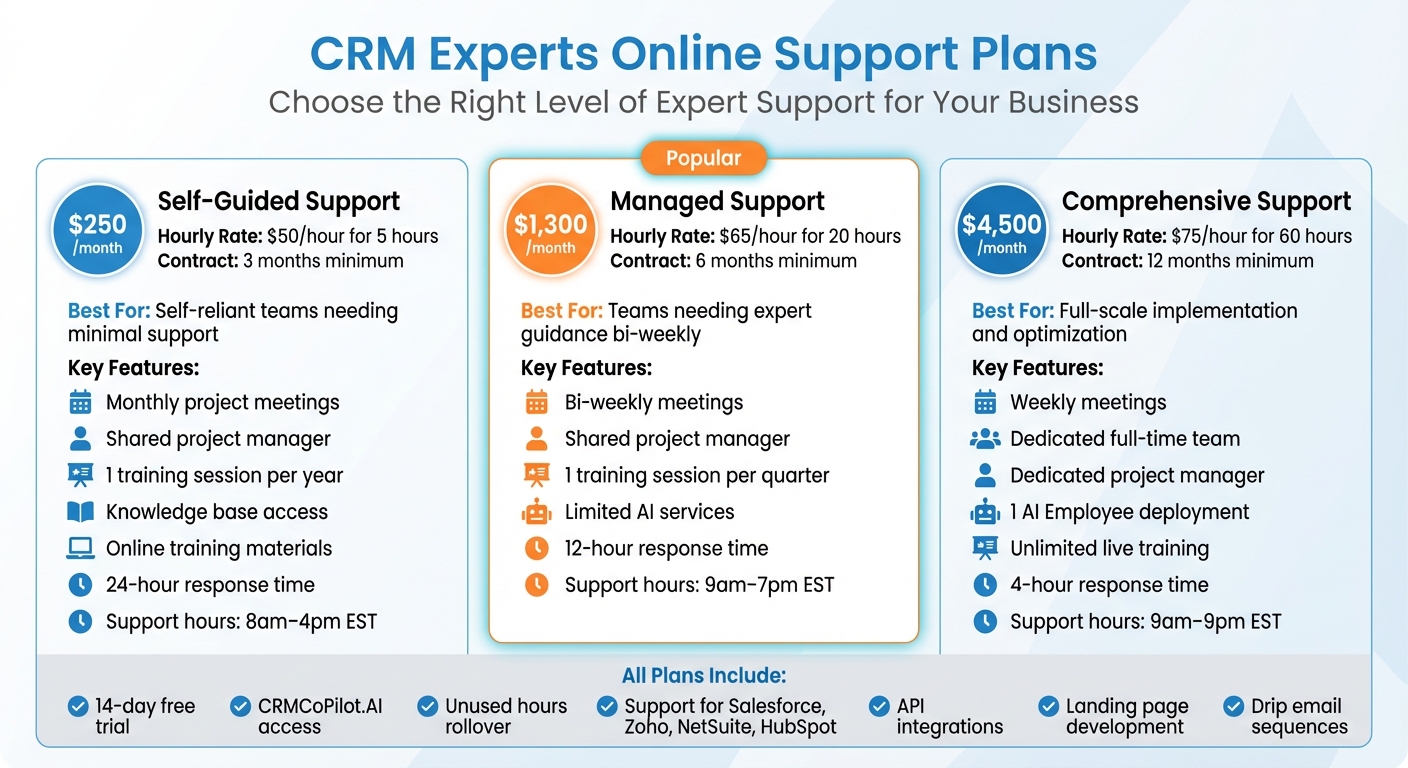
CRM Experts Online Pricing Plans Comparison: Features and Support Levels
CRM Experts Online offers flexible pricing plans designed to match different levels of support and engagement. Instead of traditional software seat licenses, their pricing revolves around service hours and expert support. Each plan includes a 14-day free trial, access to CRMCoPilot.AI for lead generation, and the ability to roll over unused hours as long as your subscription remains active.
Here’s a closer look at the three plans:
Comprehensive Support Plan
- Cost: $4,500/month ($75/hour for 60 hours)
- Features: A dedicated full-time team and project manager, weekly meetings, deployment of one AI Employee for automation, unlimited live training, and a 4-hour response time.
- Commitment: 12 months.
- Best For: Businesses seeking full-scale implementation and continuous optimization.
Managed Support Plan
- Cost: $1,300/month ($65/hour for 20 hours)
- Features: Shared project manager, bi-weekly meetings, one training session per quarter, limited AI services, and a 12-hour response time.
- Commitment: 6 months.
- Best For: Teams with internal resources that need expert guidance every two weeks to fine-tune their CRM systems.
Self-Guided Plan
- Cost: $250/month ($50/hour for 5 hours)
- Features: Monthly project meetings, shared project manager, one training session per year, access to a knowledge base, and online training materials. Response time is 24 hours.
- Commitment: 3 months.
- Best For: Self-reliant teams requiring minimal support for troubleshooting and basic guidance.
All plans include support for platforms like Salesforce, Zoho, NetSuite, and HubSpot. They also cover API integrations and creative services such as landing page development and drip email sequences. Support availability varies by plan:
- Comprehensive: 9am–9pm EST
- Managed: 9am–7pm EST
- Self-Guided: 8am–4pm EST
These options cater to businesses of all sizes, ensuring they can integrate AI-driven customer journey solutions effectively and on their own terms.
Conclusion
AI-powered customer journey orchestration is reshaping how businesses engage with customers. Instead of relying on traditional, rigid funnels, companies are now leveraging intelligent systems that respond to real-time customer behavior. The results speak for themselves: businesses using AI-driven orchestration report higher satisfaction rates, increased conversions, and the recovery of up to 35% of abandoned carts [1].
The market for customer journey orchestration is projected to hit $12.5 billion by 2025, with an annual growth rate of 24% [2][3]. Early adopters stand to gain a sharp edge over their competitors, making the case for immediate adoption even stronger.
To implement AI-powered orchestration effectively, businesses need unified customer data, real-time decision-making capabilities, and seamless CRM integration. CRM Experts Online specializes in bringing these elements together. They simplify complex technical setups, enable predictive analytics, and provide ongoing optimization tailored to each business’s needs.
CRM Experts Online offers flexible support options to fit different needs. Whether it’s the Comprehensive Support Plan for end-to-end implementation with a dedicated team, the Managed Support Plan for expert guidance with shared responsibilities, or the Self-Guided Plan for teams looking for a budget-friendly approach, they provide the tools and expertise to turn disjointed customer interactions into smooth, orchestrated experiences.
FAQs
What data do I need before using AI journey orchestration?
Before diving into AI-powered customer journey orchestration, it’s crucial to start with accurate and unified customer data. This means auditing and cleaning up data from every source to build detailed customer profiles. Pay close attention to key touchpoints, behaviors, and engagement history across all channels.
Equally important is ensuring privacy compliance with regulations like GDPR and CCPA. Without this, your efforts could face serious legal and trust-related challenges. High-quality data is the backbone of AI’s ability to predict customer behavior and fine-tune interactions in real time, creating seamless and personalized experiences.
How do I connect all channels so customers don’t repeat themselves?
To make sure customers don’t have to repeat themselves, you can use AI to create consistent and personalized experiences across all channels. AI helps coordinate interactions in real time on platforms like email, social media, and websites. By keeping unified customer profiles and leveraging real-time analytics, AI ensures that customer data and preferences are seamlessly shared across touchpoints. This allows for context-aware adjustments, eliminating repetitive questions and mismatched messaging.
How can I start small and prove ROI fast with AI orchestration?
To get quick results and demonstrate ROI with AI orchestration, it’s best to start small. Focus on one customer segment or a single interaction point where AI can make an immediate impact. Begin by auditing and refining your data to ensure accurate customer profiles. From there, leverage real-time analytics to drive personalized actions. Starting with a pilot project or a narrowly defined scope allows you to test and confirm ROI before expanding into larger initiatives.
Related Blog Posts
- AI in CRM: Demand Forecasting Basics
- Top 8 CRM Automation Tools for Marketing Teams
- How AI Improves CRM Resource Utilization
- How AI Improves CRM Workflow Efficiency

CRM & ERP Enterprise Technology Expert and Entrepreneurial Executive with 20+ years of leading CRM, ERP, Customer Experience, and Block-chain initiatives and projects across internal and customer facing technologies. Proven success in closing large deals in Pre Sales customer facing engagements and deploying enterprise wide CRM & Customer Experience solutions internationally and domestically.