
AI-powered CRM platforms are reshaping how law firms manage client relationships, intake processes, and operations. These tools automate tasks like client intake, document creation, and case tracking, saving time and reducing errors. Firms using AI report higher lead conversions, faster response times, and significant cost savings. Key highlights:
- Client Intake: AI systems respond to leads 24/7, qualify cases, and streamline onboarding, boosting conversion rates by up to 45%.
- Document Management: Automates drafting and review, cutting hours off repetitive tasks and reducing errors.
- Case Management: Tracks deadlines and case progress in real-time, ensuring no missed milestones.
- Billing: AI captures billable hours more accurately, increasing revenue by up to 20%.
- Data Security: Advanced encryption and compliance tools protect sensitive client information.
These systems centralize data, provide predictive insights, and allow firms to handle more cases without additional staff. The result? Improved efficiency, reduced costs, and better client experiences.
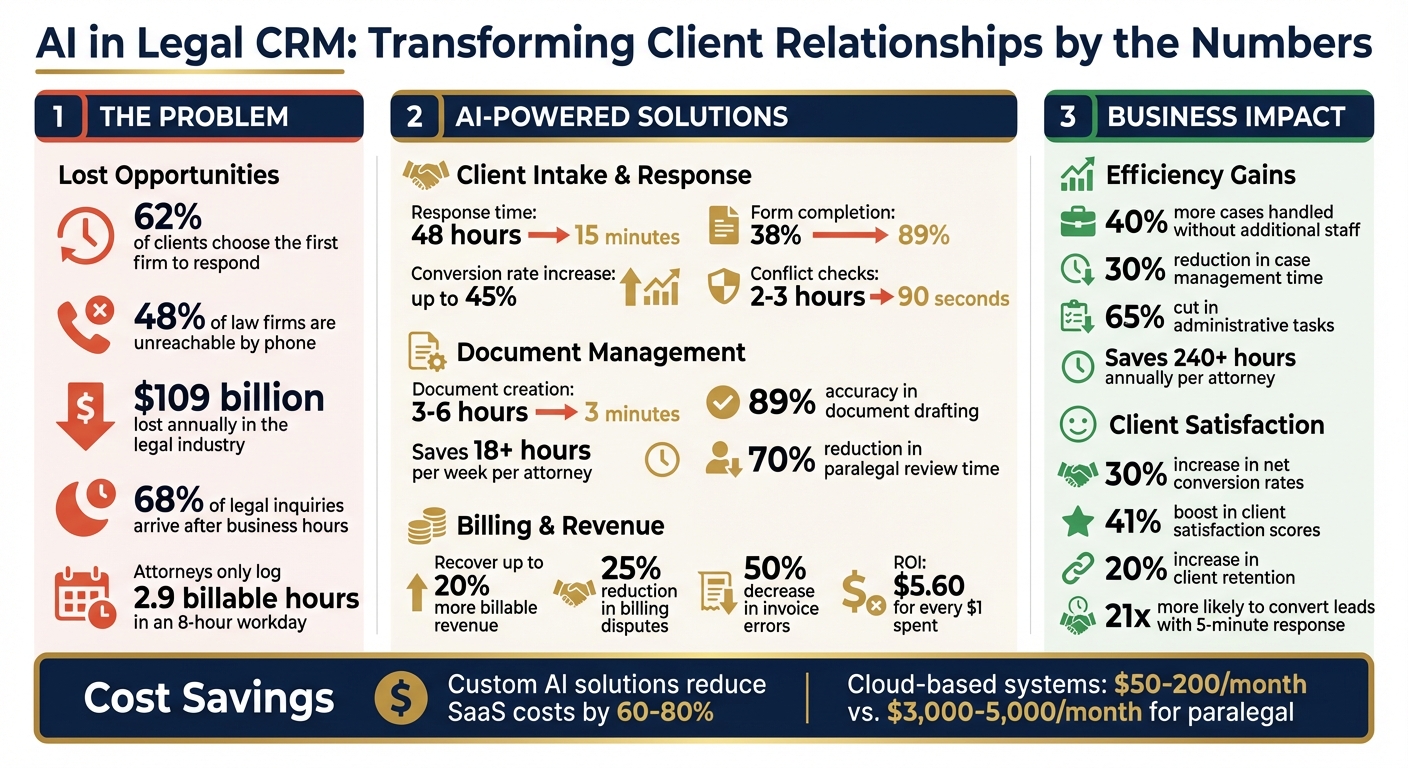
AI-Powered Legal CRM Impact: Key Statistics and ROI Metrics
Using AI to Scale and Automate Client Intake (2026)
sbb-itb-f02ae4e
Client Intake and Onboarding
The integration of AI into predictive analytics and data management has transformed client intake and onboarding in the legal field, setting a higher bar for service delivery.
When it comes to legal services, first impressions are critical. Statistics show that 62% of potential clients choose the first firm to respond, yet nearly half of law firms – 48% – are unreachable by phone. This lack of accessibility costs the legal industry an estimated $109 billion annually[7]. AI-powered CRMs are stepping in to fill these gaps by automating responses, qualifying leads, and personalizing client interactions – even outside traditional office hours.
Automated Client Intake
AI-driven intake systems solve a major issue: 68% of legal inquiries arrive after business hours[9]. These systems go beyond simply answering queries. They engage in dynamic conversations, gather case details, perform conflict checks, and route qualified leads to the right channels.
Take Pathway Law Firm in Beverly Hills as an example. In 2024, the firm adopted ConnexAI‘s advanced AI to handle a high volume of inquiries. This move resulted in a 30% increase in net conversion rates, as the system ensured no time-sensitive cases were lost to voicemail[9].
"Since implementing ConnexAI, we have already increased our net conversion rate by 30%. The AI handles the high volume of initial inquiries… ensuring no potential client falls through the cracks."
– Mychal Abello, CTO, Pathway Law Firm[9]
The speed advantage of AI-powered intake is undeniable. Response times drop from 48 hours to under 15 minutes, boosting conversion rates by up to 45%[6][9]. Tasks like conflict checks, which traditionally took 2–3 hours, are now completed in just 90 seconds[10]. Similarly, conversational data collection has improved form completion rates from 38% to 89%[10]. AI systems also use advanced logic to qualify leads based on case type, jurisdiction, and urgency, assigning scores like "hot", "warm", or "cold" to prioritize high-value prospects[7]. Bilingual support in English and Spanish further broadens a firm’s reach[7].
Once leads are captured and qualified, the focus shifts to creating a streamlined onboarding experience tailored to each client.
Personalized Onboarding Workflows
After qualifying a lead, AI-powered CRMs deliver customized onboarding experiences based on the client’s specific legal needs. For instance, a personal injury client receives a completely different set of onboarding steps compared to someone seeking estate planning services. This tailored approach eliminates unnecessary steps, speeding up the process.
The system also automates the creation of matter-specific documents – like engagement letters, fee agreements, and HIPAA releases – pre-filled with information gathered during intake. What used to take 3–6 hours can now be done in just 3 minutes, saving attorneys over 18 hours per week. These workflows integrate seamlessly with tools like Clio and MyCase[10]. Firms that respond to leads within 5 minutes are also 21 times more likely to convert them compared to those who wait 30 minutes[11].
AI onboarding doesn’t stop at documentation. It also streamlines scheduling, automates document requests, and facilitates initial case assessments. This efficiency allows firms to handle 40% more cases without needing additional staff[10], all while maintaining a personalized experience for clients.
"AI didn’t replace our team – it replaced our paperwork."
– Managing Partner, Boutique Law Firm[10]
The financial benefits are hard to ignore. Firms using AI-driven CRMs report an average return of $5.60 for every dollar spent[12]. On the flip side, poor intake practices can cost over $50,000 annually per attorney in lost revenue[8]. For firms looking to modernize their client acquisition, the tools are already here to ensure every opportunity is captured and more leads are turned into loyal clients.
Legal Research and Document Management
AI is reshaping how legal teams tackle research and manage documents, addressing inefficiencies by automating some of the most tedious tasks. This shift allows attorneys to reclaim valuable time and focus on higher-level responsibilities.
AI-Driven Document Review and Drafting
With AI-powered CRMs, drafting legal documents becomes a matter of minutes rather than hours. These systems pull from past responses, firm databases, and case outcomes to create precise proposals, RFPs, fee agreements, and court filings [13][2]. Advanced tools, like those using Dual RAG (Retrieval-Augmented Generation) technology, combine data from internal files and external legal precedents to ensure accurate and reliable drafts [5].
The impact of this technology is already evident. In 2025, a Midwest-based immigration firm replaced five separate tools with a custom AI system. This system analyzed 10,000+ past cases to draft RFE (Request for Evidence) responses with 89% accuracy. The results? A 70% reduction in paralegal review time, a 65% cut in administrative tasks, and a 41% boost in client satisfaction scores [5]. Across firms, custom AI solutions are saving employees between 20 and 40 hours per week by automating repetitive tasks [5].
AI assistants also simplify research by summarizing client data, meeting notes, and previous interactions instantly – eliminating hours of manual work [13][1]. These tools enhance client profiles with public filings, social media insights, and opposing party data, giving attorneys a full picture without extra effort [2]. By automating document assembly and data enrichment, attorneys can focus on strategy and client relationships, leaving the labor-intensive tasks to AI.
"We want to harness the data that we have within our law firm and all these systems to make better decisions more quickly. We also want to push information out to the lawyers in a way that is synthesized, easily digestible, and doesn’t involve 100 hours of manual labor to get it done."
– Laura Saklad, former COO, Orrick, Herrington & Sutcliffe [1]
Faster Legal Research
AI-powered CRMs transform legal research by connecting internal case histories with external legal databases. Using Dual RAG architecture, these systems deliver comprehensive research results in seconds, drastically cutting down the time spent on traditional methods [5].
Predictive outcome modeling takes this a step further by analyzing case histories, jurisdictional trends, and judge tendencies to forecast case outcomes and settlement probabilities [5]. This data-driven approach equips attorneys with insights that go beyond intuition, uncovering patterns across thousands of cases that would otherwise remain hidden.
The difference between traditional and AI-powered research tools is stark. Traditional CRMs merely track "what" happened, while AI systems analyze "why" it happened and predict "what’s next" [5]. Natural language processing simplifies complex legal terms into plain English, making it easier to communicate with clients and improve internal workflows [4]. Automated triggers, like sending document requests or conflict-check reminders, ensure cases move forward without constant manual intervention [2][5].
"Copilot isn’t here to replace people, but people who use AI will replace those who don’t – because it makes teams more efficient, strategic, and proactive."
– Victoria Gregory, Industry Solution Architect [13]
Case Management and Deadline Tracking
AI is reshaping how law firms handle case management and deadlines, turning what used to be cumbersome administrative tasks into smooth, automated processes. Missing a court filing or an important case milestone can be disastrous for any legal strategy. But with AI-powered CRMs, firms can automate the tracking of deadlines and case milestones, letting attorneys focus on what truly matters – delivering results for their clients.
Real-Time Case Tracking
AI CRMs bring everything – emails, text messages, documents – into one centralized platform. This means teams can search for case updates in plain language instead of digging through endless files or threads [14][20]. Imagine typing, "Where did we file that motion?" and instantly getting the answer, complete with links to the relevant documents [16][18]. On top of that, visual dashboards show key metrics like resolution rates, request volumes, and productivity at a glance [19][20].
Take Virginia Injury Law, for example. In 2025, under the leadership of CEO Christian Simpson, the firm adopted EvenUp’s Case Companion and slashed their case assessment time from 30–45 days to just 1–2 hours. The AI tool retrieved facts and summarized medical records in moments [16]. It even created case timelines automatically, pulling dates and events directly from records – no manual drafting required [16][18]. Similarly, John K. Zaid & Associates used EvenUp’s proactive AI agents to monitor client interactions. The system flagged critical case issues early in 37% of client conversations, allowing the firm to address potential problems before they escalated [16].
"Case Companion allows our case managers to quickly do assessments that used to take 30 or 45 days. Now, we can get those done in an hour or two. It’s just a revolutionary change in how we do business now."
– Christian Simpson, CEO, Virginia Injury Law [16]
With real-time case tracking, firms are empowered to act faster and more efficiently. But the benefits don’t stop there – AI also transforms how deadlines are managed.
Deadline Management and Alerts
AI takes deadline management to a new level. It doesn’t just set calendar reminders; it can process court scheduling orders, calculate all related deadlines, and automatically update firm calendars [14]. When a case begins, the system generates a tailored checklist of tasks – like intake, documentation, and filings – based on the case type or stage [22][2]. It assigns deadlines, tracks progress, and keeps the entire team in the loop [21][22].
Alerts are sent through email, SMS, app notifications, and even mobile devices, so no one misses a court date, filing deadline, or task [1][21][22]. By consolidating individual schedules, team calendars, and court dates into one view, these systems also eliminate double bookings and scheduling conflicts [21]. With an AI-driven CRM built for legal workflows, firms can cut case management time by nearly 30% [20]. For attorneys who only log 2.9 billable hours in an 8-hour day, this means reclaiming hours previously lost to tedious admin work [15][17].
AI is not just a tool – it’s a game-changer for how law firms manage their time and resources. From real-time insights to proactive deadline tracking, these systems are helping attorneys work smarter, not harder.
Data Centralization and Business Insights
AI-powered CRMs are reshaping how legal firms manage client information by turning scattered data into a cohesive, strategic resource. These systems automatically gather details from emails, calendars, and meeting transcripts, ensuring client profiles are always up-to-date and reducing the chances of errors caused by manual data entry [1]. They go a step further by enriching these profiles with information from public filings, social media, and third-party sources. This includes automatically adding case-specific details like dates of loss, opposing parties, and jurisdictional information [1][2]. Additionally, AI uncovers connections between client interactions and case details, offering deeper insights into relationships and enabling firms to act on this intelligence [23]. This centralized approach forms the backbone for making informed business decisions.
"We want to harness the data that we have within our law firm and all these systems to make better decisions more quickly. We also want to push information out to the lawyers in a way that is synthesized, easily digestible, and doesn’t involve 100 hours of manual labor to get it done."
– Laura Saklad, former COO, Orrick, Herrington & Sutcliffe [1]
Centralized Client Profiles
AI-driven CRMs create comprehensive "Client 360" dashboards that consolidate all client interactions into a single view. This includes phone logs, web chats, intake forms, social media messages, and email threads. For attorneys preparing for client meetings, this means they can quickly access critical details such as which colleagues are working with the client, significant developments in their case, and its current status [1].
These systems also reveal dormant connections and identify which attorneys have the strongest relationships with specific clients. This creates opportunities for cross-selling, such as connecting a corporate client with a tax law expert within the firm [23]. These AI-generated insights help firms improve client engagement and boost conversion rates [5].
Analytics for Business Growth
AI doesn’t just centralize data – it also unlocks predictive analytics that can drive growth. By analyzing historical case data, judge behavior, and jurisdictional trends, these tools can predict case outcomes, settlement probabilities, and estimated timelines [5][2]. For example, one mid-sized firm reported a 20% increase in client retention within a year of adopting an AI-powered CRM. This was largely due to sentiment analysis, which flagged at-risk clients before they decided to leave [3].
The analytics also pinpoint inefficiencies in workflows. Visual dashboards and heatmaps highlight bottlenecks in processes like client intake, conflict checks, or case handoffs [23]. These insights help legal professionals reclaim time, as they currently lose an average of 240 hours annually on avoidable tasks [5]. Moreover, custom AI solutions can significantly cut SaaS costs – by as much as 60% to 80% – by integrating fragmented tools into a single intelligence platform. With 76% of legal departments already using generative AI weekly, leveraging centralized data has become essential for maintaining a competitive edge [5].
Billing and Time Tracking
AI-powered CRMs are transforming back-office functions like billing and time tracking, helping law firms capture revenue that might otherwise go unbilled. Time tracking is a well-known challenge in legal practice. On average, lawyers record only 2.9 hours of billable work during an eight-hour day, leaving 5.1 hours unaccounted for [17]. Delaying time entry by even one day can result in a 25% loss of billable time [27], and nearly 40% of lawyers report losing billable hours due to inconsistent timekeeping [30]. AI tools tackle these issues by automating the process, ensuring more accurate and complete billing.
Automated Time Tracking
AI systems monitor digital activities – such as emails, document edits, calls, and meetings – to automatically track time. This eliminates the need for attorneys to reconstruct their day from memory, a process prone to errors and omissions [25][28]. Machine learning assigns these time entries to the correct case or billing code, even accommodating specialized formats like UTBMS [17][30]. Additionally, natural language processing allows lawyers to dictate time entries, which the AI interprets, extracts details from, and formats according to the firm’s standards [25].
The financial benefits are hard to ignore. AI-powered time tracking can recover up to 20% more billable revenue [26][30], with some early adopters reporting a 10% to 30% increase in billable hours captured [32][24]. Brian Belt, Founding Partner at Acevedo Belt, shared his experience with an AI billing solution integrated with Microsoft 365, Teams, and Zoom:
"Billables AI is a game changer. I recouped my annual investment in 2 days."
– Brian Belt, Founding Partner, Acevedo Belt [24]
Accurate Invoice Generation
Once time is captured, AI tools convert it into precise, client-specific invoices. These systems ensure compliance with Outside Counsel Guidelines (OCGs) by flagging issues like block billing or unauthorized tasks before invoices are generated [25][29]. They also catch anomalies – like duplicate entries or unusually long time logs – before finalizing invoices [31][25]. Invoices are then formatted in industry-standard styles like LEDES or XML, meeting diverse client requirements [30].
The results are impressive. Firms using AI-assisted billing report a 25% reduction in billing disputes [30], a 50% decrease in invoice errors [31], and a 20% faster invoice processing time [30]. Given that law firms lose between 5% and 15% of billable revenue annually due to billing inefficiencies [30], these tools provide a clear advantage. By cutting administrative costs by 15% to 30% [31] and reducing the time spent writing billing narratives by over 90% [32], AI systems free up staff to focus on more strategic tasks. They also enhance client satisfaction by delivering clear and accurate invoices.
This automation not only improves billing accuracy but also highlights how AI-powered CRMs are driving efficiency across legal practices.
Compliance and Data Security
Law firms manage sensitive information like privileged communications, financial records, and personal identifiers. A single breach can erode client trust and lead to serious professional consequences. To illustrate the stakes, GDPR fines hit €1.2 billion in 2024, and the EU AI Act enforces penalties of up to €35 million or 7% of global annual revenue for non-compliance [35]. In the U.S., intentional violations of the California Consumer Privacy Act can result in fines of $7,988 per violation [35]. With 76% of legal departments using generative AI weekly by late 2025 [5], the need for secure and compliant CRM systems is more pressing than ever. These rising penalties and strict regulations underscore the importance of robust, AI-integrated security measures.
AI-powered legal CRMs tackle these challenges through features like Zero Data Retention (ZDR) agreements with providers such as OpenAI or Anthropic. These agreements ensure client data is never stored, copied, or used to train third-party models [35]. Additionally, these platforms use industry-standard encryption protocols to secure data both at rest and in transit [35]. Role-based access controls further enhance security by limiting access to sensitive case details to specific attorneys or practice groups [34]. Automated audit trails also play a crucial role, timestamping every AI action – whether drafting an email or suggesting a deadline – and creating exportable logs that simplify compliance during bar audits or malpractice insurance reviews [2].
To maintain client trust, compliance protocols must be embedded into daily workflows. Modern platforms integrate key regulations like GDPR, HIPAA, and attorney-client privilege into automated processes, flagging potential risks in real time [5]. Features like data minimization and anonymization ensure only essential information is collected, and client identifiers are removed before processing, reducing the chance of privilege loss [34]. For firms with stringent jurisdictional requirements, options like sovereign cloud or on-premise hosting keep data within specific legal boundaries [35].
Damien Riehl, an author at Clio, highlights the importance of using tools specifically designed for the legal field:
"The easiest way to ensure compliance is to leverage purpose-built, legal-specific AI tools designed carefully to minimize risks and support ethical obligations"
– Damien Riehl, author at Clio [33]
To further safeguard data, firms should verify SOC 2 Type II certification, implement written AI policies with mandatory human oversight, and conduct Data Protection Impact Assessments (DPIAs) for high-risk processing [35][33]. With data breaches now costing organizations an average of over $4.4 million [36], these measures are critical for protecting both client information and the firm’s reputation.
Scalability and Accessibility for Legal Firms
Cloud-based AI-CRM systems have transformed how smaller law practices manage their resources, eliminating the need for hefty upfront costs and complex IT infrastructure. Instead of investing in on-site hardware, hiring IT personnel, or purchasing expensive software licenses, firms can adopt subscription models that typically cost between $50 and $200 per user per month [38]. This flexible, pay-as-you-go model allows firms to scale their technology as they grow, paying only for what they actually need [37]. This adaptability makes it easier for smaller firms to implement solutions that fit their unique needs.
But the benefits go beyond cost. For instance, 79% of lawyers currently use cloud technology to store their firm’s data [39]. With secure access to case files, client details, and collaboration tools from any device with an internet connection, cloud-based systems are perfect for remote work. In fact, 53% of lawyers in mid-sized firms who use cloud-based practice management software now prefer working remotely [39].
Flexible Solutions for Small and Mid-Sized Firms
Smaller firms can adopt and scale new tools quickly, without the delays caused by outdated systems or lengthy approval procedures [37]. A growing number of these firms – 53% of solo and small practices – are already using generative AI in their daily workflows [37]. The financial upside is clear: while an AI-CRM subscription costs $50 to $200 per month, hiring a paralegal can cost $3,000 to $5,000 monthly, factoring in benefits and office space [38]. Additionally, custom-built AI systems, which start at around $2,000, can cut long-term SaaS costs by 60–80% through consolidation [5]. Firms that embrace advanced technology often grow four times faster than those sticking with outdated systems [38].
"AI levels the playing field by giving smaller firms access to the same productivity and efficiency tools used by larger firms without the need for a large in-house IT team."
– PSM Partners [37]
Cloud-Based Accessibility
Cloud-based systems don’t just offer scalability – they also redefine how legal professionals work remotely while safeguarding sensitive data. With bank-grade encryption and multi-factor authentication, attorneys can securely access their work from anywhere [40]. This flexibility boosts efficiency, saving law firms over 8 hours per week on administrative tasks. Without automation, legal professionals can lose up to 240 hours annually – equivalent to six full workweeks – on tasks that AI could handle [5].
Modern clients also expect more digital engagement. For example, 58% of consumers now prefer virtual meetings for initial consultations, and 60% want updates via video conferencing [39]. Automated data capture from emails, calendars, and transcripts further reduces manual entry errors, freeing up more time for billable work [1]. Meanwhile, enterprise-grade features like AES-128 encryption and automated backups across secure locations ensure robust data protection without compromising accessibility [40].
| Feature | Traditional On-Premises CRM | Cloud-Based AI-CRM |
|---|---|---|
| Upfront Investment | High (Hardware, Servers, Licenses) | Low (Subscription or Setup Fee) |
| Scalability | Limited (New hardware required) | Instant (Add users/storage easily) |
| Maintenance | Requires in-house IT staff | Managed by provider |
| Accessibility | Office-bound or VPN-dependent | Mobile-friendly and remote-ready |
| Intelligence | Static data storage | Predictive insights and automation |
Conclusion
AI-powered CRMs are reshaping how law firms manage clients and streamline operations. With features like 24/7 automated lead intake and predictive analytics for case outcomes, these tools turn static databases into dynamic, strategic assets. From smoother client onboarding to automated billing, nearly every facet of legal practice benefits from these advancements.
Switching from traditional systems to AI-driven CRMs is becoming a necessity in today’s competitive legal landscape. Custom AI solutions can reduce SaaS costs by up to 60%-80% while addressing issues like data silos – problems that cause 70% of traditional CRMs to fail in law firms [5]. By adopting a unified system, firms can not only improve workflow efficiency but also enhance the client experience at every step.
"Law firms that once debated whether to adopt email are now debating AI – and history tends to favor early, thoughtful adopters."
– Timothy Carter, Chief Revenue Officer, Law.co [2]
AI-powered CRMs offer tools like automated conflict checks, real-time case tracking, and sentiment analysis that identifies at-risk client relationships. These capabilities ensure law firms can deliver the responsiveness and personalization that today’s clients demand. The real question isn’t whether to implement AI – it’s how quickly your firm can embrace it to stay ahead of the curve.
For legal practices ready to leave behind outdated tools and manual workflows, CRM Experts Online provides AI-powered CRM solutions tailored specifically for the legal industry. Their services include implementation, expert consulting, and ongoing support, helping firms transition from rented software to scalable, owned intelligence. Explore custom AI-powered CRM solutions at CRM Experts Online.
FAQs
How can I ensure an AI legal CRM is secure for client data?
To keep an AI legal CRM secure, it’s crucial to check that it offers features tailored to the legal industry’s confidentiality and compliance needs. Look for tools like data encryption, strict access controls, and detailed audit trails to safeguard sensitive client information. The platform should adhere to stringent security standards to minimize the risk of breaches, maintain client confidence, and steer clear of legal or regulatory complications. Focus on systems specifically built for the legal field, with strong data protection as a core feature.
What should we automate first when adding AI to our firm’s CRM?
Start by automating your client intake and qualification processes. Implement AI-powered chatbots or voice assistants to interact with prospects around the clock. These tools can handle tasks like asking follow-up questions, identifying potential conflicts, and even scheduling consultations – all without human intervention. This approach not only shortens response times but also improves lead conversion rates and simplifies the intake process. It’s an ideal first step for integrating AI into your CRM system.
How can AI CRM integrate with our current legal tools and workflows?
AI-driven CRMs work hand-in-hand with legal tools to handle tasks like scheduling, billing, and managing documents automatically. By centralizing client information, they cut down on manual data entry and keep records consistently up-to-date. These systems also offer predictive insights, allowing law firms to tailor client interactions while streamlining workflows. The result? Improved efficiency and smarter data management – all without the need to replace your existing tools.
Related Blog Posts
- 7 Essential AI Features Every Modern CRM Must Have
- How AI Improves CRM Resource Utilization
- How AI Improves CRM Workflow Efficiency
- Ultimate Guide to AI CRM Customization by Sector

CRM & ERP Enterprise Technology Expert and Entrepreneurial Executive with 20+ years of leading CRM, ERP, Customer Experience, and Block-chain initiatives and projects across internal and customer facing technologies. Proven success in closing large deals in Pre Sales customer facing engagements and deploying enterprise wide CRM & Customer Experience solutions internationally and domestically.