
Predictive analytics is reshaping sales strategies by replacing guesswork with data-driven precision. One standout tool is AI-powered opportunity scoring, which uses machine learning to predict which sales leads are most likely to close. Compared to manual scoring methods, AI offers:
- Higher accuracy: AI achieves up to 85–95% accuracy, while manual scoring ranges from 60–75%.
- Real-time updates: AI dynamically adjusts scores as new data emerges, unlike manual methods requiring regular updates.
- Faster processing: AI evaluates thousands of data points instantly, saving time and improving efficiency.
- Improved outcomes: Companies using AI report a 15–20% boost in sales productivity and up to 30% higher lead conversion rates.
While manual scoring allows for qualitative judgment, it’s prone to bias, slower, and struggles to scale. AI, though faster and more consistent, may overlook nuanced human insights. A hybrid approach – combining AI for data processing with human expertise for relationship management – can maximize results.
Key takeaway: Businesses adopting AI-powered CRM tools see measurable improvements in accuracy, efficiency, and sales outcomes, making it a smart move in today’s competitive market.
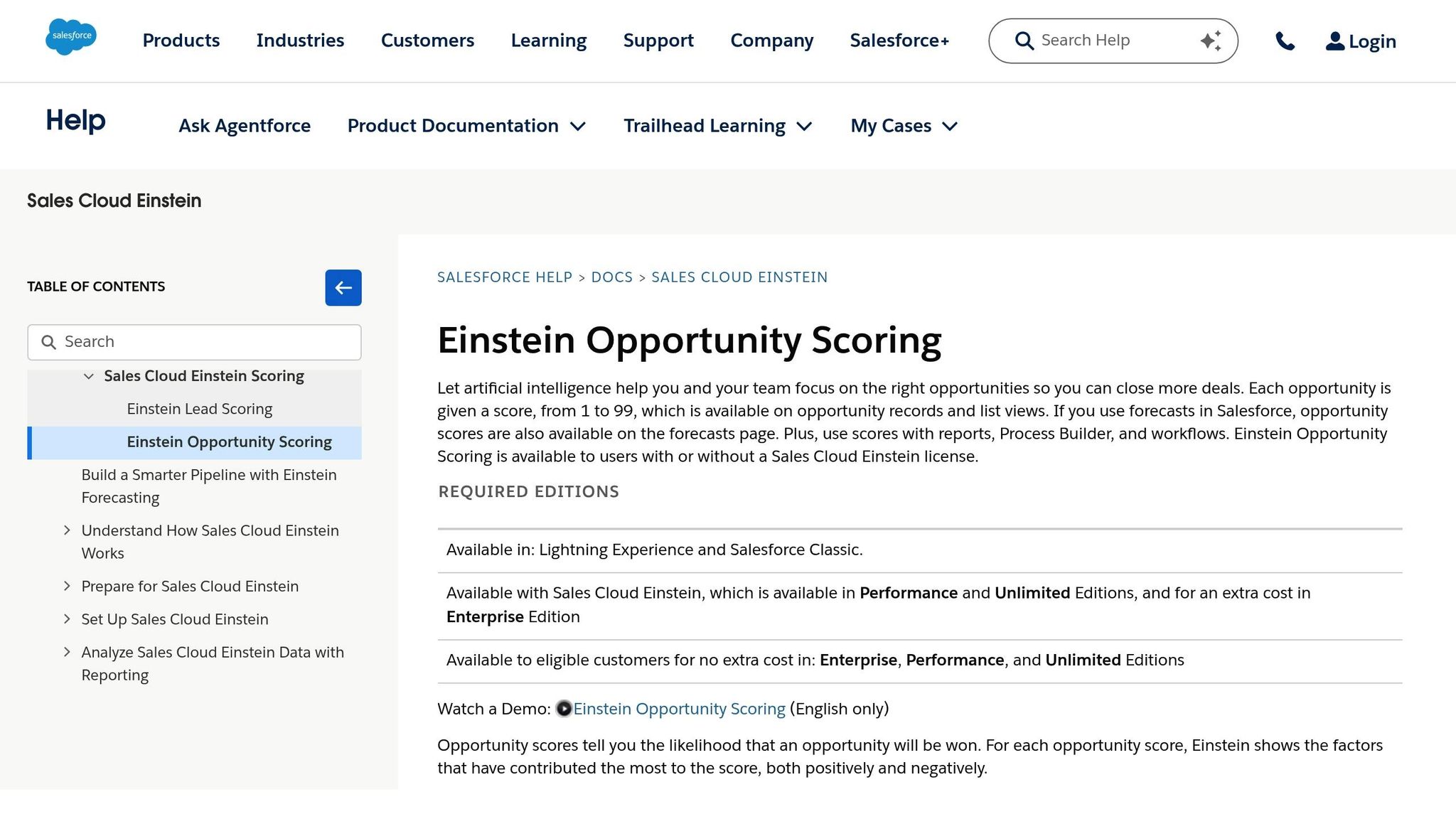
Einstein Opportunity Scoring For Everyone | Salesforce
1. Manual Opportunity Scoring
Manual opportunity scoring is the classic approach where numeric values are assigned to prospects based on factors like engagement, demographics, and their likelihood to convert. It’s a method embraced by 86% of B2B organizations [3]. This traditional system serves as a benchmark for evaluating the advancements brought by AI-driven solutions.
The process relies on marketing teams creating specific rules and criteria to evaluate potential leads. Sales representatives then assess each opportunity using factors such as company size, industry, budget, decision-making authority, and engagement history [1].
"Knowing which leads to pursue and when to act on an opportunity can make the difference between a thriving sales pipeline and wasted effort."
– Sirocco Group [1]
Accuracy
The accuracy of manual scoring typically falls between 60% and 75%, largely due to human bias and subjective judgment. This can result in an average of 25% missed opportunities and 30% false positives [4][5][6]. These challenges become more pronounced as the volume of leads grows, with inconsistent results often stemming from variations in how evaluators apply the rules [4]. Additionally, the quality of the data plays a critical role – errors or incomplete CRM data caused by human oversight can lead to flawed decisions [7].
Flexibility
One advantage of manual scoring is its ability to adapt to an organization’s specific needs. Businesses can set clear thresholds to determine when a lead qualifies as marketing-ready or sales-ready, making the transition between teams smoother [1]. This adaptability also allows for customized scoring models tailored to different product lines when needed [1]. However, frequent adjustments to scoring rules can lead to inconsistent outcomes [4]. For a well-rounded scoring model, businesses should combine demographic and behavioral data while also factoring in negative signals like bounced emails or inactivity [1].
Speed
Manual scoring is time-intensive, requiring 35% more effort for lead qualification and slowing down follow-up actions in fast-paced markets [4][6]. Tasks like data entry, tracking leads, and scheduling follow-ups eat into valuable time – an issue that becomes critical in competitive environments where quick responses are essential. Moreover, manual methods struggle to scale effectively, which can hinder growth as the number of prospects increases [6].
Business Results
When done effectively, manual scoring can deliver impressive results – boosting ROI on lead generation by 77% and increasing conversion rates by 25% through integrated scoring and grading [1][4]. However, achieving these outcomes depends on regular collaboration and seamless CRM integration. As data volumes and complexity grow, manual methods often fall short, paving the way for AI-powered predictive opportunity scoring to tackle these limitations head-on.
2. AI-Powered Predictive Opportunity Scoring
When it comes to scoring leads, manual methods often fall short, relying on rigid rules and subjective judgment. Enter AI-powered predictive opportunity scoring, which uses machine learning to analyze vast amounts of data, delivering insights that are not only objective but also dynamic. Unlike manual scoring, which remains static, AI models continuously evolve, learning from outcomes and adapting in real time. By analyzing factors like behavioral patterns, engagement history, and demographic details, these systems assign dynamic scores to leads – replacing guesswork with data-backed precision [5].
What’s more, AI integrates data from multiple channels – such as websites, emails, social media, and purchase histories – to identify early buying signals. These subtle cues often indicate when a prospect is likely to make a purchase, allowing businesses to act proactively [9]. The result? A smarter, more nuanced approach to evaluating lead quality.
Accuracy
AI-powered scoring systems are simply more accurate than traditional methods. For instance, AI models can identify warm leads with an impressive 85% accuracy [12]. Companies using AI forecasting tools have also seen a significant reduction – up to 50% – in their forecasting errors [2]. This is because AI continuously refines its predictions as it processes new data, ensuring greater precision over time.
Flexibility
One of the standout features of AI-driven scoring is its adaptability. Unlike manual methods that require constant rule updates, AI models adjust automatically as they learn from shifting data patterns. This flexibility allows them to incorporate new signals – like recent website visits or email interactions – almost instantly, ensuring that opportunity scores always reflect the latest prospect behavior [8]. This real-time adaptability is a game-changer, especially in fast-moving markets.
Speed
AI doesn’t just do a better job; it does it faster. By automating the scoring process, AI eliminates the time-consuming manual tasks that often slow teams down. The technology can process thousands of data points in an instant, enabling sales teams to assess deal probabilities even before making initial contact [12]. For example, a B2B software company reported slashing its sales cycle by 30% after adopting AI-based lead scoring, allowing its team to focus more effectively on high-priority prospects.
Business Results
The numbers speak for themselves: companies leveraging AI-powered opportunity scoring see measurable improvements across the board. On average, businesses report a 32% boost in sales productivity compared to traditional methods [9]. The market for AI-powered lead scoring is also expanding rapidly, projected to grow from $1.1 billion in 2022 to $3.4 billion by 2027, with a compound annual growth rate of 24.1% [9].
Take Salesforce as an example – the company reported a 30% increase in conversion rates and a 25% reduction in sales cycle length after implementing AI-driven lead scoring [9]. Overall, organizations adopting these predictive analytics techniques see a 15–20% improvement in sales productivity. Additionally, 98% of sales teams believe automated lead scoring enhances lead prioritization, and 62% of marketers are already using AI in their lead scoring efforts [11].
These results highlight the transformative role AI plays in modern CRM strategies, paving the way for smarter, faster, and more effective sales processes. It’s no wonder companies are turning to tools like these to stay ahead in today’s competitive landscape.
sbb-itb-f02ae4e
Pros and Cons
When comparing manual and AI-powered opportunity scoring, each method brings its own set of advantages and limitations. Understanding these differences helps clarify how they function and where they excel – or fall short – in practical use.
Manual scoring benefits from human oversight, capturing qualitative factors that machines might miss. It takes into account market trends, personal relationships, and subtle contextual details that automated systems could overlook. However, it also relies heavily on subjective judgment, which can make it slower and less consistent. Accuracy for manual scoring typically falls between 60–75%, and it requires quarterly updates to stay relevant – making it less agile in fast-evolving markets [4].
On the other hand, AI-powered scoring automates data processing, offering higher accuracy rates – usually between 85–95% – and real-time updates that reflect changing customer behaviors [4]. By analyzing vast amounts of data almost instantly, AI frees sales teams to focus on high-value opportunities instead of manual qualification. Companies using AI scoring often see immediate benefits, such as 20–30% increases in conversion rates and shorter sales cycles [14].
However, AI systems are not without flaws. They may miss important qualitative and contextual insights that human intuition naturally captures [13]. Errors in AI models can also compound over time, creating systemic issues. For instance, in 2014, Amazon‘s AI recruitment tool, trained on a decade of resumes – predominantly from men – began excluding female candidates because the system erroneously linked being male with higher qualifications [15].
| Aspect | Manual Scoring | AI-Powered Scoring |
|---|---|---|
| Accuracy Rate | 60–75% | 85–95% |
| Update Frequency | Quarterly | Real-time |
| Speed | Slow and labor-intensive | Instant processing |
| Scalability | Limited by human capacity | Virtually unlimited |
| Consistency | Varies by individual | Uniform application |
| Contextual Understanding | Strong qualitative insights | Limited nuanced interpretation |
| Bias Risk | Prone to human bias | Prone to systemic bias |
| Implementation Cost | Lower upfront costs | Higher setup and maintenance costs |
While manual scoring has lower upfront costs, AI systems demand a significant investment in setup and ongoing maintenance. The resources required to mine, store, and process large datasets can add up quickly [15]. Additionally, implementation isn’t always smooth – an IDC survey revealed that 28% of AI/ML projects fail, underscoring the risks involved [15].
Even with these challenges, the momentum is clearly shifting toward AI. Companies leveraging AI for lead scoring report an average 25% boost in conversion rates, and 85% of marketers plan to expand their use of AI in the next two years [5]. That said, AI thrives on speed and repetitive tasks, while human agents excel in empathy and nuanced decision-making [16].
A hybrid approach often strikes the best balance. Using AI for initial scoring and data processing, while relying on human expertise for complex deals and relationship management, allows organizations to combine automation’s efficiency with the strategic insights only human experience can offer.
Conclusion
The benefits of AI-powered opportunity scoring are undeniable. By integrating AI into CRM systems, businesses can elevate their decision-making processes and achieve measurable results.
Statistics highlight the impact: companies using AI for lead scoring report a 50% increase in qualified leads and a 40% reduction in customer acquisition costs [17]. Predictive analytics further enhance sales performance by 25% and improve forecast accuracy by as much as 50% [17]. These gains are crucial in today’s highly competitive markets.
AI systems excel at processing massive datasets, uncovering trends and insights that manual methods often overlook [10]. This precision is especially valuable as customer preferences shift and markets evolve.
The momentum toward AI-driven CRM solutions is clear. Currently, 87% of businesses view AI as a key component of their CRM strategy, while 62% of small and medium-sized businesses are actively using or planning to implement AI-powered CRM tools [18]. With the global CRM market projected to reach $82.7 billion by 2025, the adoption of AI is no longer optional for staying competitive [18].
To fully harness these benefits, organizations should collaborate with experts who understand both the technical and strategic aspects of AI integration. Companies like CRM Experts Online provide tailored solutions, including predictive analytics, custom development, and ongoing support, ensuring businesses achieve maximum ROI.
The time to act is now. Businesses leveraging AI-powered CRMs experience an average 25% boost in sales revenue [18]. Delaying adoption only increases the opportunity cost, making swift implementation essential for maintaining a competitive edge.
FAQs
How does AI-driven opportunity scoring boost sales productivity compared to traditional methods?
AI-powered opportunity scoring takes sales productivity to the next level by offering more precise insights into high-potential deals. Traditional manual methods often rely on subjective judgment and can be riddled with errors. In contrast, AI models sift through massive datasets to predict which leads are most likely to convert. The result? Sales teams can zero in on the prospects that truly matter.
With this smarter prioritization, businesses see improved conversion rates, faster sales cycles, and more efficient use of resources. This focused strategy doesn’t just streamline efforts – it fuels revenue growth while enabling sales teams to achieve more with less effort.
What are the risks of relying only on AI for opportunity scoring in CRM?
Relying entirely on AI for opportunity scoring in CRM systems comes with its own set of challenges. One major issue is that AI often relies on historical data, which can sometimes carry built-in biases. This might result in unfair or inaccurate scoring, potentially sidelining certain prospects or customer groups. Another concern is the lack of transparency – if users can’t understand how the AI arrives at its scores, it can be hard to trust the results.
There are also worries about data privacy, as these systems often require extensive personal information. On top of that, AI predictions aren’t always spot-on, and when its recommendations clash with human judgment, it can erode user confidence in the system. To address these challenges, it’s crucial to combine AI with human oversight and ensure that the processes behind AI-driven decisions are as transparent as possible.
How can businesses combine AI and human expertise to improve their CRM strategies?
To effectively blend AI capabilities with human expertise in CRM strategies, businesses need to establish distinct roles for each. AI excels at managing repetitive tasks, crunching data, and delivering actionable insights. Meanwhile, human agents bring the personal touch, fostering relationships and handling more nuanced or complex customer interactions.
Equipping staff with regular training to collaborate seamlessly with AI systems is crucial. Additionally, AI models should be fine-tuned based on real-world feedback to improve their accuracy and relevance. This balanced approach promotes smarter decision-making, streamlines workflows, and enhances the customer experience.
Related Blog Posts
- AI in CRM: Demand Forecasting Basics
- How AI Improves CRM Resource Utilization
- How AI Improves CRM Workflow Efficiency
- How Predictive Analytics Improves Revenue Forecasting

CRM & ERP Enterprise Technology Expert and Entrepreneurial Executive with 20+ years of leading CRM, ERP, Customer Experience, and Block-chain initiatives and projects across internal and customer facing technologies. Proven success in closing large deals in Pre Sales customer facing engagements and deploying enterprise wide CRM & Customer Experience solutions internationally and domestically.